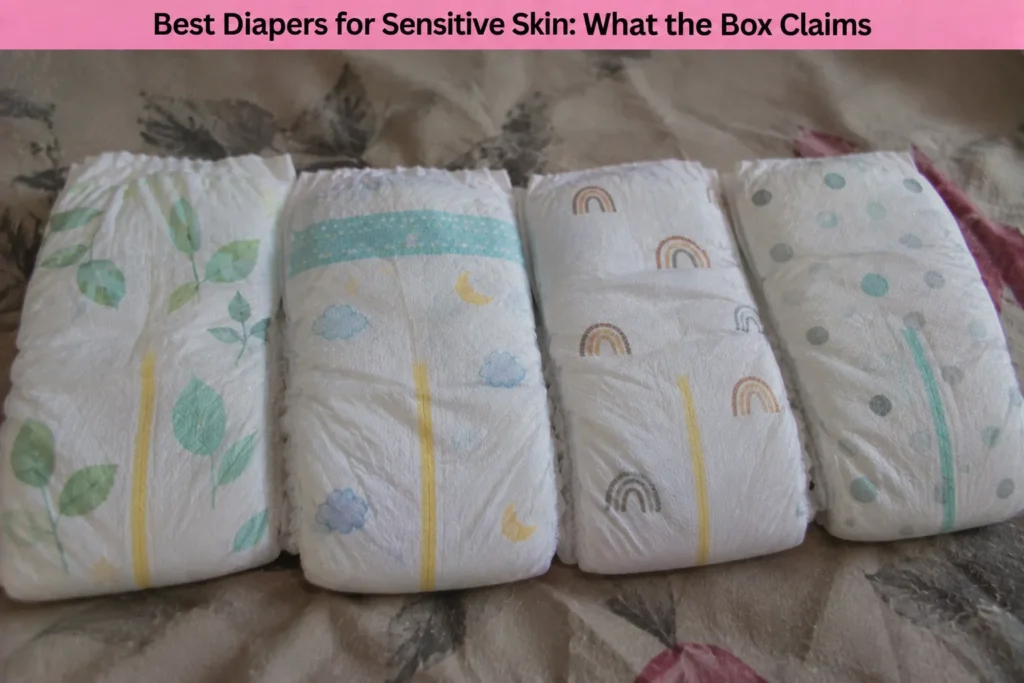
Best Diapers for Sensitive Skin: What the Box Claims

“Sensitive skin” is a marketing phrase, not a regulated category. No US agency defines it for diapers, so each brand decides what it puts behind the word. What you can compare is the specific claim list on each box, and those lists differ more than the word does. Below are the claims four diapers make on their own pages, read on August 30, 2026, and what each of those claims actually states.
“I used to give a lot of weight to phrases like “hypoallergenic” or “sensitive skin” on the box, but I’ve learned that those words alone do not tell me much about how a diaper will actually work for my child. What helped me more was reading the smaller claims carefully, especially things like fragrance, dyes, lotions, and how tight the diaper sits, then watching how the skin responded over a few days. If irritation kept getting worse or looked painful instead of settling, I stopped treating it as a shopping problem and called the pediatrician.”
Before you compare boxes: what the AAP names as the irritant
The American Academy of Pediatrics, on its HealthyChildren.org page about diaper rash, is direct about what the skin down there is up against: “The diaper area spends much of the day in contact with two very irritating substances: urine and stool.” On allergy specifically, the same page says “Common allergens include dyes or elastics in the diaper, and fragrances or preservatives in diaper wipes or creams.”
Two of the AAP’s practical points are about the diaper rather than the brand. It advises to “Change diapers frequently. Moisture from leaving a wet or soiled diaper on too long can cause skin to chafe,” and to “Make sure the diaper isn’t too tight, especially overnight. A diaper that is loose will be less likely to rub against the skin.”
The same page also sets out when the AAP says this stops being a shopping question and becomes a call to your child’s doctor: when the rash is not going away or is getting worse after two to three days of treatment, when it includes pimples, peeling skin, blisters, pus-filled or oozing or crusty sores, when a baby taking an antibiotic develops a bright pink or red rash with red spots at the edges, when the rash is especially painful, or when there is a fever along with it. None of the boxes compared below is an answer to any of those.
The short answer on “hypoallergenic”
The word most parents scan for is the one with the least behind it. The FDA, on its “Hypoallergenic” Cosmetics page, says: “There are no Federal standards or definitions that govern the use of the term ‘hypoallergenic.’ The term means whatever a particular company wants it to mean.” The same page notes that manufacturers are not required to submit substantiation of a hypoallergenicity claim to the agency.
That statement is written about cosmetics. A diaper is not a cosmetic, and in checking for this page we did not find a US regulatory definition of “hypoallergenic” that applies to diapers either. So the word on a diaper box is the manufacturer’s own, defined by the manufacturer, and the useful question is not whether a box says it, because all four of the boxes below do. The useful question is what else the brand is willing to put in writing next to it, and that is where these four stop looking alike.
What each box actually claims
Every entry below is what the brand’s own page said on August 30, 2026. “Not stated” means exactly that: the page did not make the claim, in either direction. Brands revise these pages, and the pack in your hand wins if it differs from what you see here.
| Claim | Pampers Pure | Pampers Swaddlers | Pampers Amore | Honest Clean Conscious |
|---|---|---|---|---|
| Fragrance free | Yes, “fragrance-free” | Yes, “now fragrance free” | Yes, “Fragrance Free” | Yes, “MADE WITHOUT: Fragrance” |
| Dye free | Not stated. Page describes “pigments” in “tiny amounts” | Not stated | Not stated. Same “pigments” wording as Pure | Not stated |
| Lotion free | Not stated. Page describes “a gentle balm” | Not stated | Not stated. Lists an “Emollient” | Not stated |
| Hypoallergenic | “clinically proven hypoallergenic” | “hypoallergenic” | “Hypoallergenic” | “Hypoallergenic” |
| Dermatologist claim | “Accredited by the Skin Health Alliance” | “dermatologically accredited by the Skin Health Alliance” | “Dermatologically accredited by the Skin Health Alliance” plus “third party lab tested for 1000+ chemicals” | “dermatologist tested” |
| Elemental chlorine | “processed without elemental chlorine” | “free of elemental chlorine” | “processed without elemental chlorine” | “Elemental Chlorine Free (ECF) Wood Pulp” |
| Parabens | “no parabens” | “free of parabens” | “free of parabens” | “MADE WITHOUT: Parabens” |
| Latex | “no latex”, “latex-free material” | “latex (no natural rubber)” | “latex-free material” | “MADE WITHOUT: Natural Rubber Latex” |
| Plant-based liner | Yes, “inner liner made from plant-based materials” | Not stated | Not stated | Yes, “Plant-Based Inner Liner” |
Sources, all read August 30, 2026: Pampers Pure, Pampers Swaddlers, Pampers Amore, Honest Clean Conscious Diapers.
The same seven words, read literally
Before the detail, here is the whole label in one grid: what each phrase states, and what it leaves open. Every “does not state” below is an observation about the four pages named above, not a judgment about any diaper.
| The phrase | What it states | What it does not state |
|---|---|---|
| Fragrance free | No fragrance was added | Anything about dyes, elastics or the rest of the materials |
| Hypoallergenic | The maker applies the word to this product | A standard, a test population or a threshold, and no federal definition exists |
| Dermatologist tested | A dermatologist was involved in a test | What was measured, on how many people, or what result counts as a pass |
| Dermatologically accredited | A third-party body has issued a mark | What the accreditation requires, unless that body publishes it |
| Elemental chlorine free | Elemental chlorine was not used on the pulp | What was used instead |
| Plant-based inner liner | Some of one layer comes from plants | The proportion, the plant, or anything about skin |
| No parabens, no latex | Those two are absent | Which preservatives or elastics are present |
What each claim does and does not mean
Fragrance free
This is the clearest of the seven, and the only one on the list that lines up word for word with something the AAP names as a common allergen. All four pages state it plainly, and two of them state it as a removal: the Pampers Swaddlers page says the diapers are “now fragrance free,” which tells you the formulation changed at some point. What the phrase states is an absence, that no fragrance was added. It does not say the diaper is odorless, and it says nothing at all about the other materials in the diaper, which is why “fragrance free” and “sensitive” are not the same promise even when they appear in the same sentence.
Dye free
Not one of the four claims it, and that gap matters more than usual here, because the AAP names “dyes or elastics in the diaper” among common allergens in the diaper area. Pampers Pure and Pampers Amore go the other way and describe the colors on the record: “Safe, skin-friendly colors for cute designs. The pigments we use are in tiny amounts and are away from baby’s skin.” Neither page lists which pigments, and neither defines “away from baby’s skin” as a layer or a distance. The Pampers Swaddlers and Honest Clean Conscious pages did not raise dyes at all, in either direction, so their silence is not a claim of absence.
Lotion free
Also claimed by none of the four. Two of them describe close to the opposite as a feature. The Pampers Pure page describes “a gentle balm that helps keep baby’s skin soft and healthy,” and the Pampers Amore ingredient list names an “Emollient,” described in the same words as “a gentle balm.” The Swaddlers and Honest pages say nothing either way. So if “lotion free” is on your list because someone asked you to keep applied substances off the skin for a while, none of these four boxes is claiming it, and two are telling you plainly that something is applied to the liner.
Hypoallergenic
All four say it. Pampers Pure raises it to “clinically proven hypoallergenic,” the only one of the four that attaches a phrase like “clinically proven” to the word. None of the four pages says what the claim was tested against, on how many people, over how long, or what result counts as passing. Read next to the FDA’s statement above, that is not an accusation, it is the structure of the word: with no federal definition to meet, “hypoallergenic” tells you which shopper the box is aiming at rather than what the diaper is made of. It is the least useful of the seven phrases for telling two boxes apart.
Dermatologist tested and dermatologically accredited
These are two different sentences and they are easy to read as one. Honest says “dermatologist tested,” and the page does not state what the test measured or what outcome it produced. All three Pampers products instead say they are accredited by the Skin Health Alliance, a third-party organization whose mark the brand displays, and Amore adds that it is “third party lab tested for 1000+ chemicals” without naming the chemicals or the result. We could not read the Skin Health Alliance’s own site on August 30, 2026, so this page does not describe what that accreditation requires, and none of the three Pampers pages describes it either.
Elemental chlorine free
All four state it, and the phrase describes the wood pulp step rather than anything the finished diaper does against skin. Honest spells out the industry acronym in full, “Elemental Chlorine Free (ECF) Wood Pulp From Responsibly Managed Forest.” A 1997 submission to the Maine Legislature’s Joint Standing Committee on Natural Resources, titled Environmentally Preferred Paper, describes ECF pulp as “bleached with chlorine dioxide.” So the term names the chlorine chemical that was not used rather than promising that no chlorine chemistry was involved, and none of the four brand pages we read says what is used in its place.
Plant-based inner liner
Pampers Pure and Honest both claim it, and the Swaddlers and Amore pages did not mention it. Neither of the two claiming pages states the percentage, the plant, or which layers are not plant-based. It is also worth noticing what kind of claim it is: a statement about where a material came from, not a finding about skin. Honest’s page frames it as a “plant based inner liner for gentle skin contact,” which describes the layer’s job rather than a tested outcome, and a plant origin is not by itself evidence about how any particular baby’s skin will respond.
Three tiers, one vocabulary
This is the part the roundups leave out. Pampers Pure, Pampers Swaddlers and Pampers Amore sit in three different places on the shelf, and on their own pages they use almost exactly the same sensitive-skin vocabulary: hypoallergenic, fragrance free, free of parabens, free of latex, free of elemental chlorine, accredited by the Skin Health Alliance.
That shared list barely separates them. What separates them, on those same pages, is other language entirely: Pure’s plant-based liner and its cotton outer cover, Amore’s “third party lab tested for 1000+ chemicals” and its named emollient, Swaddlers’ comparatively short list and its “now fragrance free” wording.
Which means a box marketed for sensitive skin and a box that is not can carry the same seven claims from the same maker. If you are shopping this category by scanning for the words, you are mostly re-reading one company’s house style. The differences that would matter to a particular baby sit in the smaller print, and often in the parts of the print that are missing.
Why Huggies Skin Essentials is not in the table
It belongs in this comparison and it is not here for one reason. On August 30, 2026, huggies.com returned a 403 Forbidden to two separate requests, so we could not read the brand’s own claim list for Skin Essentials.
We could have filled that column from a retailer listing or another blog. That is how a wrong claim spreads, because those pages copy each other and none of them re-checks when a brand changes its wording. Four claim lists you can verify beat five where one is secondhand. If Skin Essentials is on your shortlist, the pack itself and the brand’s own site are the two places worth trusting.
How this page was put together
No diaper on this page was tested here, and nothing on it is a test result. It is a claims comparison: we opened each brand’s own product page, copied the wording verbatim, dated the read, and recorded what the page did not say as carefully as what it did.
What was left out is just as deliberate. No prices, because they move faster than any page can be updated. No star ratings or review counts, because those belong to the retailer that collected them and they measure satisfaction, not materials. No absorbency figures, because none of the four pages publishes a measurement that could be compared against another brand’s. And no ranking, because ranking “best for sensitive skin” honestly would require testing on babies’ skin, and a claim list cannot produce that.
If your pediatrician asked you to change diapers
Two things are worth ruling out before a new box, because both of them can look exactly like a reaction to a diaper.
The first is fit. A diaper rubbing at the thigh or the waist leaves marks that read as irritation, and the AAP’s own note about a diaper that “isn’t too tight” points at the same thing. The four signs a diaper is too small covers what to look for, including the one most parents miss.
The second is leaking and prolonged wetness, which the AAP ties directly to chafing. If leaks are the pattern, the diaper fit and leak guide works through the likely causes in order, and most of them are cheaper to fix than a case of diapers.
Then, if the skin is still not settling, the AAP’s own escalation list near the top of this page is the point at which this becomes a question for a person rather than a label. A pediatrician can see the rash and can tell an irritant reaction from something that needs treating. This page cannot, and no claim on a box can either.
FAQ
Is “hypoallergenic” on a diaper box regulated?
The FDA’s “Hypoallergenic” Cosmetics page states that “There are no Federal standards or definitions that govern the use of the term ‘hypoallergenic.’ The term means whatever a particular company wants it to mean.” That statement is written about cosmetics, and in checking for this page we did not find a separate US definition covering diapers.
Which of these diapers is dye free?
None of the four claims it. Read on August 30, 2026, the Pampers Pure and Pampers Amore pages describe using pigments in “tiny amounts” kept away from the skin, and the Pampers Swaddlers and Honest Clean Conscious pages did not mention dyes in either direction.
Does “elemental chlorine free” mean no chlorine was used?
It is a pulp-processing term stated as an absence. A 1997 submission to the Maine Legislature titled Environmentally Preferred Paper describes ECF pulp as “bleached with chlorine dioxide.” None of the four brand pages read for this article states what replaces elemental chlorine in its own process.
Are “dermatologist tested” and “dermatologically accredited” the same claim?
No. Honest states “dermatologist tested” without saying what was tested or what the result was. The three Pampers products state accreditation by the Skin Health Alliance, a third-party organization. Neither wording, on its own, tells you the standard that was met.
What does the AAP say actually causes diaper rash?
Its HealthyChildren.org page names urine and stool as the two irritants the diaper area is in contact with for much of the day, and lists “dyes or elastics in the diaper, and fragrances or preservatives in diaper wipes or creams” as common allergens. That is general information, not a diagnosis of any particular baby’s skin.
Freshness
Brands rewrite these pages without notice. Every claim above was read from the brand’s own page on August 30, 2026, and this page is re-checked at least quarterly, or sooner if a reader tells us a box has changed its wording.
Author Profile
-
Saima Mostari is the founder and author of BelovedTots. She has raised two young children, Pona and Ruku, and spent years working in child development at Neurosparks, a therapy center that provides Speech Therapy, Occupational Therapy, and ABA Therapy for children with developmental needs.
It was there, watching long therapy sessions get interrupted by leaking, ill-fitting diapers, that she began researching which products actually perform under real-world conditions, not just on the packaging.
She holds a Master's in Psychology and Guidance from the University of Dhaka, and brings a behavioral observation lens to every product she reviews. When she's not testing diapers or writing guides, she's probably negotiating bedtime with a 4-year-old.
Latest entries
- September 30, 2026Diaper Brands and ComparisonsLuvs vs Pampers: P&G’s Budget vs Premium Line
- September 27, 2026Diaper Brands and ComparisonsKirkland Diapers vs Huggies: What’s Different in 2026
- September 26, 2026Diaper Brands and ComparisonsKirkland Diapers Review: What Costco’s Diaper Is Now
- September 24, 2026Diaper Brands and ComparisonsHuggies Little Snugglers vs Snug and Dry: Which Fits?