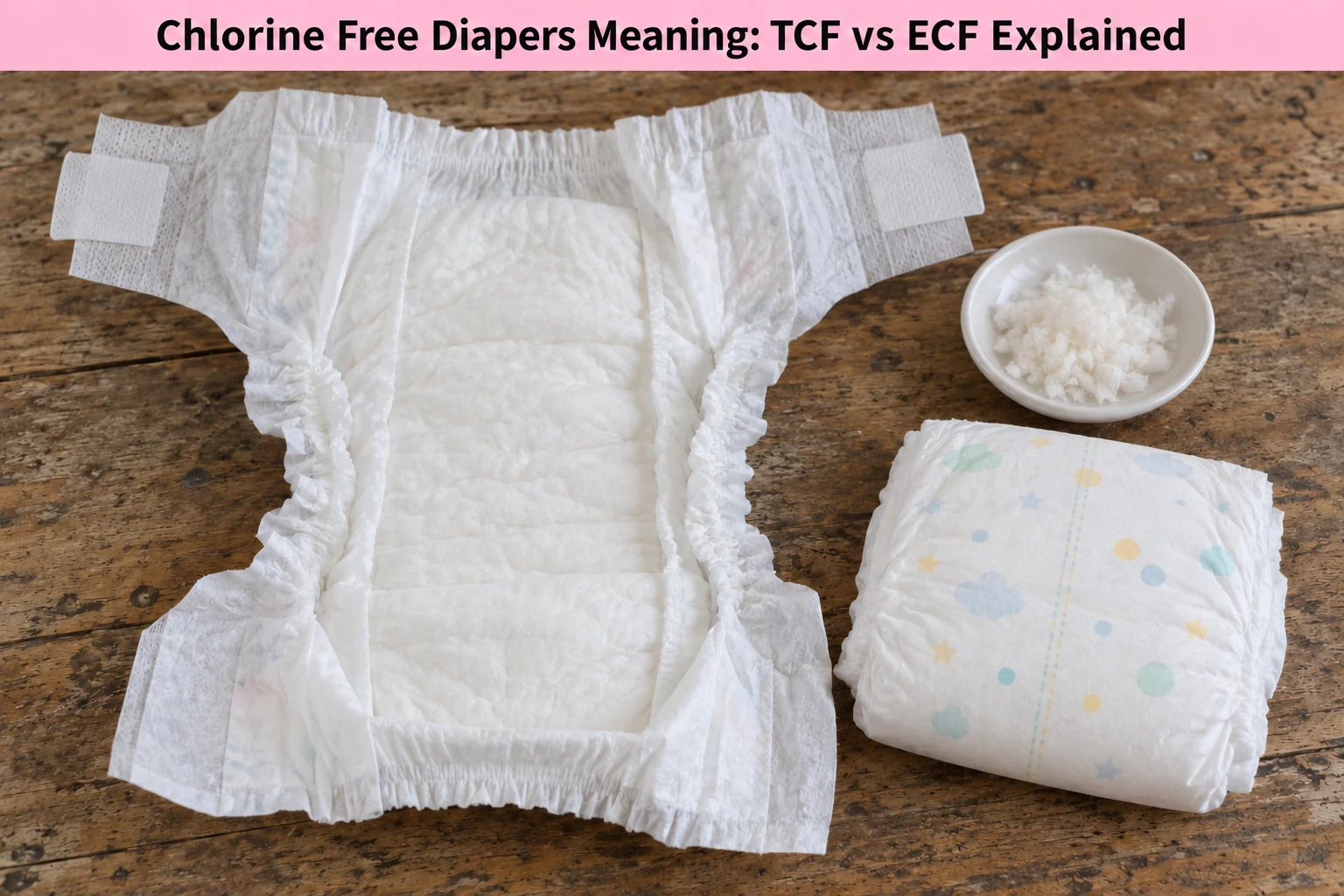
Chlorine Free Diapers Meaning: TCF vs ECF Explained

"Chlorine-free" on a diaper box is a statement about how the wood pulp in the absorbent core was bleached. It is not a statement that no chlorine-related chemistry touched any part of the diaper. Two terms sit behind it. TCF (totally chlorine free) means the pulp was bleached without chlorine or its derivatives. ECF (elemental chlorine free) means no elemental chlorine was used, but chlorine dioxide was. That is how Coterie's explainer defines them, and it is a diaper maker's definition, so read it with that in mind.
Below: what each term means, what makers on each side argue, what a regulator page does and does not say, and what to look for on the box.
Chlorine free diapers meaning: TCF, ECF and the box wording
Wood pulp, sometimes called fluff pulp, is the fibrous material in a diaper's absorbent core. Bleaching is a manufacturing step applied to that pulp, and "chlorine-free" wording on the box is a claim about which bleaching chemistry was used.
| Term | What it means | Who defines it here |
|---|---|---|
| TCF, totally chlorine free | Pulp not bleached with chlorine or chlorine derivatives | Coterie's TCF explainer (read October 3, 2026) |
| ECF, elemental chlorine free | No elemental chlorine, but bleaching with chlorine dioxide, a chlorine derivative | Same page |
| "No chlorine bleaching" | Unclear. Could describe either. | Wording used on some maker pages |
The third row matters. A box that says "no chlorine bleaching" or "chlorine-free" without TCF or ECF is leaving a question open, and the answer sits on the maker's website, if anywhere.
"I read chlorine-free as a question about the pulp, not a promise about every part of the diaper. I would look for the exact TCF or ECF wording on the maker's materials page, because a white diaper does not reveal how its pulp was processed. I also keep the environmental argument separate from a skin concern instead of expecting one bleaching label to settle both."
What each side of the debate says
Both camps are diaper sellers, so both are making a case.
The TCF case. Coterie says it uses exclusively TCF pulp in its absorbent core. It argues that TCF goes further than ECF by eliminating chlorine-derived chemicals, which it connects to reducing exposure to dioxins, a chlorine-processing byproduct, and that this matters because diapers sit against developing skin for long stretches.
The ECF case. EveryLife, on its ECF pulp page (read October 3, 2026), argues that ECF and TCF are both safe in diapers and that the difference is environmental rather than a safety issue. It says modern technology addressed 1990s concerns about discharge, that TCF pulp comes from a small number of suppliers, and that TCF's lower yield largely cancels its environmental benefit over ECF.
These two positions disagree on whether TCF is meaningfully better, and each is written by a company that has chosen a side. Neither page is neutral evidence, and this page does not try to settle it. What the two do agree on, in effect, is that the difference starts at the pulp mill.
What a regulator page does say
The pulp bleaching question is regulated where it is made, at the mill. The EPA's pulp, paper and paperboard effluent guidelines page (last updated March 24, 2026, read October 3, 2026) describes the 1998 "Cluster Rule," which set effluent limitations for toxic pollutants in the industry, including dioxin (2,3,7,8-TCDD) and certain chlorinated phenols. The page does not distinguish ECF from TCF, and it is about mill discharge, not about diapers.
So the regulator source supports one narrow point: dioxin from pulp bleaching is a recognized mill-effluent concern with limits attached. It does not say how much, if any, ends up in a diaper, or whether a baby is affected. A box cannot answer that either.
What "chlorine-free" leaves out
Even a clean TCF claim covers one ingredient in one layer. It does not tell you about:
- The other materials. The topsheet, the backsheet, the elastics, the adhesives and the superabsorbent polymer are separate materials with their own claims or none.
- Skin reactions. The American Academy of Pediatrics' HealthyChildren.org diaper rash page (dated 12/18/2024, read October 3, 2026) says babies with sensitive skin may react to a specific ingredient in diapers, wipes or creams, and names dyes or elastics in the diaper and fragrances or preservatives in wipes or creams as common allergens. Pulp bleaching is not among the examples it names. That is not a finding that it is or is not a factor. It is a statement of what the page lists.
- Whether the claim is verified. The sources read here do not point to a single required certificate for TCF on a diaper. A maker's own page is the usual source.
The FTC's Green Guides, in their October 2012 summary (read October 3, 2026), also bear on this. A "free-of" claim can be deceptive if the product lacks one substance but contains another that poses a similar environmental risk, and general environmental claims have to be qualified. A narrowly stated pulp claim is the kind of qualified wording the guidance describes. A vague "chemical-free" is not.
Should TCF cost more? What a reader can and cannot weigh
Whether TCF is worth a higher price is a household decision, and the sources here do not settle it. Prices vary by maker, size and retailer, so no figure is quoted. What the evidence in this page supports is a way to compare:
- Which term does the maker use, TCF or ECF? If the box only says "chlorine-free," the maker's materials page may say.
- What is the claim about? If the reason for caring is the environment, the mill is where the difference is argued. If the reason is a baby's skin, the AAP page above is the source for what it names as common allergens, and it does not list pulp bleaching.
- Is the claim isolated or part of a pattern? A maker that explains its pulp, its topsheet, its film and its disposal route is giving more to check than one that offers a single phrase.
If a baby has a rash that keeps coming back or looks severe, that is a question for your pediatrician, not a pulp-bleaching decision. Our guide to what diaper rash is and when to call covers the escalation criteria first.
Where this label shows up
The chlorine claim is one of several that appear together on "natural" or "sensitive" lines. Our page on what the box claims on sensitive-skin diapers reads seven of those claims side by side, and our diaper brands guide shows which lines make which promises, so a chlorine claim can be read in context rather than alone.
Quick reference
- TCF: no chlorine or chlorine derivatives in pulp bleaching (Coterie's definition).
- ECF: no elemental chlorine, but chlorine dioxide used (same source).
- Both are claims about pulp, not the whole diaper.
- Makers on both sides are sellers. The EPA page describes mill discharge limits and does not rank TCF against ECF.
- "Chlorine-free" with no TCF or ECF term leaves the question open.
FAQ
Is there chlorine in a chlorine-free diaper?
"Chlorine-free" refers to pulp bleaching. TCF means no chlorine or chlorine derivatives were used to bleach the pulp, per Coterie's definition. The claim says nothing about the other materials in the diaper.
What is the difference between TCF and ECF?
TCF avoids chlorine and its derivatives. ECF avoids elemental chlorine but uses chlorine dioxide, which is a chlorine derivative, per Coterie's explainer.
Is TCF better for a baby than ECF?
The sources read here do not establish that. Makers disagree: one argues TCF goes further, another argues both are safe and the difference is environmental. The AAP's diaper rash page does not list pulp bleaching among common allergens. A pediatrician is the right person to ask about a specific baby.
Does the EPA regulate chlorine in diapers?
The EPA page read here covers effluent limits for pulp and paper mills, including dioxin, under the 1998 Cluster Rule. It does not address diapers or rank bleaching methods.
Do I have to pay more for chlorine-free diapers?
Prices vary by maker and retailer, so no figure is given here. Whether the difference is worth it is a household choice.
Author Profile
-
Eamin Hosen is the founder and author of BelovedTots. He has raised two young children, Pona and Ruku, and spent years working in child development at Neurosparks, a therapy center that provides Speech Therapy, Occupational Therapy, and ABA Therapy for children with developmental needs.
It was there, watching long therapy sessions get interrupted by leaking, ill-fitting diapers, that he began researching how products perform during everyday use and where their performance falls short of packaging claims.
He holds a Master’s in Psychology and Guidance from the University of Dhaka and brings a behavioral observation lens to every product he reviews. When he’s not testing diapers or writing guides, he’s probably negotiating bedtime with a 4-year-old.
Latest entries
- November 13, 2026Diaper Brands and ComparisonsBamboo Diapers: Viscose, Rayon and the Box Claims
- November 12, 2026Diaper Rash and SkinHypoallergenic Diapers: What the Word Really Promises
- November 11, 2026Diaper Brands and ComparisonsChlorine Free Diapers Meaning: TCF vs ECF Explained
- November 10, 2026Diaper Brands and ComparisonsEco Friendly Diapers: What the Labels Actually Mean