
Huggies Little Swimmers vs Pampers Splashers Compared

Huggies Little Swimmers and Pampers Splashers are close to the same product: disposable swim pants built to contain solid mess, not to soak up pee. The differences are in sizes, closures and fit. Reviewed.com (updated June 25, 2025) lists Little Swimmers in extra-small through large, with resealable sides and a good fit on smaller, skinnier kids, while Splashers come in small through large and start at a lower weight than Little Swimmers' small. The CDC adds the point that matters more than the brand: swim diapers may help hold in solid poop, but not diarrhea, and they are not a substitute for frequent changes.
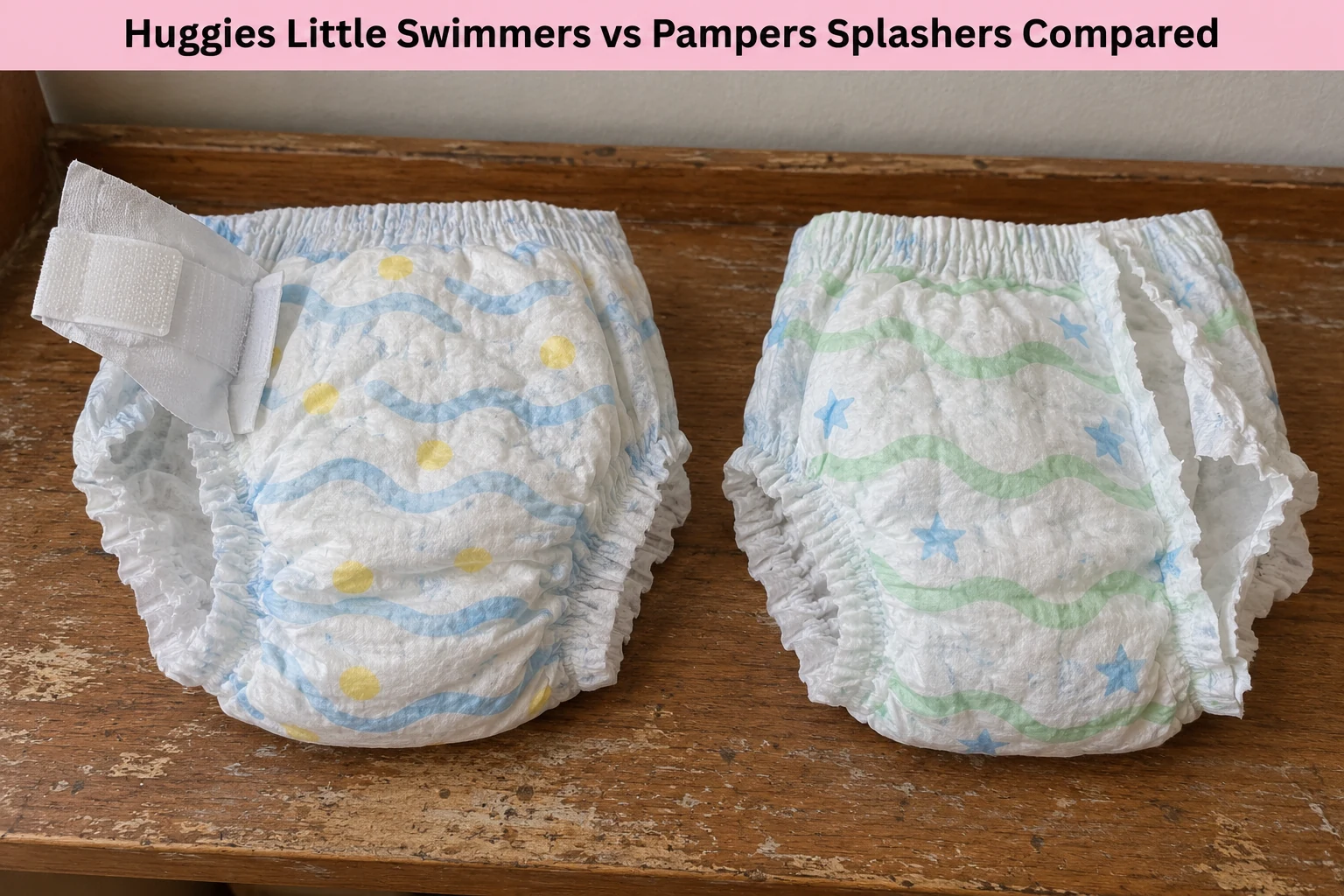
Below: the sizes side by side, what each design does, what the CDC says swim diapers can and cannot do, a simple routine for the pool, and what to check on any store brand.
Huggies Little Swimmers vs Pampers Splashers: sizes side by side
Reviewed.com's guide to swim diapers (updated June 25, 2025, read October 3, 2026) gives these weight ranges. They are a reviewer's report, and ranges can change between product versions, so confirm them on the pack you buy.
| Size | Huggies Little Swimmers | Pampers Splashers |
|---|---|---|
| Extra-small | 7 to 18 lbs | Not offered |
| Small | 16 to 26 lbs | 13 to 24 lbs |
| Medium | 24 to 34 lbs | 20 to 33 lbs |
| Large | 32 lbs and up | 31 lbs and up |
Three things follow from the table:
- Splashers start lower in the small size. A 14 lb baby fits Splashers small (13 to 24 lbs) but is under Little Swimmers small (16 lbs and up). That baby would need the Little Swimmers extra-small, which Reviewed.com notes can be hard to find.
- Sizes overlap, so weight alone does not always decide. A 25 lb toddler fits Little Swimmers small (up to 26 lbs) and medium (from 24 lbs), and Splashers medium (20 to 33 lbs). Fit settles it.
- Neither brand's top size has an upper limit on the chart. Large is "and up," so a bigger child needs the pack's own guidance.
Pampers says on its swim diaper page (updated January 16, 2026, read October 3, 2026) that swim diapers are "sized similarly to regular diapers, typically by weight range, but each brand fits a bit differently." So a size 4 in regular diapers does not tell you the swim size. Our cross-brand diaper size chart shows how regular sizes differ between makers, and the same weight-first approach applies to swim.
"For this comparison, I look at the weight range and how the sides open before deciding between the names on the pack. A refastenable side can make checks easier, while a tear-away seam changes how a soiled swim diaper comes off. I would still pack spares and plan regular checks, because neither brand's fit or closure removes the limits of a swim diaper."
What each design does
Pampers Splashers. Pampers lists a "No Swell Core" that keeps the diaper lightweight, a "360-degree stretchy waistband," "Dual leak-guard barriers" and "Easy-Tear sides" for quick changes. Reviewed.com found them "good for all sorts of water play activities like splash pads and beach days," and lists them as convenient, snug-fitting and affordable. Its listed drawback is that there is no extra-small.
Huggies Little Swimmers. Reviewed.com reports "a great fit for smaller and skinnier kids," lists resealable sides as a strength, and lists the hard-to-find extra-small as the drawback.
The closure difference is practical. Easy-tear sides are built to come off fast after an accident. Resealable sides let you check and refasten. If you plan to check every hour, that detail matters more than a leak-guard claim, since the closure decides how easy each check is.
What swim diapers do and do not do
This is the part many comparisons skip, and it changes how to read both products.
Pampers states: "Swim diapers aren't designed to absorb liquids, including your baby's pee." They are meant to hold solids without swelling, and that is true of both brands in this comparison.
The CDC's page on swim diapers (last reviewed May 8, 2024) is more direct: "Swim diapers and swim pants may help hold in solid poop (not diarrhea), but they are not a substitute for frequent diaper changing and bathroom breaks." It also says swim diapers "do not keep germs, like Cryptosporidium, that can be spread in diarrhea from contaminating the water." Its advice is to change them in a diaper-changing area away from the poolside and to check them about every 60 minutes. Pampers gives a slightly shorter window, every 30 to 60 minutes.
A second CDC page, on preventing diarrheal illness while swimming (last reviewed May 19, 2025), says that swim diapers are "not leak-proof" and "can only delay poop germs from getting into the water for a few minutes."
So both products are a back-up layer, not a pass to skip the checks. The difference between them matters less than the check routine.
A simple routine for the pool or beach
Since the brand matters less than the routine, it helps to plan the routine before the trip. The two CDC pages above add up to a short list:
- Check on a schedule. The CDC suggests about every 60 minutes, and Pampers suggests every 30 to 60 minutes. A phone timer keeps it from slipping during play.
- Count bathroom breaks too. The CDC says swim diapers are not a substitute for bathroom breaks, so regular trips to the toilet for a child who uses one still matter.
- Change away from the water. The CDC says to change swim diapers in a diaper-changing area away from the poolside, and its diarrheal illness page adds to wash hands afterward.
- Pack spares. A soiled swim diaper is one you leave the water to replace, so extras on hand avoid a long search in the middle of a visit.
This routine is the same whether the pack says Huggies, Pampers or a store name.
Fit: what to look for at the pool
Both brands fit by weight, but fit still varies by child. Reviewed.com's reports point in different directions: Little Swimmers suited smaller, skinnier kids, and Splashers were described as snug-fitting. That is one reviewer's experience, not a rule for every body shape.
At the pool, the same fit checks that apply to regular diapers apply here:
- Waist. The band should lie flat without digging in or folding.
- Legs. Gaps at the leg openings are where solid mess escapes. Our guide on why diapers leak at the legs explains how gaps form.
- Too small. Red marks or a struggle to close the sides point to the next size. Our page on how to tell if a diaper is too small covers the signs.
Swim pants are also wet and stretchy when you check them, so a fit judged on a dry floor at home can look different after water play.
Store brands: what to check
This page compares the two national brands. Store-brand disposable swim diapers are sold by major retailers, but their sizes, closures and features are set per product and change, so check each one directly rather than assuming it matches either brand above. Before buying one, look on the pack for:
- the weight range for the size, not just a size number
- whether it is sold as a swim diaper or swim pant, and how the sides close
- any statement that it holds solids and not liquid, which should match what the CDC and Pampers describe
- the count per pack, since you may use several in one outing
For the wider picture of who makes what, our diaper brands guide is a place to start.
Which suits which situation
| Situation | What the sources point to |
|---|---|
| Baby under about 16 lbs | Splashers small starts at 13 lbs. Little Swimmers has an extra-small, which can be hard to find. |
| Smaller, skinnier child | Reviewed.com reports Little Swimmers fit smaller, skinnier kids well. |
| Splash pad or beach day | Reviewed.com reports Splashers suit water play of this kind. |
| Quick changes after an accident | Pampers lists easy-tear sides. |
| Checking and refastening | Reviewed.com lists resealable sides on Little Swimmers. |
| Child with diarrhea | The CDC says swim diapers do not contain it, so a swim diaper is not a safeguard. |
For price, neither brand's per-pack cost is fixed. Retail prices change with pack size, size and store, so compare the cost per swim diaper on the day you buy. Also check your pool's own rules on swim diapers before you go, since pools set their own policies.
FAQ
Are Little Swimmers or Splashers better?
The sources describe them as close. Reviewed.com reports Little Swimmers fit smaller and skinnier kids well and have resealable sides, while Splashers are snug-fitting, affordable and suit splash pads and beach days. Fit on your child and the size range you need usually decide it.
Do swim diapers hold pee?
No. Pampers states swim diapers "aren't designed to absorb liquids, including your baby's pee." They are designed to hold solids without swelling.
Do swim diapers prevent poop from getting in the pool?
Not reliably. The CDC says swim diapers and swim pants may help hold in solid poop, not diarrhea, and that they are "not leak-proof" and can only delay poop germs from getting into the water for a few minutes.
How often should you check a swim diaper?
The CDC says to check swim diapers and swim pants about every 60 minutes and to change them in a diaper-changing area away from the poolside. Pampers advises checking every 30 to 60 minutes.
Can my child wear a regular diaper in the pool instead?
Regular diapers are built to absorb and can swell in water, which is the reverse of what a swim diaper is designed to do. Pampers says swim diapers are designed to contain solids "without swelling."
Author Profile
-
Eamin Hosen is the founder and author of BelovedTots. He has raised two young children, Pona and Ruku, and spent years working in child development at Neurosparks, a therapy center that provides Speech Therapy, Occupational Therapy, and ABA Therapy for children with developmental needs.
It was there, watching long therapy sessions get interrupted by leaking, ill-fitting diapers, that he began researching how products perform during everyday use and where their performance falls short of packaging claims.
He holds a Master’s in Psychology and Guidance from the University of Dhaka and brings a behavioral observation lens to every product he reviews. When he’s not testing diapers or writing guides, he’s probably negotiating bedtime with a 4-year-old.
Latest entries
- November 13, 2026Diaper Brands and ComparisonsBamboo Diapers: Viscose, Rayon and the Box Claims
- November 12, 2026Diaper Rash and SkinHypoallergenic Diapers: What the Word Really Promises
- November 11, 2026Diaper Brands and ComparisonsChlorine Free Diapers Meaning: TCF vs ECF Explained
- November 10, 2026Diaper Brands and ComparisonsEco Friendly Diapers: What the Labels Actually Mean