Pull Ups vs Diapers: Absorbency, Sides and Real Cost

The short answer on pull ups vs diapers: training pants such as Huggies Pull-Ups and Pampers Easy Ups pull on like underwear and are made for potty training, while diapers are made to hold everything a child produces. Pampers says plainly that its Easy Ups training pants are less absorbent than its diaper pants. So pull-ups are not just diapers that cost more. They trade some absorbency for a child's independence on the potty. There is also a third product most comparisons skip: pull-on diaper pants, which go on like a pull-up but absorb like a diaper.
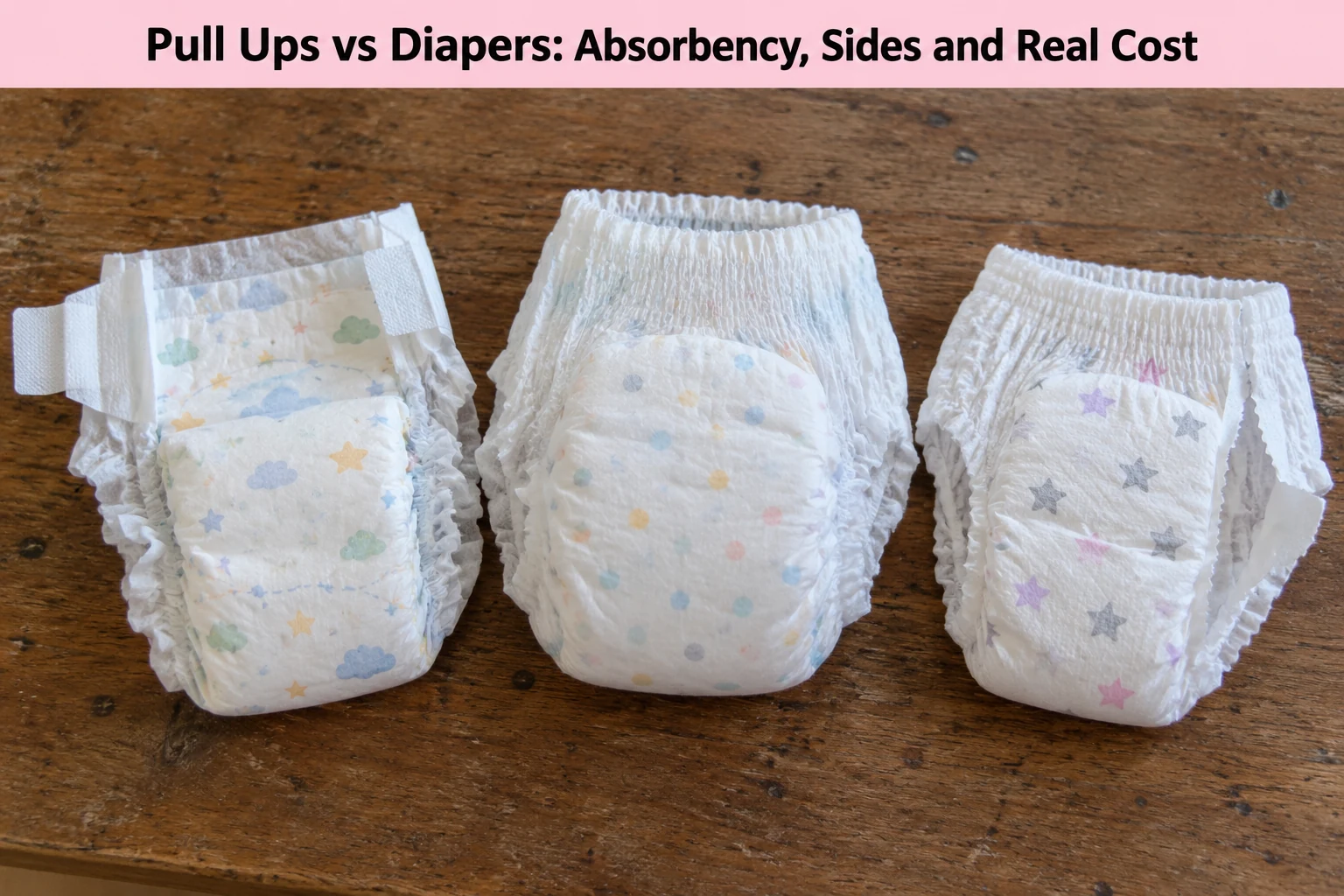
This guide covers what actually changes between them, how to compare cost without being fooled by the pack, and which one suits which stage.
Pull ups vs diapers at a glance
Most parents think there are two choices. The shelf has three.
| Taped diaper | Pull-on diaper pant | Training pant | |
|---|---|---|---|
| Pampers example | Any tab-fastened line | Cruisers 360 | Easy Ups |
| How it goes on | Lying down, tabs fastened at the hips | Stepped into, pulled up | Stepped into, pulled up |
| Made for | Babies and toddlers in diapers | Active babies and toddlers who need full diaper absorbency | Toddlers learning to use the potty |
| Absorbency | Full diaper | Full diaper | Less than a diaper pant, per Pampers |
| Taking a dirty one off | Open the tabs | Tear the side seams | Tear the side seams (Easy Ups) |
| Fit adjustment | Tabs can be moved | Fixed stretch waistband | Fixed stretch waistband |
The rows on purpose and absorbency come from Pampers' guide to diaper pants (updated November 16, 2025, read October 2, 2026). It describes diaper pants as designed for babies and toddlers who need full diaper absorbency, and training pants as specifically made for potty training and less absorbent than diaper pants. The same guide says taped diapers give an adjustable fit and suit younger babies who lie down for changes.
"I check the product category before treating every pull-on as a substitute for a diaper. A pull-on diaper pant and a training pant can look similar but serve different stages, so easier changes alone would not make me give up absorbency that is still needed. For cost, I compare the price per piece in the right weight range and how many are actually used, rather than the price of the whole pack."
The product most comparisons skip: pull-on diaper pants
When a parent searches pull ups vs diapers, they are usually asking one of two different questions:
- Can my toddler wear something that pulls on, because diaper changes have become a wrestling match?
- Is it time to start potty training products?
They have different answers. If the problem is a toddler who will not lie still, the product is a pull-on diaper pant. Pampers says in the same guide that diaper pants suit active babies from around 6 months, and it lists Cruisers 360 in sizes 3 to 7. You get the pull-on shape without giving up diaper absorbency.
If the question is potty training, the product is a training pant. Pampers describes its Easy Ups as made for potty training and as feeling and fitting more like real underwear.
Buying training pants to solve a changing-table problem is how a family can end up with more leaks than they had in diapers. The pull-on shape is the same. The core is not.
Absorbency: what the makers themselves say
This is where leak complaints start, so it is worth reading the makers' own words carefully.
- Diaper pants: Pampers says its diaper pants offer up to 12 hours of leak protection.
- Training pants: Pampers says its training pants are less absorbent than its diaper pants. On the Easy Ups product page (read October 2, 2026), Pampers also claims up to 100% leakproof protection day and night, with leak-guard barriers at the leg cuffs and absorbent channels.
Those two statements sit on the same maker's pages, so read the second one in light of the first. A training pant can contain a pee accident well and still hold less than a diaper does over a long stretch. Neither page gives an absorbency figure in milliliters, and we will not invent one.
What this means in practice: if your toddler is still doing most of their peeing in a diaper, a training pant has less margin. If they are using the potty for most pees and the pant is there for the occasional miss, the lower absorbency matters far less.
Sides: tabs, tear-away seams, and the poopy change
The side design changes how you take a dirty one off, which matters more than people expect.
Taped diapers open at the hips, so a poopy diaper comes off with the child lying down and nothing passes down the legs.
Pull-on pants are a different job. Pampers' instruction for a soiled diaper pant is to tear apart the sides and slowly slide it out from between your baby's legs. The Easy Ups product page describes easy tear sides for convenience, even on the go. If you use a different brand of training pant, check the pack for how its sides open before the first messy change.
Fit adjustment is the trade-off. A taped diaper can be fastened tighter or looser at the tabs. A pull-on pant has a fixed stretch waistband, so if the size is borderline there is nothing to adjust. If you are seeing red marks or gaps, our guide on how to tell if a diaper is too small covers the signs, and the same checks apply to pull-on styles.
Cost: how to compare without being fooled by the pack
Prices move week to week and differ by store, so this article does not quote them. What you can do in a minute at the shelf or online is compare the cost per piece:
- Divide the pack price by the number of pieces in it. Do this for each product you are comparing, in the size your child actually wears.
- Compare like sizes. Diapers use numbered sizes and training pants use T sizes such as 2T-3T, so match by the weight range printed on each pack, not by the size name.
- Count how many you use per day, not just the per-piece price. A training pant that comes off at the potty and stays dry between trips may last longer than a diaper changed on a schedule. A training pant that leaks and needs a full outfit change does not.
- Check the price at the moment you buy. Pack counts change with size, and the per-piece price changes with them.
That last step is why a fixed per-piece number in any article goes stale. Your own receipt is the honest comparison.
Fit and feel
Training pants are made to be pulled up and down by the child. The Easy Ups product page describes a 360 stretchy waistband that lets toddlers pull them up and down independently, and says they fit just like real cotton underwear. That is the point of the product: a child who can manage their own pants at the potty is doing part of the job themselves.
Diapers, including diaper pants, are designed around containment instead. For a child who is not using the potty yet, the underwear-like feel adds little, and a child who still needs full absorbency gives up margin for it.
Nights are a separate question
Day and night can need different products. In the Easy Ups FAQ, Pampers says its Easy Ups Ultra protect against leaks day or night, and its training pants article describes underwear in the day with training pants at night as one approach.
If your toddler is waking up soaked in a diaper, fit and absorbency are the first things to check, and our guide to why diapers leak at night walks through them before you switch products. For a child who has outgrown size 6 but is not ready for training pants, our page on size 7 and size 8 diapers covers who makes them.
If night wetting worries you, or your child was dry at night and has started wetting again, that is a question for your pediatrician, not a product decision.
Which one fits your situation
- Changes have become a battle, potty training is not on the table yet: pull-on diaper pants keep diaper absorbency.
- Your toddler is showing interest in the potty and using it some of the time: training pants are the product built for that stage.
- Your toddler uses the potty most of the time and needs a backup: training pants, or underwear in the day with training pants at night, as Pampers describes.
- Nighttime is still wet every night: an overnight diaper or a night-rated training pant, with a pediatrician conversation if it concerns you.
Whether your child is ready for potty training at all is a developmental question your pediatrician can help with. This page is about the products, not the method.
FAQ
Are pull-ups the same as diapers?
No. Training pants such as Pull-Ups and Easy Ups are made for potty training. Pampers says its Easy Ups training pants are less absorbent than its diaper pants, which are designed for children who need full diaper absorbency.
Are pull-ups less absorbent than diapers?
The maker we could check says yes. Pampers' diaper pants guide describes its training pants as less absorbent than its diaper pants. Neither product page gives an absorbency measurement.
Is there a diaper that pulls on like a pull-up?
Yes. Pull-on diaper pants, such as Pampers Cruisers 360 in sizes 3 to 7, go on like a training pant but are designed for full diaper absorbency, according to Pampers.
How do you take off a pull-up with poop in it?
If it has tear-away sides, as Pampers Easy Ups do, tear the sides rather than pulling it down the legs. Pampers' instruction for a soiled diaper pant is to tear apart the sides and slowly slide it out from between the legs.
Are pull-ups more expensive than diapers?
Prices change by store and week, so compare cost per piece on the day you buy: divide the pack price by the count, in the size your child wears, and factor in how many you actually use per day.
Author Profile
-
Eamin Hosen is the founder and author of BelovedTots. He has raised two young children, Pona and Ruku, and spent years working in child development at Neurosparks, a therapy center that provides Speech Therapy, Occupational Therapy, and ABA Therapy for children with developmental needs.
It was there, watching long therapy sessions get interrupted by leaking, ill-fitting diapers, that he began researching how products perform during everyday use and where their performance falls short of packaging claims.
He holds a Master’s in Psychology and Guidance from the University of Dhaka and brings a behavioral observation lens to every product he reviews. When he’s not testing diapers or writing guides, he’s probably negotiating bedtime with a 4-year-old.
Latest entries
- November 13, 2026Diaper Brands and ComparisonsBamboo Diapers: Viscose, Rayon and the Box Claims
- November 12, 2026Diaper Rash and SkinHypoallergenic Diapers: What the Word Really Promises
- November 11, 2026Diaper Brands and ComparisonsChlorine Free Diapers Meaning: TCF vs ECF Explained
- November 10, 2026Diaper Brands and ComparisonsEco Friendly Diapers: What the Labels Actually Mean