When to Switch to Pull Ups: Product Readiness Signs

There is no right age for when to switch to pull ups. The better trigger is what your child is doing: training pants such as Pull-Ups and Pampers Easy Ups are made for children who are learning to use the potty, so the switch makes sense once training has started and your child can pull pants up and down. The American Academy of Pediatrics says children generally show signs of bladder and bowel control between 18 and 24 months, and that toilet training in the US usually begins between ages 2 and 3. If your real problem is a toddler who fights diaper changes, a pull-on diaper pant may be the better fit.
Below are the product signs to look for, what the AAP and the makers each say, and the cases where switching early creates more leaks than it solves.
Is 18 months too early? Is 3 too late?
These are the two ages parents ask about most, so start with what the pediatric source says about age.
On its page on the right age to potty train (last updated May 24, 2022, read October 2, 2026), HealthyChildren.org, the AAP's site for parents, says:
- Children generally show signs of bladder and bowel control between 18 and 24 months of age.
- The average age toilet training begins in the US is between 2 and 3 years.
- Most children in the US are bowel and bladder trained by 4 years of age.
Read together, 18 months sits at the very start of the window when control usually begins to show, so a switch at that age only makes sense if your child is actually showing readiness signs. Three sits inside the usual starting range, not past it. Age alone does not decide it either way, which is the same reason we argue that age is the wrong number for diaper sizes.
If you are worried that your child is early, late or stuck, the AAP's advice on the same page is to talk with your child's doctor if any concern comes up before, during or after toilet training.
"I would make the switch around what the child can actually do, rather than a birthday or the size of the last diaper pack. Interest in the potty and being able to help manage pants make a training product more useful. If the only problem is a wriggly change, I would look at a pull-on diaper first and keep the absorbency question separate from readiness to train."
The readiness signs the AAP lists
The AAP page lists signs that a child may be developmentally ready for toilet training. In summary, a child who:
- Is dry for at least 2 hours at a time during the day, or is dry after naps
- Shows signs they are about to pee or poop, such as grunting, freezing or squatting
- Can follow simple instructions
- Can walk to and from the bathroom and help undress
- Does not like being in wet diapers and wants to be changed
- Asks to use the toilet or potty chair
- Asks to wear big-kid underwear
These are signs of readiness to train, not signs that a product needs to change. But a few of them are exactly the signs that tell you a training pant would be usable.
Product readiness: the signs that point to a training pant
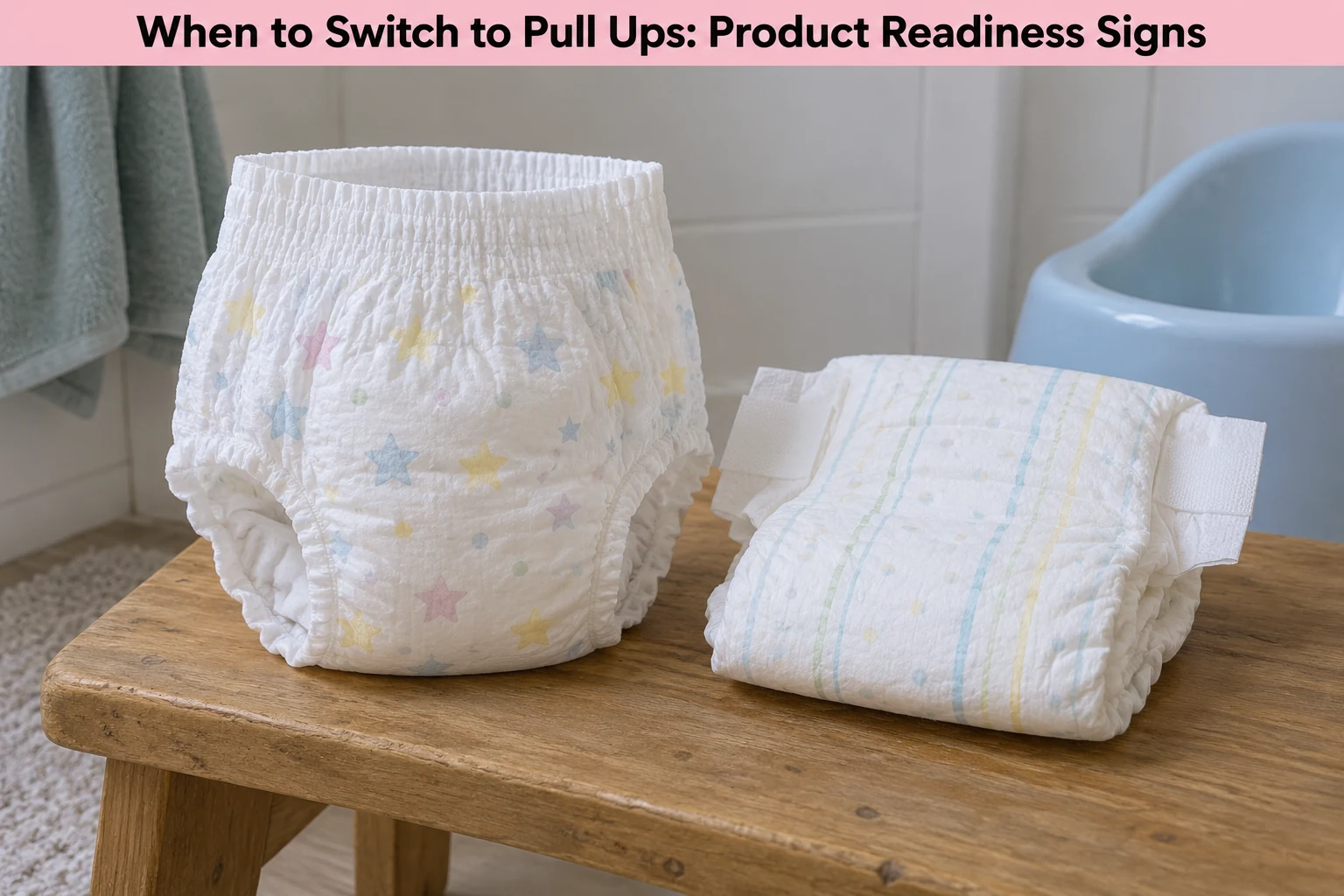
A training pant is a product with a specific design. On its Easy Ups product page (read October 2, 2026), Pampers describes a 360 stretchy waistband that lets toddlers pull the pants up and down independently, and easy tear sides for changes. Pampers' diaper pants guide (updated November 16, 2025, read October 2, 2026) also says its training pants are less absorbent than its diaper pants.
So the product makes sense when these line up:
- Training has started. Your child is using the potty at least some of the time. A training pant is built for that stage, according to Pampers.
- Your child can manage pants. Helping to undress is on the AAP's readiness list, and pulling the pant up and down alone is what the training pant is designed for. If you are still doing all the pulling, the main benefit is missing.
- Your child is not peeing a full diaper's worth between potty trips. Because training pants absorb less than diaper pants, per Pampers, a child who still relies on a diaper for most pees has less margin in one.
- Your child fits the size range. Pampers sells Easy Ups from 2T-3T up to 6T-7T. Training pants use T sizes rather than numbered diaper sizes, so match by the weight range printed on the pack.
What the AAP says about training pants
None of the switching guides in our search covered this.
In its potty training tips, the AAP's page suggests switching to big-kid underwear when toilet training starts. It notes that some parents use cloth training pants, which are a little thicker, to protect clothing. And it says that diapers and disposable training pants send children a message that they are not taking over and do not need to learn to use the toilet.
The maker frames it differently. In its Easy Ups FAQ, Pampers describes Easy Ups as potty training pants designed to help toddlers move from diapers to underwear, and its training pants article describes one approach as underwear during the day with training pants at night.
We are not going to tell you which approach to take. What the sources do show is this:
- For daytime training, the AAP page favors underwear, with cloth training pants as an option some parents use.
- For the maker, disposable training pants are a step between diapers and underwear, and one Pampers article suggests them for nights once daytime underwear starts.
You can also land somewhere in between. Your pediatrician can help you think it through for your child.
When a pull-on diaper is the better switch
Plenty of parents searching this are not thinking about potty training at all. They have a toddler who twists, rolls and crawls away mid-change, and they want something that goes on standing up.
That is a different product. Pampers' diaper pants guide describes pull-on diaper pants as designed for babies and toddlers who need full diaper absorbency, and lists Cruisers 360 in sizes 3 to 7. They go on like a training pant and come off by tearing the sides, but they keep a diaper's absorbency.
If you switch to training pants to solve a changing problem, you give up absorbency your child still needs, and leaks become more likely. If the problem is the changing table, switch the shape, not the category.
Signs it is too early for training pants
These signs suggest diapers or diaper pants are still the better fit for now:
- Your child is not using the potty yet. A training pant is designed around potty training, per Pampers.
- The training pant leaks most days. It may be absorbency, not fit, since training pants hold less than diaper pants by Pampers' own account.
- Your child has no interest in pulling pants up or down. The main design advantage goes unused.
- A big family change is happening. The AAP's page lists a move, a new baby, or a major illness, death or family crisis as reasons toilet training may be put on hold.
What about naps and nights?
Day and night are separate decisions. The AAP readiness list includes being dry after naps, and night dryness is its own question.
For a child still in diapers who is soaking through at night, fit and absorbency are the first things to check before a new product category, and our guide to why diapers leak at night covers both. For a child who has outgrown size 6 diapers but is not ready for training pants, our page on size 7 and size 8 diapers explains who makes them.
If your child was dry at night and starts wetting again, or night wetting worries you, that is a question for your pediatrician.
When to switch to pull ups: a simple decision path
- Not potty training, changes are fine: stay in diapers.
- Not potty training, changes are a battle: consider pull-on diaper pants.
- Training has started, child can manage pants: training pants are designed for this stage, or underwear with cloth training pants, as the AAP page describes.
- Dry in the day, wet at night: training pants or diapers at night while daytime moves to underwear, as Pampers describes.
- Any worry about readiness, regression or night wetting: your pediatrician.
FAQ
What age do kids switch to pull-ups?
There is no set age. The AAP says children generally show signs of bladder and bowel control between 18 and 24 months, and that toilet training in the US usually begins between ages 2 and 3. Training pants make the most sense once training has started.
Can you put an 18-month-old in pull-ups?
You can, if they fit the size range. Whether it helps depends on readiness. The AAP places the first signs of bladder and bowel control between 18 and 24 months, and a training pant is designed for a child who is potty training, per Pampers. A pull-on diaper pant suits a younger toddler who only needs easier changes.
Is 3 too late to start pull-ups?
No. The AAP says toilet training in the US usually starts between 2 and 3 and most children are trained by 4. If you are worried about timing, the AAP's advice is to talk with your child's doctor.
Does the AAP recommend pull-ups for potty training?
The AAP's HealthyChildren.org page suggests switching to big-kid underwear when toilet training starts, notes that some parents use cloth training pants, and says diapers and disposable training pants send a message that children are not taking over.
Are pull-ups as absorbent as diapers?
Not according to Pampers, which says its training pants are less absorbent than its diaper pants.
Author Profile
-
Eamin Hosen is the founder and author of BelovedTots. He has raised two young children, Pona and Ruku, and spent years working in child development at Neurosparks, a therapy center that provides Speech Therapy, Occupational Therapy, and ABA Therapy for children with developmental needs.
It was there, watching long therapy sessions get interrupted by leaking, ill-fitting diapers, that he began researching how products perform during everyday use and where their performance falls short of packaging claims.
He holds a Master’s in Psychology and Guidance from the University of Dhaka and brings a behavioral observation lens to every product he reviews. When he’s not testing diapers or writing guides, he’s probably negotiating bedtime with a 4-year-old.
Latest entries
- November 13, 2026Diaper Brands and ComparisonsBamboo Diapers: Viscose, Rayon and the Box Claims
- November 12, 2026Diaper Rash and SkinHypoallergenic Diapers: What the Word Really Promises
- November 11, 2026Diaper Brands and ComparisonsChlorine Free Diapers Meaning: TCF vs ECF Explained
- November 10, 2026Diaper Brands and ComparisonsEco Friendly Diapers: What the Labels Actually Mean