
Overnight Pull Ups: What Changes After Daytime Training

Staying dry at night is a separate skill from staying dry by day, so wet nights after daytime training are common. The American Academy of Pediatrics (AAP) says that although most children are toilet trained between 2 and 4 years of age, "some children may not be able to stay dry at night until they are older." Overnight pull ups are pull-on pants made with night in mind, so they are meant to hold more than a daytime training pant while that skill develops. The AAP's line for when to call: "If your child has been completely toilet trained for 6 months or longer and suddenly begins wetting the bed, talk with your child's doctor."
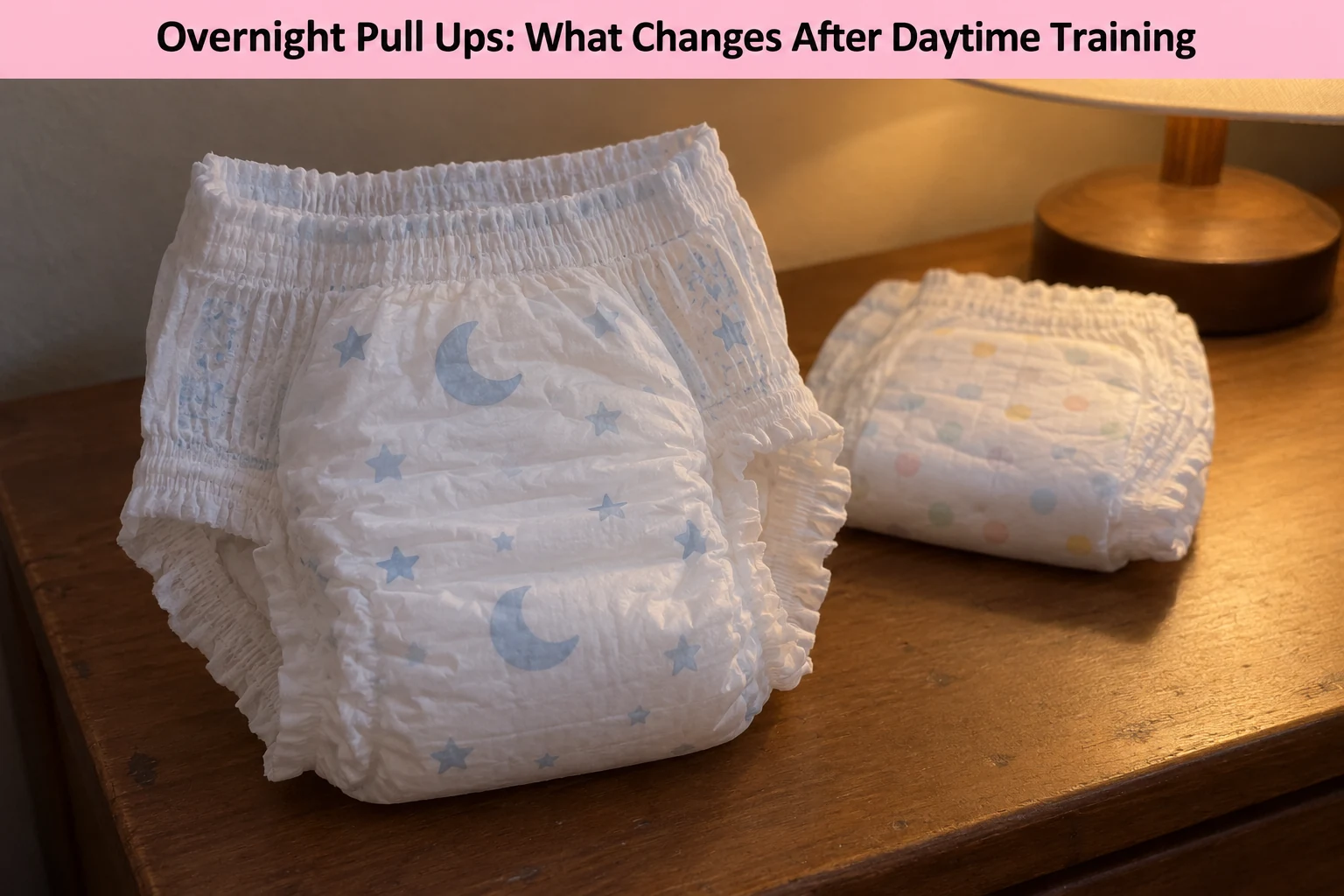
Below: when to talk to a pediatrician, why days and nights are different, what changes between daytime training pants and night products, and what to check on a pack.
When to talk to your pediatrician
This comes first because it is the part a parent needs before anything about products. HealthyChildren.org, the AAP's parent site, says in its bedwetting article (last updated December 22, 2021, read October 3, 2026): "If your child has been completely toilet trained for 6 months or longer and suddenly begins wetting the bed, talk with your child's doctor."
A sudden change after a long dry stretch is the situation the AAP singles out. Wet nights from the start of training are the ordinary pattern described below. Neither this page nor a diaper pack can tell you the cause of an individual child's wetting. A pediatrician can, so any worry about your own child is a question for them.
"I keep dry days and dry nights as separate expectations, so using protection at night would not feel like undoing daytime progress. A wet morning makes me check whether liquid escaped through a gap or the pant was genuinely full before changing size or product. If wetting returns after a long dry stretch, I would raise it with the pediatrician rather than assume a stronger night pant answers the whole question."
Why dry days do not mean dry nights
Daytime and nighttime control are not the same milestone. Pampers' guide to night-time potty training (updated July 2, 2026, read October 3, 2026) puts it this way: "It takes time for the bladder to mature and for the brain to be able to send signals that it's time to wake up from sleep to pee." It adds that bed-wetting is normal up to age 5 or 6, as bladder control during sleep develops gradually.
The AAP gives a sense of how common it is. It reports that "studies have shown that 15% of 5- and 7-year-olds wet the bed. But by age 15, fewer than 1% wet the bed." That is a published figure from the AAP's page, read on October 3, 2026, and it is a snapshot of a population, not a prediction for any one child.
The AAP also speaks to how families respond: "Do not blame your child. Remember that it is not your child's fault. Offer support, not punishment, for wet nights." That matters for products. A pull-up is a way to keep wet nights from becoming a source of stress, not a signal that the child has done something wrong.
What changes from daytime training pants to night
Daytime training pants are built for small accidents. Pampers' diaper pants guide (updated November 16, 2025, read October 3, 2026) says its training pants are "less absorbent than diaper pants" and made for potty training, so toddlers can recognize when they need to use the potty. That design suits a child who is going to the toilet during the day and has an occasional accident. A night is a different job: many hours and, potentially, one large release of urine.
Night products are made to hold more. Makers offer pull-ons or underwear-style products marketed for night. The absorbency claims on those packs are the maker's own, so compare them within a line and read the pack for the weight range and what it says it holds.
Daytime pants can also be used at night. Pampers states: "Yes, you can use pull-ons at night when potty training." It says pull-on training pants like Easy Ups "can help protect your child's bedding while still allowing them to practice pulling them up and down independently." That is a maker's view. It is also worth knowing the AAP's suggestion for children who start wetting after training: "simply go back to training pants at night and try again another time."
Diapers or diaper pants can still be the right format. Pampers describes diaper pants as made for children who "still need a full-functioning diaper." If a child has not yet started daytime training, or is still wetting heavily at night, a night-labeled diaper is a product category in its own right. Our guide to best overnight diapers covers what the boxes claim, and overnight diapers vs sizing up covers whether a bigger size or a night line suits the problem.
| Option at night | What it is | What the sources say |
|---|---|---|
| Daytime training pants | Pull-on pants for potty training | Pampers says they can be used at night, and that they are less absorbent than diaper pants |
| Night-labeled pull-ups or nighttime underwear | Pull-ons with a night claim on the pack | Absorbency claims are the maker's own; read the weight range and what the pack says |
| Overnight diaper or diaper pants | Full diaper absorbency in a diaper or pull-on shape | Pampers describes diaper pants as for children who still need full absorbency |
Reading a wet morning: leak or full?
This is the practical part most overnight pull-up pages skip. A wet morning can mean two different things, and they point to different fixes.
- The pant is heavy and full but nothing escaped. The product held what it was made to hold. The question is only whether the child is comfortable.
- Urine escaped at the legs or waist while the pant is partly dry. That points to fit, not capacity. A pant that gaps at the thighs lets liquid out before it is full. Our pages on why diapers leak at night and how to tell if a diaper is too small walk through fit checks that apply to pull-ons as well.
- The pant is soaked through and leaking from the middle. The load exceeded what the pant holds, so a different night product or a different format is the question.
The same approach works for diapers. Looking at where the wetness is, not just that it is there, saves guessing between a bigger size, a different brand and a different format.
A readiness note, and what it is not
Pampers lists signs that a child may be ready to try nights without a pant: they "stay dry during naps," "wake up dry several mornings in a row," and are "consistently successful with daytime toilet training." That is Pampers' list, not a medical test. The AAP's bedwetting article is the better guide on when wetting is expected and when to ask a doctor.
This page covers products, not potty-training method. If you want a view on your own child's readiness, the pediatrician is the right person.
What to check on the pack
- Weight range, not age. Pull-on sizes are set by weight, and ranges differ by maker.
- The night claim and who makes it. The claim is the maker's. Read it as marketing, not a measurement.
- Fit at the legs and waist. Gaps and red marks matter more than the label.
- Whether the child can pull them on and off. Pull-on pants are meant to be used independently, per Pampers.
- The count per pack. Wet nights can mean one pant a night.
FAQ
Is it normal for a child to be dry in the day and wet at night?
Yes. The AAP says most children are toilet trained between 2 and 4 years of age, but some may not be able to stay dry at night until they are older, and it reports that 15% of 5- and 7-year-olds wet the bed. A pediatrician is the person to ask about any individual child.
When should I call the pediatrician about night wetting?
The AAP says that if a child has been completely toilet trained for 6 months or longer and suddenly begins wetting the bed, to talk with the child's doctor. A pediatrician can answer questions about any other concern.
Can my child wear daytime training pants at night?
Pampers says yes, and that pull-ons like Easy Ups can protect bedding while a child practices pulling them up and down. Pampers also says training pants are less absorbent than diaper pants, so a child who wets heavily may soak through.
What if my child starts wetting the bed after being dry?
The AAP's advice for this situation, in its words, is to "simply go back to training pants at night and try again another time." If it follows 6 months or more of full toilet training, the AAP says to talk with the child's doctor.
Are overnight pull ups the same as diapers?
Not exactly. They are pull-on pants like training pants, but made with night use in mind. The claims on each pack are the maker's own, so compare the weight range and the description on the pack.
Author Profile
-
Eamin Hosen is the founder and author of BelovedTots. He has raised two young children, Pona and Ruku, and spent years working in child development at Neurosparks, a therapy center that provides Speech Therapy, Occupational Therapy, and ABA Therapy for children with developmental needs.
It was there, watching long therapy sessions get interrupted by leaking, ill-fitting diapers, that he began researching how products perform during everyday use and where their performance falls short of packaging claims.
He holds a Master’s in Psychology and Guidance from the University of Dhaka and brings a behavioral observation lens to every product he reviews. When he’s not testing diapers or writing guides, he’s probably negotiating bedtime with a 4-year-old.
Latest entries
- November 13, 2026Diaper Brands and ComparisonsBamboo Diapers: Viscose, Rayon and the Box Claims
- November 12, 2026Diaper Rash and SkinHypoallergenic Diapers: What the Word Really Promises
- November 11, 2026Diaper Brands and ComparisonsChlorine Free Diapers Meaning: TCF vs ECF Explained
- November 10, 2026Diaper Brands and ComparisonsEco Friendly Diapers: What the Labels Actually Mean