Cloth Training Pants vs Pull Ups: How They Compare

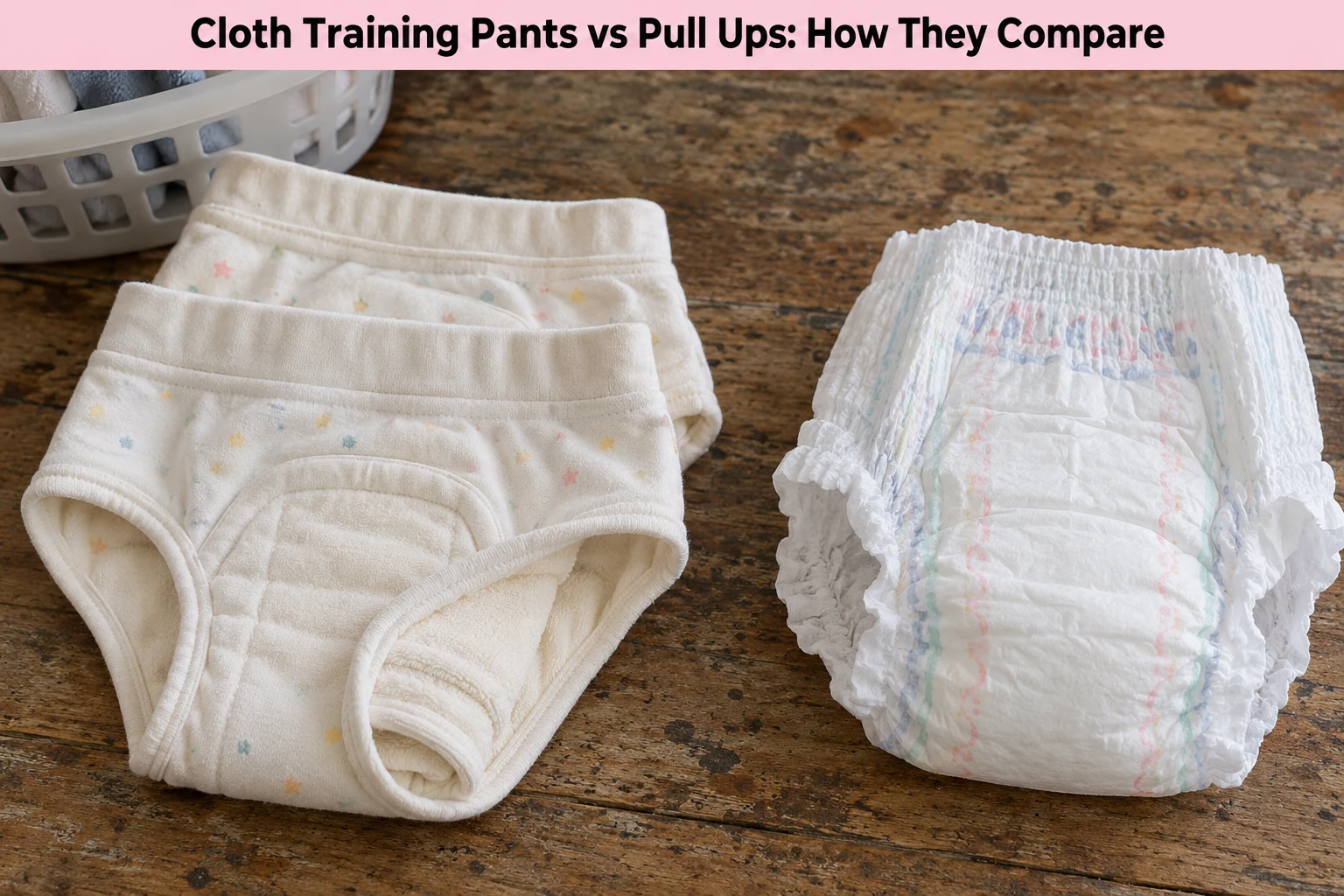
Cloth training pants are reusable and less absorbent. Disposable pull ups are absorbent and thrown away after an accident. That one difference drives most of the rest: cloth is lighter on waste and can cost less over time, but it means more laundry and more leaks on outings and at night, while disposables hold more and need no washing. Coterie, a diaper brand that publishes a comparison, says cloth training pants "aren't as absorbent as most disposable pull-up style diapers," which is why it points to disposables for longer outings and overnight. The two can also be combined.
Below: what each product is, how they compare on absorbency, laundry, cost and waste, where each fits in a day, and a short way to decide.
Cloth training pants vs pull ups at a glance
The two sources below are brands that sell disposables (Pampers and Coterie), so read their claims as maker views. Where a statement is a belief rather than a measured result, we say so.
| Cloth training pants | Disposable pull ups | |
|---|---|---|
| Absorbency | Lower, meant for small accidents | Higher, meant to contain more |
| Washing | Wash after each accident | None, thrown away |
| Upfront cost | Higher, you buy a set | Lower per pack |
| Cost over time | Can be lower, since reusable | Recurring, every pant is used once |
| Waste | Less | More |
| Outings and overnight | Risk of leaks | Better suited, per Coterie |
| Feeling wetness | Child feels it, which some people believe helps | Varies by pant |
"I would choose cloth or disposable training pants around the day we need to manage, rather than expect one material to make training happen faster. Cloth brings washing and a need for clean spares, while disposable pull-ons offer a different level of protection for longer stretches. A mixed routine can make sense, but I would count the extra laundry and actual use before assuming cloth has already paid for itself."
What each product actually is
"Pull ups" is a brand name from Huggies that many people use for any disposable pull-on training pant. Pampers sells its own, called Easy Ups. In this article, "pull ups" means disposable pull-on training pants as a category.
Cloth training pants are reusable pants made from fabric. Different makers build them differently, so check each product's description for what it holds and whether it has any waterproof layer.
Pampers' diaper pants guide (updated November 16, 2025, read October 3, 2026) describes training pants as made for potty training and "less absorbent than diaper pants." That puts training pants, cloth or disposable, below a diaper in absorbency.
Absorbency and leaks
Absorbency is the clearest difference. Coterie's comparison of cloth and disposable pull-ups (published December 3, 2024, read October 3, 2026) says cloth pants are not as absorbent as most disposable pull-ups and that disposables suit longer outings and overnight because cloth risks "leaks and blowouts." Coterie sells a disposable pull-up, so it has a stake in that view, but the logic is also straightforward: a pant built to hold less will leak sooner.
If leaks do show up, check fit before blaming the product. A pant that gaps at the legs or sags at the waist will leak whatever it is made of. Our guide to how to tell if a diaper is too small covers the red-mark and tight-fit signs, and the same checks apply to pull-on pants.
Feeling wet: what the claim is
The argument most often made for cloth is that it lets a child feel wetness. Coterie says cloth pants "allow the child to feel wetness, which some schools of thought believe can potentially help them" recognize when toileting is needed. Pampers makes a related claim for its own training pants, saying they "encourage toddlers to recognize when they need to use the potty."
Both statements are presented by the makers as beliefs or design intentions. Neither source presents a measured result showing that cloth or disposable gets a child out of pants faster, and the American Academy of Pediatrics pages we read on toilet training do not rank cloth against disposable. The honest takeaway is that feeling wet is a reason some families choose cloth, not a proven advantage.
Laundry, cost and waste
Laundry. Cloth means a lot more of it. Coterie notes the extra laundry adds energy costs and parental effort. Wash and care instructions vary by maker, so the label on the pants you buy is the guide.
Cost. Coterie says the initial investment in cloth is "significantly higher," but that it "can save money in the long run since you can reuse over and over." No price figures are given here, because prices change. A simple way to test it yourself:
- Take the upfront cost of the cloth set you are considering.
- Divide it by the price of one disposable pull-up in the pack you would buy.
- The result is the number of disposable pants the cloth set has to replace to break even, before counting the cost of extra laundry.
If the set replaces that many disposables comfortably, cloth is likely to cost less. If your child will be in pants for only a few more months, it may not.
Waste. Coterie says cloth creates "less waste compared to disposable pull-ups." That is a claim about fewer pants going to the trash. It does not count the water and energy used in washing, which the same source mentions as a cost.
Where each one fits in a day
- At home, daytime. Cloth is the easier fit. Accidents are small and close to a washing machine, and a changed pair is a few steps away.
- Outings and travel. Disposables carry the load better. A wet cloth pant needs a bag to carry it home, and Coterie recommends disposables for longer outings.
- Daycare or preschool. Policies on what children wear differ by program, so ask what the program expects before choosing.
- Nights. Night wetting is a separate matter from daytime training. The American Academy of Pediatrics says on its bedwetting article (last updated December 22, 2021, read October 3, 2026) that although most children are toilet trained between 2 and 4 years of age, "some children may not be able to stay dry at night until they are older." Coterie says disposables suit overnight because cloth risks leaks. For the product side of night leaks, see our page on why diapers leak at night. If night wetting is a worry for your own child, your pediatrician is the right person to ask.
A mixed routine
The two are not an either-or choice. Coterie suggests disposables for outings and nights. Taken with its view of cloth, that points to a pattern: cloth at home during the day, disposable for the longer stretches. The reasoning is simply to match absorbency to the situation, with cloth where an accident is small and easy to wash, and disposable where a leak would be hard to deal with.
How to decide
Four questions cover most of it:
- How much laundry can you take on? If the answer is little, disposables fit.
- How long will your child be in pants? The shorter the stretch, the less time a cloth set has to pay for itself.
- Where will your child spend most of the day? Home, outings and daycare each point to different products.
- Do you need night protection? If so, plan for a different product at night, whichever you choose by day.
FAQ
Are cloth training pants as absorbent as pull ups?
No. Coterie says cloth training pants are not as absorbent as most disposable pull-ups. Pampers says training pants in general are less absorbent than diaper pants. Cloth is built for small accidents.
Do cloth training pants help with potty training?
Some people believe that feeling wetness helps a child recognize when to use the toilet. Coterie describes it as a view held by "some schools of thought," and the sources here do not show a measured result. It is a reason some families choose cloth, not a guarantee.
Is cloth cheaper than pull ups?
Coterie says cloth costs more upfront and can save money in the long run since it is reusable. The savings depend on how many disposables the set replaces and on the cost of extra laundry, so the break-even sum in this article is the way to check for your own situation.
Can cloth training pants be used overnight?
Coterie says disposables suit overnight use because cloth risks leaks. Night dryness develops on its own timeline, and the American Academy of Pediatrics says some children cannot stay dry at night until they are older. Your pediatrician can answer questions about an individual child.
Can I use both?
Yes. Coterie recommends disposables for outings and nights, which fits a routine of cloth at home by day and disposables for longer stretches.
Author Profile
-
Eamin Hosen is the founder and author of BelovedTots. He has raised two young children, Pona and Ruku, and spent years working in child development at Neurosparks, a therapy center that provides Speech Therapy, Occupational Therapy, and ABA Therapy for children with developmental needs.
It was there, watching long therapy sessions get interrupted by leaking, ill-fitting diapers, that he began researching how products perform during everyday use and where their performance falls short of packaging claims.
He holds a Master’s in Psychology and Guidance from the University of Dhaka and brings a behavioral observation lens to every product he reviews. When he’s not testing diapers or writing guides, he’s probably negotiating bedtime with a 4-year-old.
Latest entries
- November 13, 2026Diaper Brands and ComparisonsBamboo Diapers: Viscose, Rayon and the Box Claims
- November 12, 2026Diaper Rash and SkinHypoallergenic Diapers: What the Word Really Promises
- November 11, 2026Diaper Brands and ComparisonsChlorine Free Diapers Meaning: TCF vs ECF Explained
- November 10, 2026Diaper Brands and ComparisonsEco Friendly Diapers: What the Labels Actually Mean