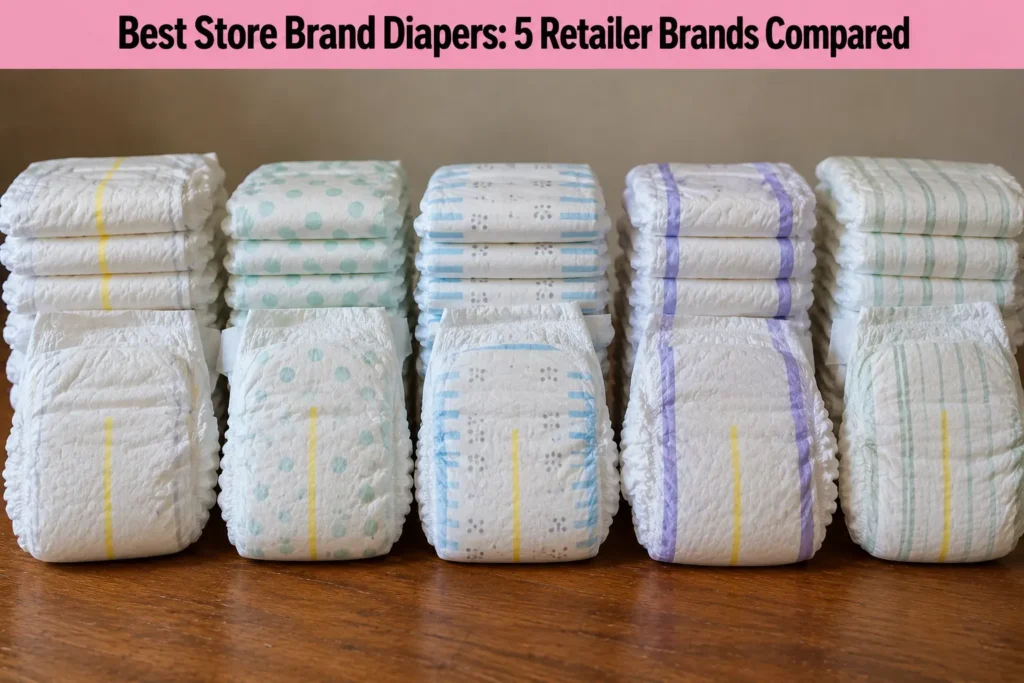
Best Store Brand Diapers: 5 Retailer Brands Compared

The best store brand diapers are the ones that fit your baby without gaps, come in the size you need, and cost the least per diaper on the day you buy. No single store brand wins on all three for every baby. The five big US store brands are Kirkland Signature (Costco), up&up (Target), Parent’s Choice (Walmart), Mama Bear (Amazon) and Member’s Mark (Sam’s Club). The biggest recent change is who makes them: Kimberly-Clark, the maker of Huggies, has exited its US private label diaper business, so older “it’s just Huggies in a different box” advice is out of date.
This page is a research-based comparison. We have not hands-on tested these diapers. Everything below comes from the retailers’ and makers’ own published information, read on October 2, 2026, and we say plainly where a retailer publishes too little to compare. If leaks are the reason you are shopping, rule out fit first with our diaper fit and leak guide, because a cheaper brand will not fix a sizing problem.
“Buying store-brand diapers has taught me that the cheapest box is only a bargain if the fit actually works for my child. I pay much more attention now to the weight range, pack count, and whether the diaper has changed manufacturers, because an older review may describe a product that is no longer on the shelf. For a brand I have not tried before, I would rather start with the smallest pack I can find, check the legs and waist for a day or two, and then decide whether the lower cost is really worth buying in bulk.”
How we compared the five store brands
A “best” list with no criteria is just an ad, so here are ours. We looked at five things for each store brand:
- Who makes it, and whether that has changed. A store brand is made under contract, and the contract can move. When it moves, older reviews describe a different diaper.
- What the retailer actually publishes on its own product pages: size range, product lines and label claims.
- Size coverage, especially whether there is a newborn size at the small end.
- Line options, such as a sensitive version, an overnight version or training pants under the same brand.
- How you can check cost without trusting a price quoted in an article.
We left out star ratings and review counts. They are not evidence of fit on your baby, and they change daily. We also left out prices, which move by store, size and week. For a map of the name brands these compete with, see our guide to diaper brands and who makes what.
Store brand diapers at a glance
| Store brand | Sold by | Maker publicly named? | What the retailer’s own pages showed (read October 2, 2026) |
|---|---|---|---|
| Kirkland Signature | Costco | Yes, reported as First Quality since January 2025 | Covered in our Kirkland review, linked below |
| up&up | Target | Not on the pages we read | Disposable diapers including a newborn size, “Up to 12 Hours of Leak Protection”, plus day and nighttime training pants |
| Parent’s Choice | Walmart | Not on the pages we read | No current specifications we could confirm |
| Mama Bear | Amazon | Not on the pages we read | Gentle Touch line labeled hypoallergenic; Plush Protection line labeled hypoallergenic and fragrance-free |
| Member’s Mark | Sam’s Club | Not on the pages we read | No current specifications we could confirm |
That last column is uneven on purpose. Where we could not confirm a detail from the retailer itself, we did not fill the gap with numbers from other review sites.
The maker question: why 2025 changed store brand diapers
For years, the most repeated fact about store brand diapers was that Kirkland was made by the Huggies company. That stopped being true at the start of 2025.
In December 2024, trade publication Tissue Online North America reported (December 13, 2024, read October 2, 2026) that Kimberly-Clark was ending its private label diaper production for Costco, and that First Quality would make Kirkland Signature diapers starting in January 2025.
Kimberly-Clark’s own numbers confirm the wider picture. In its fourth quarter 2025 results release filed with the SEC (January 27, 2026, read October 2, 2026), the company repeatedly attributes part of its sales decline to “the exit of the company’s private label diaper business in the US.”
What this means for you:
- Any article that says a US store brand diaper is “made by Huggies” is describing the past, going by Kimberly-Clark’s own filing.
- Reviews written before 2025 may describe a different Kirkland diaper. Check the date on any review before you trust it.
- First Quality makes store brands as a business. Its own website (read October 2, 2026) says it makes “the retail store brands you know and love” as well as its own brands, which include Cuties.
On the pages we read, Target, Walmart, Amazon and Sam’s Club do not name who makes their diapers. That is common for store brands, and it means you cannot assume a store brand is the same diaper as any name brand.
Kirkland Signature (Costco)
Kirkland is the store brand most parents ask about, and the one whose story changed most. Its manufacturer moved from Kimberly-Clark to First Quality in January 2025, per the trade report above, so the “same as Huggies” reputation it built over many years belongs to an earlier diaper.
We cover Kirkland in depth in two places. Our Kirkland diapers review looks at what Costco’s diaper is now, including its size range, and our Kirkland vs Huggies comparison walks through what changed when the maker did.
What to concede: Kirkland is sold in large club cases through a membership retailer. That suits a family that already knows its baby fits the diaper. It is a bigger commitment for a family still trying brands, because a case that does not fit is a lot of diapers.
up&up (Target)
Target’s own results page for up&up diapers (read October 2, 2026) listed up&up disposable diapers in sizes that include newborn, with the claim “Up to 12 Hours of Leak Protection.” The same page listed up&up Comfort-Stretch training pants for boys and girls and an up&up Nighttime training pant, so the brand also covers the step after diapers.
Target does not say what the 12 hours is measured against, so read it as a label claim, not a test result. That is true of every hours-based claim on any diaper box.
What to concede: a range that runs from newborn to training pants is convenient, but convenience is not fit. A diaper line can fit differently at each size, so try a small pack each time you move up.
Parent’s Choice (Walmart)
Parent’s Choice is Walmart’s store brand, sold in Walmart stores and online. We could not confirm current specifications, line names or label claims from Walmart’s own product pages at the time of writing, so we are not reporting any.
Rather than borrow numbers from other review sites, check three things on the pack before you buy: the weight range for your size, whether the line has a sensitive or overnight version, and the count in the box, so you can work out the cost per diaper (method below).
What to concede: with no named maker and no specifications we could confirm, Parent’s Choice is the brand on this list where your own small-pack trial matters most.
Mama Bear (Amazon)
Mama Bear is Amazon’s own diaper brand. On the Amazon product pages we read (October 2, 2026), two lines appeared:
- Mama Bear Gentle Touch, labeled hypoallergenic, with leakage protection named in the product title.
- Mama Bear Plush Protection, labeled hypoallergenic and fragrance-free.
“Hypoallergenic” is a label, not a standard. The FDA states (content current as of February 25, 2022, read October 2, 2026) that there are no federal standards or definitions governing the term, and that manufacturers are not required to submit proof of the claim to the FDA. Read it as “the brand chose to say this,” not as a promise your baby will not react.
What to concede: buying online means you cannot see or feel the diaper before the box arrives, and a repeat delivery can keep sending a size your baby has already outgrown. Match the quantity to how fast your baby is growing.
Member’s Mark (Sam’s Club)
Member’s Mark is Sam’s Club’s store brand and the closest like-for-like rival to Kirkland, since both are sold through warehouse clubs. As with Walmart, we could not confirm current lines, sizes or claims from Sam’s Club’s own pages at the time of writing.
What to concede: Member’s Mark shares Kirkland’s main trade-off. Club cases can bring the per-diaper cost down, but they make a wrong-fit purchase expensive. Check the weight range on the case against your baby’s weight, and if your baby sits near the top of the range, think about whether you will finish the case before sizing up.
How to compare store brand diapers yourself
Because prices, pack counts and even manufacturers change, the most reliable comparison is one you run on the day you buy.
- Work out cost per diaper. Divide the pack price by the number of diapers, in the size your baby actually wears. Do this for each brand. Pack counts change between sizes, so a brand that is cheapest in size 2 may not be cheapest in size 5.
- Match by weight, not by size number. Size numbers do not always mean the same weight range across brands. Our cross-brand diaper size chart shows how far they drift.
- Buy the smallest pack first. A day in a small pack tells you more about fit at the legs and waist than any review.
- Check nights separately. A diaper that is fine by day can leak overnight. If nights are the problem, an overnight line or a size check usually matters more than the brand.
- Count your changes, not just the price. A cheaper diaper that needs more frequent changes, or causes outfit changes, may not be cheaper per day.
It is also worth comparing store brands with the budget lines from name-brand makers. Luvs is Procter & Gamble’s budget line, and our Luvs vs Pampers guide explains how it differs from Pampers.
Store brands and sensitive skin
Store brand packs carry the same kinds of label words as name brands: hypoallergenic, fragrance-free, free of certain ingredients. Since the FDA says “hypoallergenic” has no federal definition, a store brand that uses it is making the same unregulated claim a name brand makes. Our guide to diapers for sensitive skin explains what each of those label words does and does not mean.
If your baby has a rash that does not clear, keeps coming back, or looks unusual, that is a question for your pediatrician before it is a question about which store brand to buy.
FAQ
Who makes Kirkland diapers now?
First Quality, according to a December 2024 trade report that said First Quality would make Kirkland Signature diapers starting in January 2025. Before that, Kimberly-Clark, the maker of Huggies, made them.
Are any store brand diapers made by Huggies?
Not in the US, going by Kimberly-Clark’s own reporting. The company’s fourth quarter 2025 results describe the exit of its private label diaper business in the US, so claims that a US store brand is “made by Huggies” are out of date.
Which store brand diaper is the cheapest?
It depends on the store, the size and the week. Divide the pack price by the diaper count in your baby’s size for each brand on the day you buy. That is the only comparison that stays accurate.
Do store brand diapers come in newborn size?
Some do. Target’s up&up page listed a newborn size when we read it on October 2, 2026. Check the size range on the specific brand and pack before you buy for a newborn.
Are store brand diapers hypoallergenic?
Some are labeled that way, such as Amazon’s Mama Bear Gentle Touch and Plush Protection lines. The FDA says there is no federal definition of hypoallergenic, so treat it as a label claim rather than a guarantee.
Author Profile
-
Eamin Hosen is the founder and author of BelovedTots. He has raised two young children, Pona and Ruku, and spent years working in child development at Neurosparks, a therapy center that provides Speech Therapy, Occupational Therapy, and ABA Therapy for children with developmental needs.
It was there, watching long therapy sessions get interrupted by leaking, ill-fitting diapers, that he began researching how products perform during everyday use and where their performance falls short of packaging claims.
He holds a Master’s in Psychology and Guidance from the University of Dhaka and brings a behavioral observation lens to every product he reviews. When he’s not testing diapers or writing guides, he’s probably negotiating bedtime with a 4-year-old.
Latest entries
- November 13, 2026Diaper Brands and ComparisonsBamboo Diapers: Viscose, Rayon and the Box Claims
- November 12, 2026Diaper Rash and SkinHypoallergenic Diapers: What the Word Really Promises
- November 11, 2026Diaper Brands and ComparisonsChlorine Free Diapers Meaning: TCF vs ECF Explained
- November 10, 2026Diaper Brands and ComparisonsEco Friendly Diapers: What the Labels Actually Mean