
How to Tell If a Diaper Is Too Big: Signs, Causes and Fixes

Sources checked 2026-08-23.
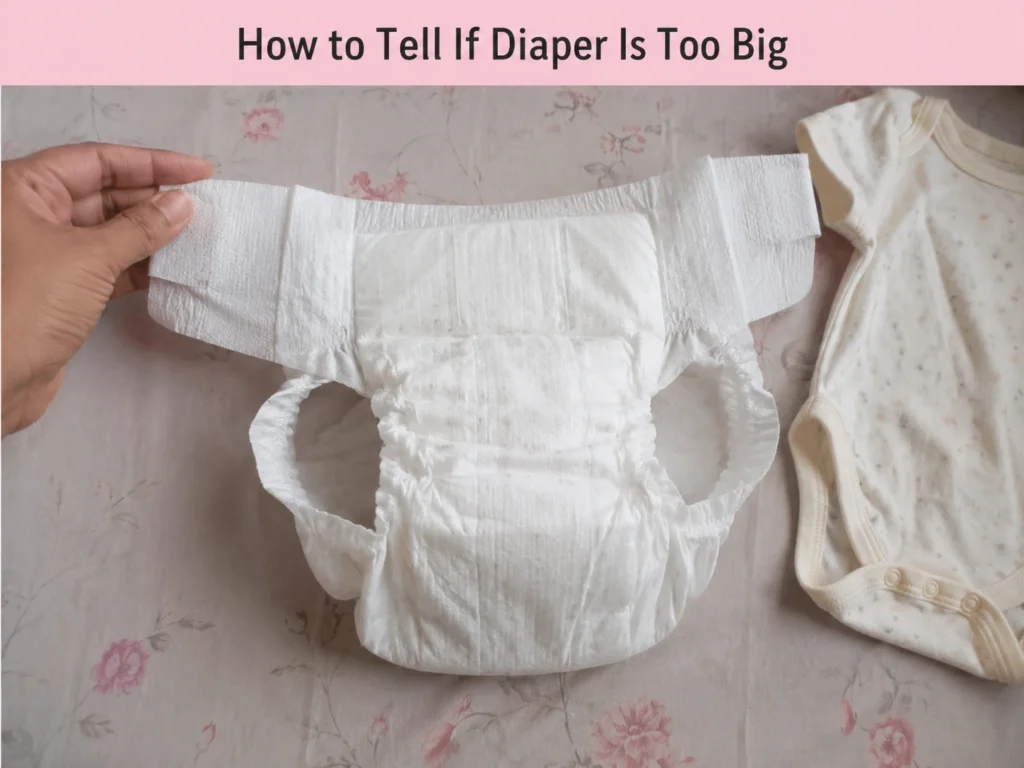
A diaper is too big when it leaks without leaving a mark. That is the signature: gaps you can see at the leg openings, tabs that land well past the center of the waistband, a waistband sitting above the belly button, and a diaper that sags while it is still dry. Pathways.org, the child development nonprofit, gives the clearest single marker, saying the waistband should come up to just under the belly button and that “if it goes over, their diaper may be too big”. The rest of this page is about how the oversized diaper got onto your baby, because that is what usually tells you what to do next.
“I can usually tell a diaper is too big when it looks comfortable but leaves visible gaps around the legs, sags while still dry, or the tabs travel too far across the waist. In my experience, those quiet fit problems often explain leaks better than simply blaming absorbency or moving up another size.”
Too big is a quieter problem, and that is why it lasts
An outgrown diaper argues with you. It leaves pressure lines, the tabs fight you, the waistband slides down the belly. You notice within days.
An oversized diaper does none of that. It goes on easily, it looks comfortable, and it reads as room to grow, which sounds like a good thing. The only symptom is a leak, and a leak has a dozen plausible explanations that all feel more likely than the box being wrong, because you chose that box on purpose. So the overnight stretch gets blamed, then a heavy wetter phase, then the brand. The delay, rather than the leak itself, is the real cost of this one.
The four ways a diaper ends up too big
Unlike a diaper that is too small, an oversized one rarely arrives by accident. Work out which of these four is yours and the fix is usually obvious.
You sized up to stop a leak. Check this one first. If the original leak ran down the thighs, it was a leg cuff problem, and a bigger diaper makes a leg cuff problem worse rather than better.
The night size migrated into the day. Running a larger size overnight is a legitimate strategy, but on a busy morning the wrong stack gets used, and nobody notices for days.
Somebody bought the big box. A gift, a warehouse pack, or a stock-up bought while your baby was in the weight overlap. The box exists, so the diaper gets used.
You switched brands or lines at the same number. Same digit, different cut. A line built for older, more mobile babies is shaped differently at the same size, so the number carried over and the fit did not.
The three signs, and what each one physically means
A visible gap at the leg opening. Straighten your baby’s legs and look at where the cuff meets the thigh. Contact all the way around is the seal, and everything a diaper does depends on it. Pampers describes a correct fit as having “leg cuffs that wrap neatly without gaps”. A gap you can see is not a small failure of that standard, it is the failure, and it explains why a bigger diaper with more capacity can leak sooner than a smaller one. Capacity only counts inside a seal.
Tabs landing well past the center. In a diaper that fits, the tabs meet near the middle without a stretch. When they cross the middle and keep going toward the opposite hip, the waistband has more material than your baby’s waist has circumference, and the excess gathers into folds that channel liquid instead of holding it.
Sagging while still dry. A wet diaper sags because it is heavy, which tells you nothing. A dry one that hangs low between the legs is telling you the rise is longer than the distance it has to cover, and a rise that is too long is the same thing as a low back waistband the moment your baby sits down.
The newborn case, where a big diaper is a different problem
For a baby whose umbilical cord stump has not yet fallen off, an oversized diaper does something more specific than leak: it rides up over the stump.
The American Academy of Pediatrics, on HealthyChildren.org, tells parents to “keep the diaper folded below the cord to keep urine from soaking it”, and says there is no need to use alcohol on the stump, “just keep it clean”. A diaper with too much rise resists being folded down and works its way back up over the stump between changes.
The AAP also gives clear reasons to call. If the cord actively bleeds, “call your baby’s doctor immediately”. Contact your pediatrician if you notice signs of infection, such as foul-smelling discharge, redness of the skin around the base, or crying when the area is touched, and seek medical advice if the stump has not fallen off by three weeks of age. Cord care is a pediatrician conversation, not a diaper-buying decision, and this page is general information rather than medical advice.
When “suddenly loose” is not about the diaper
One scenario deserves separating out, because the answer is not a smaller diaper.
If a size that fit perfectly last week now seems loose, and nothing about the brand, the line or the pack changed, look at your baby rather than the diaper. Diaper output is the signal that matters here. HealthyChildren.org states that by 5 to 7 days old a newborn should “have 6 or more wet diapers per day, with nearly colorless or pale yellow urine”, and that by the same age stools “should be yellow and loose, with small curds”, with at least three or four a day. It also tells parents to schedule the first checkup no more than 48 hours after hospital discharge, because “the weight check at that visit will help to know if your baby is getting enough milk from feedings”.
A drop in wet diapers, or a diaper that has gone loose without anything about the pack changing, is a call to your pediatrician rather than a trip to the store. No fit checklist substitutes for that.
What to do with the box you already bought
You do not have to throw it out, and you should not fasten it tighter to compensate.
Tightening is the instinctive fix and it is the wrong one. It gathers the extra material into ridges against the skin without closing the leg gap, and the AAP notes on HealthyChildren.org that diapers “fastened too tightly can trap moisture, which can cause diaper rash”, adding that a diaper should not be too tight, especially overnight. The oversized box has three honest destinations instead.
Use it overnight, where the extra capacity is genuinely useful and the longer wear time changes the arithmetic. Set it aside until the fit checks pass, which on the upper sizes can be a long wait, because the shared weight bands up there are wide; our page on how the diaper weight overlaps actually work shows how wide each one is. Or reopen the smaller size for daytime, which is a normal correction rather than an admission of error.
Too big or too small: telling them apart in one look
The two failures produce opposite evidence, and one observation separates them. Look at the skin along the elastic lines after a change.
Marks and no gaps means the diaper is too small, and the full diagnosis, including the application faults that imitate it, is in our guide to the signs a diaper is too small. Gaps and no marks means it is too big, and this page is your list. Marks and gaps at the same time, which does happen, usually points at a shape mismatch rather than a size mismatch: the right number, the wrong cut. That case belongs in the wider diaper fit and leak troubleshooting guide, which routes each symptom to the thing that causes it.
FAQ
Can a diaper be too big even if the weight is right?
Yes, and it is common on the upper sizes, where two or three ranges cover the same weight. Weight ranges overlap by design, so your baby can sit squarely inside the range for a size that is still too long in the rise or too wide at the leg. Fit decides, not the number on the pack.
Is a diaper that is too big dangerous?
We could not find an authoritative source describing a safety risk from an oversized diaper in an otherwise healthy baby, so we are not going to claim one. The documented consequences are practical: leaks, and for a newborn a diaper that will not stay folded below the umbilical cord stump, which the AAP asks parents to do. Any specific worry about your baby belongs with your pediatrician.
My baby’s diaper gaps at the legs but the tabs are snug. What is that?
Usually a shape mismatch rather than a size one. Before you change size, pull the leg cuffs out with a finger at the next few changes, because a tucked cuff creates a channel that looks a lot like a gap. If the gap is still visible with the cuffs out and the legs straight, the cut of that line does not match your baby’s thighs, and a different line at the same size number is the change to try.
Should I just size down if I sized up too soon?
Check first, then decide. If the smaller size still fastens near the middle without a stretch, covers the whole bottom lying flat, and leaves no pressure lines, it is still a valid size and going back is reasonable. If the smaller size fails those checks too, the problem is not the size step, it is the fit of both options, and a different line is worth trying.
Sources
- Pathways.org, “When Should You Size Up Baby’s Diaper?”.
- Pampers, “When to Size Up Diapers and Why Fit Matters”.
- HealthyChildren.org (American Academy of Pediatrics), “Umbilical Cord Care in Newborns”, “How to Tell if Your Breastfed Baby is Getting Enough Milk”, and “Why is my baby always getting diaper rashes?”.
This article is general information about diaper fit, not medical advice. Anything involving your baby’s skin, umbilical cord, feeding or weight belongs with your pediatrician.
Author Profile
-
Saima Mostari is the founder and author of BelovedTots. She has raised two young children, Pona and Ruku, and spent years working in child development at Neurosparks, a therapy center that provides Speech Therapy, Occupational Therapy, and ABA Therapy for children with developmental needs.
It was there, watching long therapy sessions get interrupted by leaking, ill-fitting diapers, that she began researching which products actually perform under real-world conditions, not just on the packaging.
She holds a Master's in Psychology and Guidance from the University of Dhaka, and brings a behavioral observation lens to every product she reviews. When she's not testing diapers or writing guides, she's probably negotiating bedtime with a 4-year-old.
Latest entries
- September 30, 2026Diaper Brands and ComparisonsLuvs vs Pampers: P&G’s Budget vs Premium Line
- September 27, 2026Diaper Brands and ComparisonsKirkland Diapers vs Huggies: What’s Different in 2026
- September 26, 2026Diaper Brands and ComparisonsKirkland Diapers Review: What Costco’s Diaper Is Now
- September 24, 2026Diaper Brands and ComparisonsHuggies Little Snugglers vs Snug and Dry: Which Fits?