Swim Diapers and Pull Ups Guide for the Toddler Years

Short answer: this swim diapers and pull ups guide comes down to two products with two different jobs. A swim diaper is for the water only. It does not absorb pee and, per the CDC, may help hold in solid poop but is not leak-proof. Pull-ups, or disposable training pants, are for land. They absorb like a diaper but pull on and off like underwear. Neither replaces the other, and neither is required at a set age. What changes the decision is where your child is (pool or land) and what your child can do (still in diapers, learning, or using the toilet).
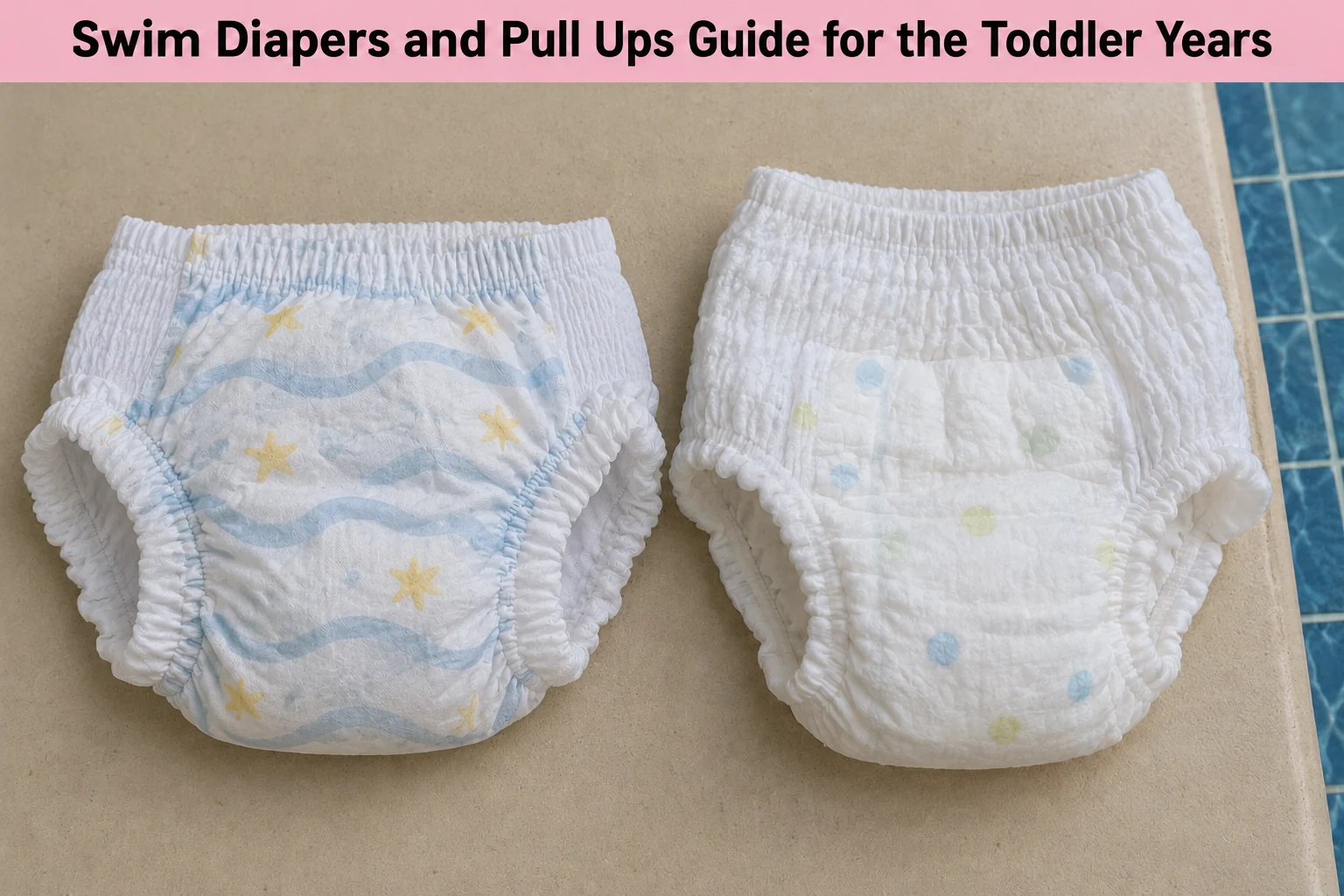
This guide maps the in-between years, from the first pool day to the last pair of training pants, and explains where each product fits and where it falls short.
Swim diapers and pull ups guide: the stages at a glance
Most families meet both products in the same stretch, somewhere between a baby's first summer and the preschool years. The sources below do not tie either product to a birthday, so this map uses stages, not ages.
| Stage | On land | In the water |
|---|---|---|
| Baby or toddler in diapers | Regular diapers | Swim diaper |
| Toddler learning to use the toilet | Underwear, cloth training pants or disposable training pants | Swim diaper, per most pool rules |
| Child reliably using the toilet in the day | Underwear (night is a separate question) | Check the pool's own policy |
The table is a map, not a rule. Pools, swim schools and daycares set their own requirements, and your pediatrician is the right person for questions about your child's development.
"I keep swim diapers and training pants in separate roles when planning an outing. The swim diaper goes on just before entering the water, while an absorbent diaper or training pant is for the journey and the time afterward. I also check the pool's rules and plan regular checks, because a swim diaper does not hold pee or make the water safe when a child has diarrhea."
Part 1: Swim diapers
What a swim diaper does
A swim diaper is built without the absorbent core that a regular diaper relies on. Pampers' swim diaper guide (updated January 16, 2026, read September 27, 2026) says: "Swim diapers don't hold pee because they're designed not to absorb liquid," and describes them as "designed to contain poop and prevent it from entering the water."
The work is done by the fit: snug leg openings and a stretchy waist that stay close to the body while water passes through the fabric.
What a swim diaper cannot do
This is the most important point in the whole swim section. The CDC's Healthy Swimming tips for using swim diapers (last updated May 8, 2024, read September 27, 2026) says: "Swim diapers and swim pants may help hold in solid poop (not diarrhea), but they are not a substitute for frequent diaper changing and bathroom breaks." It adds that they are "not leak-proof" and "do not keep germs, like Cryptosporidium, that can be spread in diarrhea from contaminating the water."
The CDC's routine around them is short:
- Check swim diapers and swim pants about every 60 minutes.
- Change them in a diaper-changing area, away from the poolside.
- "Wash hands after diaper/pants changing to prevent the spread of germs in and around the pool."
- Anyone sick with diarrhea stays out of the water, swim diaper or not.
If your child has diarrhea or seems unwell, that is a reason to call your pediatrician as well as a reason to skip the pool.
Why a regular diaper is not an option
A regular diaper is built to absorb, and in a pool it absorbs pool water. Pampers says a regular diaper in pool water "absorbs liquid immediately and can become heavy, leak, or fall apart," and that you should not put one under a swim diaper either. The mechanism is simple: the absorbent core that locks away urine on land fills with pool water instead.
Disposable or reusable
Swim diapers come in two broad forms. Disposable swim diapers are single-use, like regular diapers. Reusable swim diapers and swim pants are washable fabric garments, usually with snug leg and waist elastic. The CDC's guidance covers "swim diapers and swim pants" together: neither is leak-proof. Some swim schools and pools ask for a particular type or combination, so the pool's policy is the first thing to check before buying.
Swim diaper sizing
Pampers notes that swim diapers are "sized similarly to regular diapers, typically by weight range, but each brand fits a bit differently." The fit test is the same as on land: close at the legs and waist, with no gaps. Our guide on when to size up diapers explains how weight overlaps between sizes work, and the same thinking applies when a child sits between two swim sizes.
Part 2: Pull-ups and training pants
What pull-ups are
Many parents say "pull-ups" for the whole category of disposable training pants, though Pull-Ups is also a specific brand. Other makers sell their own versions, such as Pampers Easy Ups. Pampers' Easy Ups product page (read September 27, 2026) describes the traits the category shares, for its own product:
- They pull on like underwear. Pampers: "Simply pull on, using the stretchy waistband."
- They come off by tearing the sides. Pampers: "Tear at the side seams and gently remove."
- They absorb. Pampers describes "Dual Leak-Guard Barriers around the leg cuffs and Extra Absorbent Channels."
- They are sized in toddler "T" sizes, not diaper numbers. Pampers lists Easy Ups in 2T-3T through 6T-7T.
Those are the maker's own claims about its own product. We have not tested training pants.
Pull-ups vs diapers: the real difference
The main difference is how they go on and off, not what they are made to do. A tab diaper opens flat and is fastened by an adult. A training pant is designed so a child can pull it up and down; Pampers says its "360 stretchy waistband makes it easy for your toddler to pull up and down independently." Both absorb.
That shared absorbency matters in two places. First, it is why training pants are not swimwear: a product described as having "Extra Absorbent Channels" is built to take in liquid, the same property that makes a regular diaper fail in a pool. Second, it sits at the center of the AAP's view on them, below.
What the AAP says about disposable training pants
This is the part most product pages leave out. The AAP's parent site, HealthyChildren.org, in "The Right Age to Potty Train" (last updated May 24, 2022, read September 28, 2026), says: "Diapers and disposable training pants send a message to children that they are not taking over and do not need to learn to use the toilet." Its toilet training tips page (last updated November 6, 2023, read September 28, 2026) says: "When toilet training starts, switch to big-kid underwear." It also notes that some parents "may use cloth training pants, which are a little thicker, to protect children's clothing."
So the pediatric view is more cautious than the shelf suggests. Disposable training pants are a product many families buy, and they have practical uses, but the AAP pages we read do not present them as a daytime training tool. How and when to train is a conversation for you and your pediatrician; this site covers the products, not the method.
Signs that the product question is coming up
HealthyChildren.org says that "In general, children show signs of bladder and bowel control between 18 and 24 months of age." Among the readiness signs it lists are a child who "Is dry at least 2 hours at a time during the day or is dry after naps" and who "Asks to use the toilet or potty-chair."
Those signs are where the diaper, training pant and underwear decision starts to matter. They are not a deadline. Some children stay in diapers well past that window, which is why the largest diaper sizes exist; our page on size 7 and size 8 diapers covers who makes them.
Nights are a separate question
Being dry in the daytime and being dry overnight are different milestones, so the product decision can differ between day and night. If the night problem is leaks rather than timing, our guide on why diapers leak at night covers the fit side. Questions about night wetting in an older child belong with your pediatrician.
Part 3: Where the two products meet
Can a toddler in training pants wear them in the pool?
Training pants are not swim products. Pampers says of swim diapers that "Most public pools require swim diapers for any baby or toddler who isn't fully potty-trained." A child in training pants on land is, by that description, usually a child who still needs a swim diaper in the water. The swim diaper goes on right before swimming, and the training pants go back on afterward.
When does a child stop needing a swim diaper?
No source we read gives an age. The pool's rules decide it, and Pampers' description suggests pools tie it to being fully potty-trained. Ask the pool or swim school directly before the first session without one.
What to pack for a pool day in the in-between years
- Swim diapers or swim pants, more than you think you need, since the CDC advises checking about every 60 minutes.
- Regular diapers or training pants for before and after.
- A change of clothes and a bag for wet or soiled items.
- Anything your pool's policy requires.
The questions this stage raises
Each of these gets its own answer as the series grows, but the short versions follow from everything above:
- Swim diaper vs regular diaper: one fails in water, the other fails on land.
- How swim diapers work: they hold solids for a while, not pee and not diarrhea.
- Disposable vs reusable swim diapers: start with what your pool requires.
- Swim diaper sizes: sized by weight like regular diapers, with brand-to-brand differences.
- Pull-ups vs diapers: same absorbency idea, different way on and off.
- When to switch to pull-ups: a product decision that follows readiness, not a birthday.
- Pull-ups sizes: toddler T sizes, not diaper numbers.
The honest summary
- A swim diaper is for water only, holds no pee, and is not leak-proof, per the CDC.
- A regular diaper is for land only, and fails in water, per Pampers.
- Training pants are a land product that absorbs like a diaper and pulls on like underwear.
- The AAP pages we read favor underwear or cloth training pants over disposable training pants during daytime training.
- Pools, swim schools and daycares set their own rules. Check them first.
- Your pediatrician is the right person for questions about readiness, illness or night wetting.
FAQ
What is the difference between swim diapers and pull-ups?
A swim diaper is built not to absorb, so it can be worn in water; Pampers says it does not hold pee. Pull-ups and other training pants are built to absorb like a diaper and are meant for land. Neither replaces the other.
Can you use pull-ups as swim diapers?
Training pants are made to absorb, which is the property that makes a regular diaper swell and fail in pool water. Swim diapers are the product designed for the water, and Pampers says most public pools require them for children who are not fully potty-trained.
At what age do kids stop wearing swim diapers?
No source we read sets an age. Pampers says most public pools require swim diapers for any baby or toddler who isn't fully potty-trained, so your pool's policy decides it.
Does the AAP recommend pull-ups for potty training?
The HealthyChildren.org pages we read say that diapers and disposable training pants send a message that children do not need to learn to use the toilet, and suggest switching to underwear when training starts, with cloth training pants as an option some parents use. Your pediatrician can advise on your child.
Are swim diapers leak-proof?
No. The CDC says swim diapers and swim pants are not leak-proof and do not keep diarrhea germs out of the water. It advises checking them about every 60 minutes and changing them away from the poolside.
Author Profile
-
Eamin Hosen is the founder and author of BelovedTots. He has raised two young children, Pona and Ruku, and spent years working in child development at Neurosparks, a therapy center that provides Speech Therapy, Occupational Therapy, and ABA Therapy for children with developmental needs.
It was there, watching long therapy sessions get interrupted by leaking, ill-fitting diapers, that he began researching how products perform during everyday use and where their performance falls short of packaging claims.
He holds a Master’s in Psychology and Guidance from the University of Dhaka and brings a behavioral observation lens to every product he reviews. When he’s not testing diapers or writing guides, he’s probably negotiating bedtime with a 4-year-old.
Latest entries
- November 13, 2026Diaper Brands and ComparisonsBamboo Diapers: Viscose, Rayon and the Box Claims
- November 12, 2026Diaper Rash and SkinHypoallergenic Diapers: What the Word Really Promises
- November 11, 2026Diaper Brands and ComparisonsChlorine Free Diapers Meaning: TCF vs ECF Explained
- November 10, 2026Diaper Brands and ComparisonsEco Friendly Diapers: What the Labels Actually Mean