
Swim Diaper vs Regular Diaper: Why Not in the Pool

Short answer: in the swim diaper vs regular diaper question, the two do opposite jobs. A regular diaper is built to soak up liquid, so in a pool it soaks up pool water. Pampers says a regular diaper in pool water "absorbs liquid immediately and can become heavy, leak, or fall apart." A swim diaper is built not to absorb at all. It is meant to help hold in solid poop while water passes through. The catch the CDC adds: swim diapers are not leak-proof either, so neither one makes the water clean on its own.
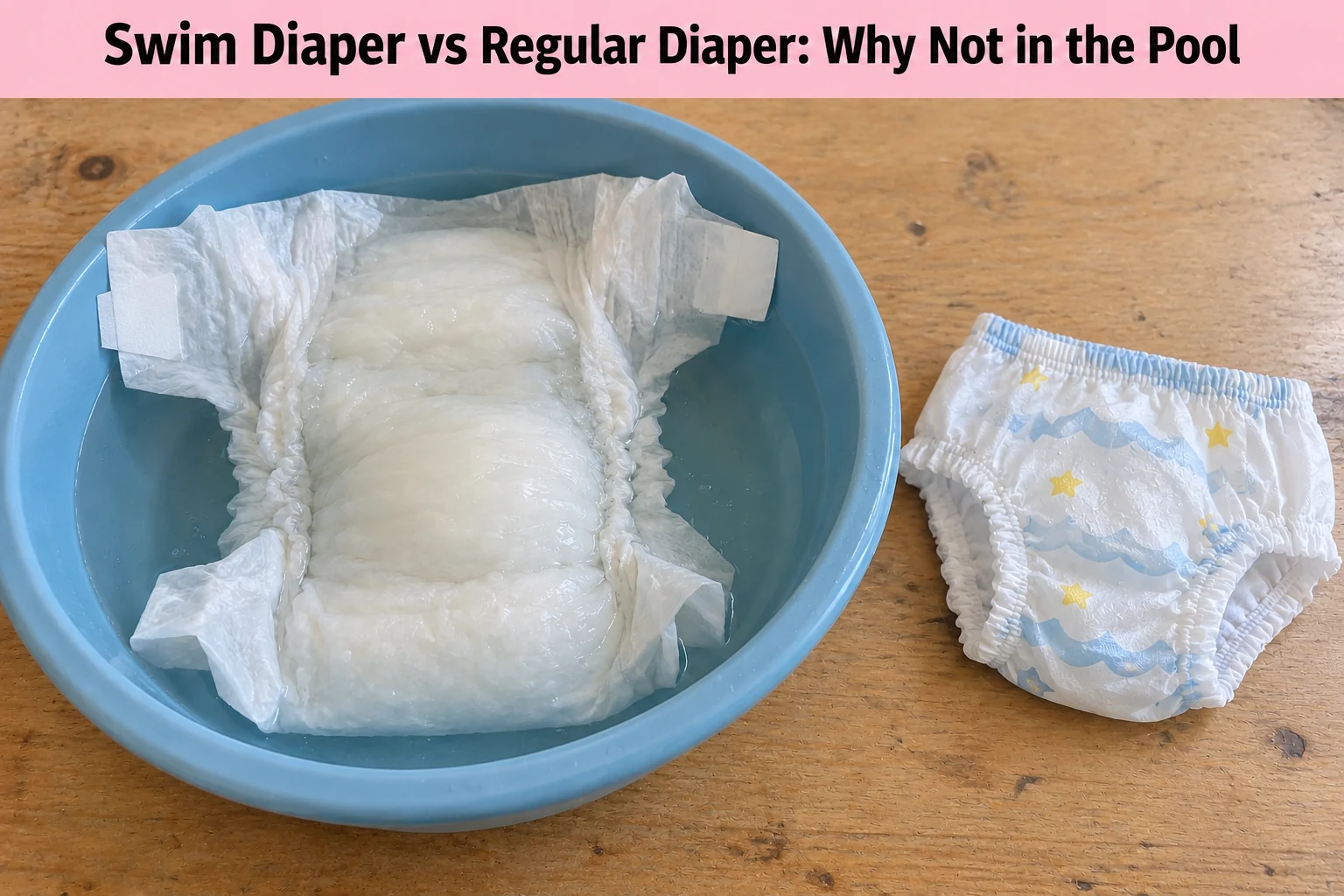
Below is the mechanism behind each, what the CDC says to do at the pool, and why a swim diaper is just as wrong on dry land.
Why a regular diaper fails in water: the core
Every disposable diaper is built around an absorbent core. Pampers' own page on what goes into its diapers (updated June 18, 2026, read September 27, 2026) describes that core as a "super-absorbent gel material (also known as super-absorbent polymers or polyacrylate)" that "is dry and granular, like sugar, but forms a gel as it absorbs liquid quickly." It says the material "can retain up to 30 times its weight in liquid."
On land, that is exactly what you want. A baby pees, the gel locks it away, the skin stays drier.
In a pool, the same gel has no way to tell urine from pool water. It starts drawing in water once the diaper goes under. Pampers' guide to swim diapers (updated January 16, 2026, read September 27, 2026) describes the result: the diaper "can become heavy, leak, or fall apart."
A heavy, swollen diaper also changes the fit. Extra weight can drag the waist down and pull the leg openings away from the thighs, which is the same gap that causes leaks on land. Our guide to why diapers leak at the legs explains that seal in detail. In the water, a sagging diaper cannot hold anything in, which defeats the only reason to have one on.
"The distinction I keep in mind is absorbency: the core that makes a regular diaper useful on land is what makes it swell in the pool. I would pack a separate swim diaper and change back into an absorbent product afterward, rather than layer a regular diaper underneath. A swim diaper still needs frequent checks and does not make swimming with diarrhea acceptable."
How a swim diaper is built differently
A swim diaper drops the thing that makes a regular diaper work: the absorbent core. Pampers says it plainly: "Swim diapers don't hold pee because they're designed not to absorb liquid." Its Splashers product is described as having a "No Swell Core" that "Won't swell in water."
Without a core to fill up, the swim diaper stays close to its dry size and weight. What is left to do the work is the fit:
- Leg openings that sit close against the thighs.
- A stretchy waist. Pampers lists a "360-degree stretchy waistband" and "Dual leak-guard barriers" for Splashers.
- Material that lets water through instead of trapping it.
Pampers describes the swim diaper as "designed to contain poop and prevent it from entering the water." That is the whole job: solids, not liquid.
Swim diaper vs regular diaper: side by side
| Regular disposable diaper | Swim diaper | |
|---|---|---|
| Built to | Absorb and hold urine | Not absorb; help hold in solid poop |
| Absorbent core | Yes, super-absorbent gel | No (Pampers Splashers: "No Swell Core") |
| In pool water | Soaks up water; Pampers says it can get heavy, leak or fall apart | Stays close to dry size |
| Holds pee? | Yes, on land | No, per Pampers |
| Holds diarrhea? | Not in water | No. The CDC says swim diapers may help with solid poop "(not diarrhea)" |
| Right place to wear it | On land | In the water, put on right before swimming |
What the CDC says a swim diaper cannot do
This is the part most product pages leave soft, and it matters more than which diaper you pick.
The CDC's Healthy Swimming tips for using swim diapers (last updated May 8, 2024, read September 27, 2026) says: "Swim diapers and swim pants may help hold in solid poop (not diarrhea), but they are not a substitute for frequent diaper changing and bathroom breaks." It adds that they are "not leak-proof" and "do not keep germs, like Cryptosporidium, that can be spread in diarrhea from contaminating the water."
The CDC's page on preventing diarrheal illnesses at pools (last updated May 19, 2025, read September 27, 2026) explains why that matters:
- "Diarrhea is the most common illness linked to water we swim in."
- "If someone has a diarrhea accident in the water, millions of diarrhea-causing germs can get in the water."
- "Crypto can stay alive for more than 7 days, even if pool water is properly disinfected."
- "Swallowing even a small amount of water containing germs can make you sick."
So the honest framing is not "swim diaper good, regular diaper bad." It is this: a regular diaper cannot work in water at all, and a swim diaper helps only with solids, only for a while, and only alongside the routine below.
The pool routine the CDC describes
The CDC's swim diaper and diarrheal illness pages set out a short routine for caregivers:
- Check often. The CDC says to check swim diapers and swim pants frequently, about every 60 minutes. Pampers suggests checking every 30 to 60 minutes for accidents.
- Change away from the water. The CDC says to change them in a diaper-changing area, away from the poolside, and its illness page says to "Change diapers away from the pool to help keep germs out of the water."
- Wash hands after. "Wash hands after diaper/pants changing to prevent the spread of germs in and around the pool."
- Stay out with diarrhea. The CDC says anyone sick with diarrhea should stay out of the water, whether or not they wear swim diapers or swim pants. After Crypto, its illness page says not to go back in the water "until 2 weeks after your diarrhea has completely stopped."
- Take bathroom breaks. For children who use the toilet, the CDC says to "Regularly take kids to the bathroom so they don't have to go in the water."
If your child has diarrhea or seems unwell, that is also a reason to check in with your pediatrician, separate from the pool question.
Do you wear a regular diaper under a swim diaper?
This is the most common follow-up, and the maker's answer is no. Pampers says you don't need, and shouldn't use, a regular diaper under a swim diaper. The same core that fails on its own in the pool fails under a swim diaper too: it fills with water and swells, and the swim diaper on top cannot change that.
Why a swim diaper is wrong on land, too
The mismatch runs both ways. Because a swim diaper has no absorbent core, Pampers says it does not hold pee. On a beach blanket or in a car seat on the way home, a swim diaper will let urine straight through. Pampers suggests putting the swim diaper on "right before entering the water."
A practical packing list therefore has both: swim diapers for the water, regular diapers for before and after, and a change of clothes. Pampers notes that swim diapers are "sized similarly to regular diapers, typically by weight range, but each brand fits a bit differently." If you are unsure how sizes line up between brands, our cross-brand diaper size comparison helps.
Safety beyond the diaper
A diaper is a hygiene question. Water is a safety one. The AAP's HealthyChildren.org page on infant water safety (last updated May 18, 2026, read September 27, 2026) tells parents never to leave a baby alone, or in the care of another young child, in or near water, even for a moment. It describes touch supervision, keeping a hand on the baby, as the standard around water.
No diaper choice changes that. Nor does a swim diaper make it fine to change a baby at the pool's edge, which the CDC specifically advises against.
Check your pool's policy
Public pools, swim schools and water parks set their own rules about swim diapers and swim pants. Ask before you go, especially for swim lessons, so you arrive with what they require.
A quick way to remember it
- Regular diaper: absorbs. Good on land, bad in water.
- Swim diaper: does not absorb. Helps with solids in water, bad on land.
- Neither: makes the water safe from diarrhea germs. That part is the routine: check hourly, change away from the pool, wash hands, stay out when sick.
If poop regularly escapes a regular diaper at home too, the fit may be the issue rather than the product. Our guide to diaper blowouts up the back covers the land version of the problem.
FAQ
Can I use a regular diaper in the pool?
No. Pampers says a regular diaper in pool water "absorbs liquid immediately and can become heavy, leak, or fall apart." Its absorbent core fills with pool water, so it stops fitting and stops holding anything in.
Does a swim diaper hold pee?
No. Pampers says swim diapers "don't hold pee because they're designed not to absorb liquid." They are meant to help contain solid poop.
Are swim diapers leak-proof?
No. The CDC says swim diapers and swim pants are "not leak-proof" and do not keep diarrhea germs such as Cryptosporidium out of the water. It advises checking them about every 60 minutes and changing them away from the poolside.
Should I put a regular diaper under a swim diaper?
Pampers says you don't need, and shouldn't use, a regular diaper under a swim diaper. The regular diaper's core would still fill with water.
Can my baby swim with diarrhea if they wear a swim diaper?
The CDC says anyone sick with diarrhea should stay out of the water, whether or not they use swim diapers. Swim diapers may help with solid poop, not diarrhea. Your pediatrician can advise on the illness itself.
Author Profile
-
Eamin Hosen is the founder and author of BelovedTots. He has raised two young children, Pona and Ruku, and spent years working in child development at Neurosparks, a therapy center that provides Speech Therapy, Occupational Therapy, and ABA Therapy for children with developmental needs.
It was there, watching long therapy sessions get interrupted by leaking, ill-fitting diapers, that he began researching how products perform during everyday use and where their performance falls short of packaging claims.
He holds a Master’s in Psychology and Guidance from the University of Dhaka and brings a behavioral observation lens to every product he reviews. When he’s not testing diapers or writing guides, he’s probably negotiating bedtime with a 4-year-old.
Latest entries
- November 13, 2026Diaper Brands and ComparisonsBamboo Diapers: Viscose, Rayon and the Box Claims
- November 12, 2026Diaper Rash and SkinHypoallergenic Diapers: What the Word Really Promises
- November 11, 2026Diaper Brands and ComparisonsChlorine Free Diapers Meaning: TCF vs ECF Explained
- November 10, 2026Diaper Brands and ComparisonsEco Friendly Diapers: What the Labels Actually Mean