Eco Friendly Diapers: What the Labels Actually Mean

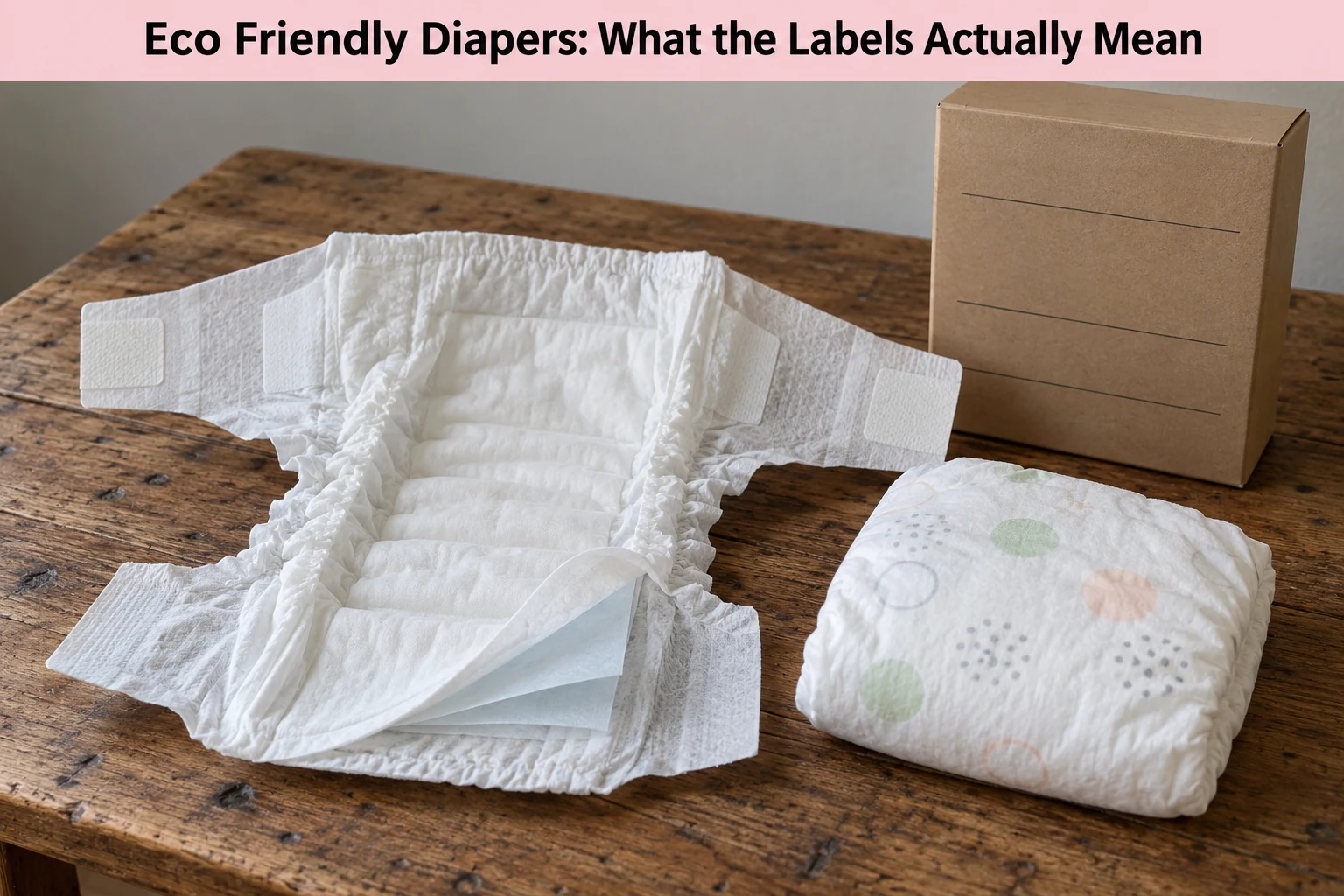
"Eco friendly" is not a standard on a diaper box. The FTC's Green Guides, in their October 2012 summary, say marketers should not make unqualified claims like "green" or "eco-friendly," because they are hard to substantiate. A general claim has to be qualified with a specific, clear benefit. So the useful question is never "is this diaper eco friendly?" but "which specific claim is on the box, and what does it cover?" Chlorine-free, plant-based, biodegradable, compostable and non-toxic are five different claims with five different tests.
This page decodes each one, section by section.
Eco friendly diapers: what the word itself promises
The FTC's Green Guides summary (published October 2012, read October 3, 2026) says three things that matter in the diaper aisle:
- A broad claim like "eco-friendly" needs to be qualified with a specific benefit.
- Pointing at one small benefit while implying a big one is deceptive, and marketers are expected to weigh trade-offs when they claim an overall environmental advantage.
- Claims about biodegradability, compostability and "free-of" statements each have their own conditions.
That is guidance for marketers, not a seal a diaper earns. It does not tell you a given box is accurate. It tells you what a careful claim should look like, which makes it a usable yardstick for reading one.
"I look for the specific claim behind an eco-friendly label: which layer it covers, what standard can be checked, and what disposal route is actually available. Plant-based content, pulp bleaching, and compostability answer different questions, so I do not let one stand in for the others. I also keep those environmental questions separate from whether the diaper fits well or suits a baby's skin."
The two audiences behind every label
Most eco diaper wording is written for one of two readers, and the box often lets one claim quietly stand in for the other.
Claims about the planet (pulp sourcing, plant-based content, biodegradable, compostable) fall under the FTC's environmental-claims guidance.
Claims about a baby's skin (hypoallergenic, non-toxic, "clean," fragrance-free) are a different question. The American Academy of Pediatrics' HealthyChildren.org diaper rash page (dated 12/18/2024, read October 3, 2026) says babies with sensitive skin may have an allergic reaction to a specific ingredient in diapers, wipes or creams, and names dyes or elastics in the diaper, and fragrances or preservatives in wipes or creams, as common allergens. It does not say that an environmental claim lowers that risk, and neither does any source cited here.
A box that says "plant-based" has told you about materials. It has not told you anything about skin. Keeping the two columns apart is the single most useful habit for reading this aisle.
Label decoder: what each claim can and cannot mean
| Label on the box | What it can mean | What it does not tell you | Covered in |
|---|---|---|---|
| Eco-friendly / green | Nothing fixed. Needs a specific qualifier. | Which part of the diaper, which benefit, compared to what. | Section above |
| Chlorine-free | How the wood pulp in the core was bleached. | Anything about the other materials, or whether TCF or ECF was used, unless the box says. | Chlorine-free section |
| Plant-based | Some share of materials come from plants. | Which layer, what share, or how the plant fiber was processed. | Plant-based section |
| Bamboo | A bamboo-derived fiber, usually processed. | Whether it is bamboo fiber or rayon/viscose made from bamboo. | Plant-based section |
| Biodegradable | The material can break down under some conditions. | How long, where, or whether a landfill provides those conditions. | Biodegradable section |
| Compostable | Breaks down in a composting process. | Whether a composting service reaches you. | Biodegradable section |
| Non-toxic / clean | A marketing word. | What was tested, against what standard. | Non-toxic section |
| Hypoallergenic | A marketing word with no federal definition (FDA, for cosmetics). | Whether a baby will react or not. | Skin section |
Chlorine-free: a claim about pulp bleaching
On a diaper box, "chlorine-free" refers to how the wood pulp that makes up part of the absorbent core was bleached. Two terms are in play: TCF (totally chlorine free) and ECF (elemental chlorine free). Coterie's explainer (read October 3, 2026) defines TCF as no chlorine or chlorine derivatives, and ECF as no elemental chlorine but bleaching with chlorine dioxide. Makers sit on both sides of this and each argues for its own choice, so the exact wording on the box is worth reading closely. A box that says only "no chlorine bleaching" has not told you which of the two it means.
Plant-based and bamboo: a material, not a result
"Plant-based" says some materials come from plants. It does not say how much, which layer, or that the diaper is better for skin or for the planet. One check that exists is the USDA Certified Biobased Product label, which the USDA's BioPreferred page (read October 3, 2026) describes as assuring that a product contains a verified amount of renewable biological ingredients, third-party certified. The page does not describe what the label says about processing or end-of-life.
Bamboo is its own decoding job. The FTC says that when bamboo has been chemically processed into rayon or viscose, no trace of the original plant is left, and its consumer page on bamboo fabrics (December 2022, read October 3, 2026) says that process is far from eco-friendly. That guidance is about fabric, but it shows why "bamboo" on a box is a material name worth asking about.
Biodegradable and compostable: conditions decide everything
The Green Guides summary says an unqualified "biodegradable" claim needs evidence that the entire product will completely break down and return to nature within a reasonably short period after customary disposal, which the summary puts at one year. It adds that products headed for landfills, incinerators or recycling facilities will not meet that standard, so unqualified claims should not be made for them.
For "compostable," the same summary says marketers need evidence that all materials break down into usable compost safely and in about the same time as the surrounding materials. It says the claim must be qualified if the product cannot be composted at home or in a timely way, or if municipal or institutional composting facilities are not available to a substantial majority of consumers.
Read together, those two statements make a plain reading rule. "Biodegradable" with no conditions on a product that goes in household trash is a claim to question. "Compostable" is a claim about a process, and whether that process exists where you live is a separate fact.
"Non-toxic" and "clean": what the FTC expects behind the words
The Green Guides summary says a non-toxic claim requires competent and reliable scientific evidence that the product is safe for people and the environment. The summary does not address "clean" at all. Neither word tells you which substances were excluded or which tests were run. Where a box lists what it is made without, the Green Guides' "free-of" section applies: such a claim can be deceptive if the product lacks one substance but contains another that poses a similar risk.
What certifications can and cannot show
A certification mark is a stronger signal than a slogan, because someone outside the company set the test. It is still narrower than it looks. OEKO-TEX STANDARD 100, per its own page (read October 3, 2026), is a label for textiles tested for harmful substances, against a list of over 1,000, with infant items in the strictest product class. The label can be verified by QR code or by entering the certificate number in its Label Check tool.
Two things follow. A certification covers what it tests, so a mark about textile components does not speak to pulp bleaching or disposal. And a certificate number can be checked, while a logo alone cannot.
What the claims do not answer: skin
Eco labels do not settle whether a diaper suits a particular baby's skin. For rash, the AAP page above lists when to contact the doctor, including a rash that persists beyond 2 to 3 days of treatment, or one with blisters, pus-filled sores, crusting, severe pain or fever. If a rash is a worry, that is a conversation for your pediatrician, not a decision to make from a box. Our guide to what diaper rash is and when to call lays out the escalation criteria first, and our look at what the box claims on sensitive-skin diapers applies the same label-reading approach to skin wording.
A short checklist for reading any box
- Is the claim specific, or is it only "eco" or "clean"?
- Does it say which part of the diaper it covers: pulp, topsheet, film, whole product?
- Is there a certificate number or a named standard you can look up?
- For compostable, is there a named service, and does it serve your area?
- Does the maker publish a full materials or ingredient list?
The same questions work across every maker covered on our diaper brands page, which sorts out which lines make which claims.
FAQ
Is there a legal definition of "eco friendly" for diapers?
Not in the sources read here. The FTC's Green Guides summary (October 2012) says broad claims like "eco-friendly" should be qualified with a specific benefit, rather than defining the term.
Does "plant-based" mean a diaper is biodegradable?
No. Plant-based describes where some materials come from. Biodegradable and compostable are separate claims with their own conditions, per the FTC Green Guides summary.
Does a compostable diaper compost in my trash?
The Green Guides summary says a compostable claim should be qualified if composting facilities are not available to a substantial majority of consumers. Whether one reaches you is a local fact to check with the maker.
Do eco friendly diapers cause fewer rashes?
The sources cited here do not say so. The AAP names dyes, elastics, fragrances and preservatives as common allergens in diapers, wipes and creams, and lists persistent or severe rash as a reason to contact the pediatrician.
What should I look for on a box instead of "eco friendly"?
Specific claims with named standards, such as a certificate number, a named composting service or a materials list, plus the maker's own explanation of which layer each claim covers.
Author Profile
-
Eamin Hosen is the founder and author of BelovedTots. He has raised two young children, Pona and Ruku, and spent years working in child development at Neurosparks, a therapy center that provides Speech Therapy, Occupational Therapy, and ABA Therapy for children with developmental needs.
It was there, watching long therapy sessions get interrupted by leaking, ill-fitting diapers, that he began researching how products perform during everyday use and where their performance falls short of packaging claims.
He holds a Master’s in Psychology and Guidance from the University of Dhaka and brings a behavioral observation lens to every product he reviews. When he’s not testing diapers or writing guides, he’s probably negotiating bedtime with a 4-year-old.
Latest entries
- November 13, 2026Diaper Brands and ComparisonsBamboo Diapers: Viscose, Rayon and the Box Claims
- November 12, 2026Diaper Rash and SkinHypoallergenic Diapers: What the Word Really Promises
- November 11, 2026Diaper Brands and ComparisonsChlorine Free Diapers Meaning: TCF vs ECF Explained
- November 10, 2026Diaper Brands and ComparisonsEco Friendly Diapers: What the Labels Actually Mean