
Diaper Rash: What It Is, What Helps, and When to Call

Most babies get diaper rash. It is common, it is usually manageable at home, and there are specific circumstances in which it is not.
Those circumstances come first on this page, because a parent looking at an angry-looking rash at eleven at night needs the escalation criteria before the explanation.
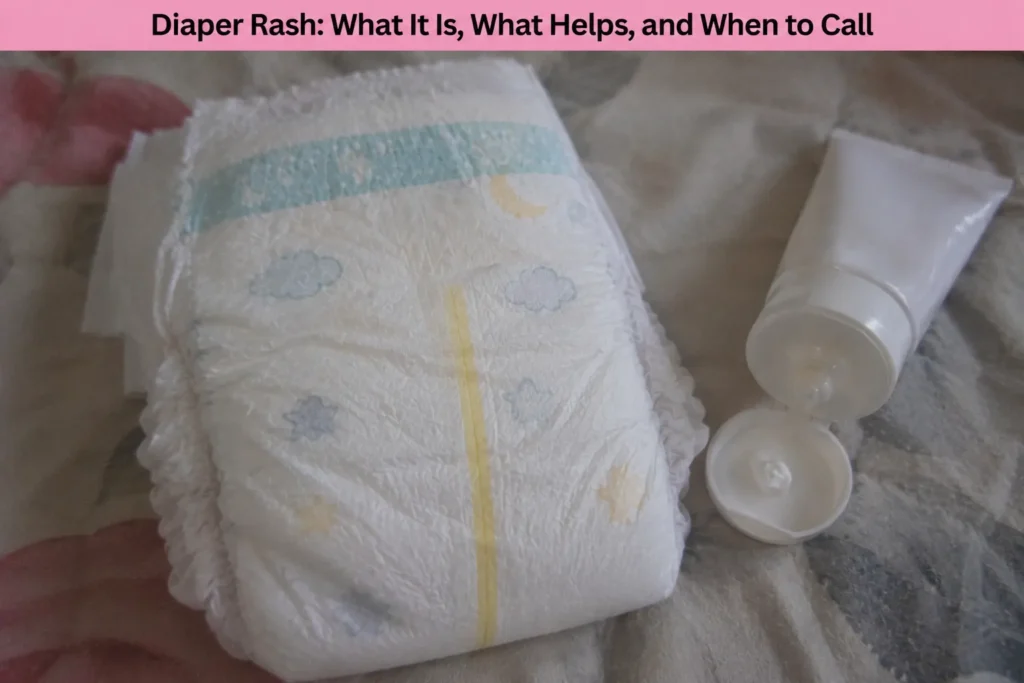
“I’ve dealt with mild diaper-area redness that improved once I became more deliberate about frequent changes, keeping the skin clean and dry, and using a proper barrier layer instead of constantly trying different products. What mattered most to me, though, was learning when to stop treating it as an ordinary diaper rash. If the skin is getting worse, looks blistered, peeling, oozing or unusually painful, lasts despite care, or comes with fever, I would rather call the pediatrician than try to diagnose the cause myself.”
When the AAP says to call your doctor
The American Academy of Pediatrics, on its HealthyChildren.org page “Common Diaper Rashes & Treatments” (last updated 12/18/2024), advises contacting your doctor if:
- “The rash is not going away, or it is getting worse after two to three days of treatment”
- “The rash includes pimples, peeling skin, blisters, pus-filled or oozing or crusty sores”
- “Your baby is taking an antibiotic medicine and develops a bright pink or red rash”
- “The rash is especially painful” or is accompanied by fever
That is the AAP’s list, quoted. This site publishes no list of its own alongside it, and it does not add to it, subtract from it or rank the items. If what you are looking at matches any of them, that is the answer, and the call is the next step rather than more reading.
If you are unsure whether what you are seeing matches, call. Uncertainty is a reason to ask somebody who can look, not a reason to keep searching.
What the AAP says causes it
The same page identifies several distinct causes, and the distinction matters because they are not the same problem.
Irritant dermatitis, which is the ordinary and by far the most common one. The AAP describes the mechanism directly: “The diaper area spends much of the day in contact with two very irritating substances: urine and stool.”
Yeast infection, which the AAP describes as “caused by overgrowth of a type of fungus found naturally in the digestive tract”.
Bacterial infection, which the AAP attributes to staph or strep bacteria.
Allergies, which the AAP describes as an “allergic reaction to a specific ingredient in diapers, wipes and/or creams”.
This page does not tell you which one you are looking at, and no page can. Telling those apart from a description, or from a photograph on the internet, is guesswork, and the consequence of guessing is treating for the wrong thing while the right thing continues. That determination belongs to your pediatrician, and the AAP’s criteria above include the situations where it most matters.
The antibiotic item on the AAP’s call-your-doctor list is worth reading in that light: it is on the list because that combination points somewhere specific.
What the AAP lists as prevention and treatment
The AAP’s guidance on the same page includes:
- “Change diapers frequently”, to prevent moisture damage and chemical breakdown
- “Coat the skin with a thick layer of barrier paste”, using zinc oxide or petrolatum
- “Choose a highly absorbent diaper”, to keep skin dry
- “Keep the area clean”, with daily baths during irritation
Three notes on reading that list.
“Frequently” is the AAP’s word, and it is not an interval. We looked for a published change-frequency figure on the AAP’s own diapers page (last updated 5/17/2021) on 2026-08-28 and did not find one. That page does say cloth diapers “need to be changed more frequently” than disposables, and that with disposables “your baby’s skin has less contact with pee and poop.” So this site publishes no number of hours. How often to change a newborn diaper covers the practical version and where the night decision belongs.
Zinc oxide and petrolatum are ingredients the AAP names, not products this site recommends. No brand appears on this page, no percentage is stated, and nothing is ranked. What each barrier ingredient does, and how to read what is printed on a tube, are their own subjects.
“A thick layer” is the AAP’s own phrasing, and it is worth noticing because the instinct is to rub a thin film in. The AAP’s word is coat.
Why the diaper itself is part of the picture
The AAP names urine and stool as the irritants and lists a highly absorbent diaper among its prevention items. That puts this rash cluster and this site’s fit cluster on the same problem from two directions.
A diaper that leaks is a diaper that is not keeping skin dry, and a leak is usually a seal failure rather than an absorbency failure. The single most common free fix is untucking the leg cuffs at every change, because a ruffle folded inward wicks liquid out rather than containing it: cuff flipping and the leg ruffle trick covers it, and the diaper fit and leaks guide covers the wider diagnosis.
A diaper that is too small also concentrates pressure and rubbing at the waist and thighs, which is a separate mechanical irritation from the chemical one. How to tell if a diaper is too small covers the signs, including persistent red marks.
One thing this page will not do is tell you which brand is gentler on skin. The AAP names an ingredient in a diaper, wipe or cream as a possible allergic trigger, and identifying which ingredient is affecting a particular baby is a clinical question rather than a shopping one.
The absence worth knowing about
While we are being straight about what is knowable: on 2026-08-24 this site checked the consumer pages of both major US brands for a published absorbency capacity figure, in milliliters or grams, and neither publishes one.
That matters here because the AAP’s guidance includes choosing a highly absorbent diaper, and there is no published figure by which to compare absorbency between products. So any page ranking diapers by absorbency for rash-prone skin is comparing claims, not measurements.
Huggies’ consumer and healthcare pages returned access errors to our fetcher on 2026-08-24. That is our retrieval failing, not the company withholding anything.
What this pillar does not do
It does not diagnose. It does not name a cream. It does not rank products. It does not tell you how long to wait.
Those are not gaps left for later. They are the boundary this site works inside, and the reason is straightforward: a page cannot see your baby, and the difference between the four causes the AAP names is the difference between treatments that work and treatments that do not.
What this page can do is give you the AAP’s own words, dated, so you can act on them or take them to the person who can examine your child.
The short version
- The AAP’s when-to-call criteria are quoted at the top of this page. If what you see matches, call.
- The AAP names four kinds of cause: irritant, yeast, bacterial and allergic. This page will not tell you which is yours.
- Its prevention guidance is frequent changing, a thick layer of barrier paste using zinc oxide or petrolatum, a highly absorbent diaper, and keeping the area clean.
- “Frequently” is the AAP’s word. We found no published interval and do not supply one.
- Fit and leaks are part of keeping skin dry, and the leg cuffs are the most common free fix.
- No brand, no product, no dose, no ranking. Your pediatrician decides what this is.
Author Profile
-
Saima Mostari is the founder and author of BelovedTots. She has raised two young children, Pona and Ruku, and spent years working in child development at Neurosparks, a therapy center that provides Speech Therapy, Occupational Therapy, and ABA Therapy for children with developmental needs.
It was there, watching long therapy sessions get interrupted by leaking, ill-fitting diapers, that she began researching which products actually perform under real-world conditions, not just on the packaging.
She holds a Master's in Psychology and Guidance from the University of Dhaka, and brings a behavioral observation lens to every product she reviews. When she's not testing diapers or writing guides, she's probably negotiating bedtime with a 4-year-old.
Latest entries
- September 30, 2026Diaper Brands and ComparisonsLuvs vs Pampers: P&G’s Budget vs Premium Line
- September 27, 2026Diaper Brands and ComparisonsKirkland Diapers vs Huggies: What’s Different in 2026
- September 26, 2026Diaper Brands and ComparisonsKirkland Diapers Review: What Costco’s Diaper Is Now
- September 24, 2026Diaper Brands and ComparisonsHuggies Little Snugglers vs Snug and Dry: Which Fits?