
Diaper Blowouts Up the Back: Causes and What Prevents Them

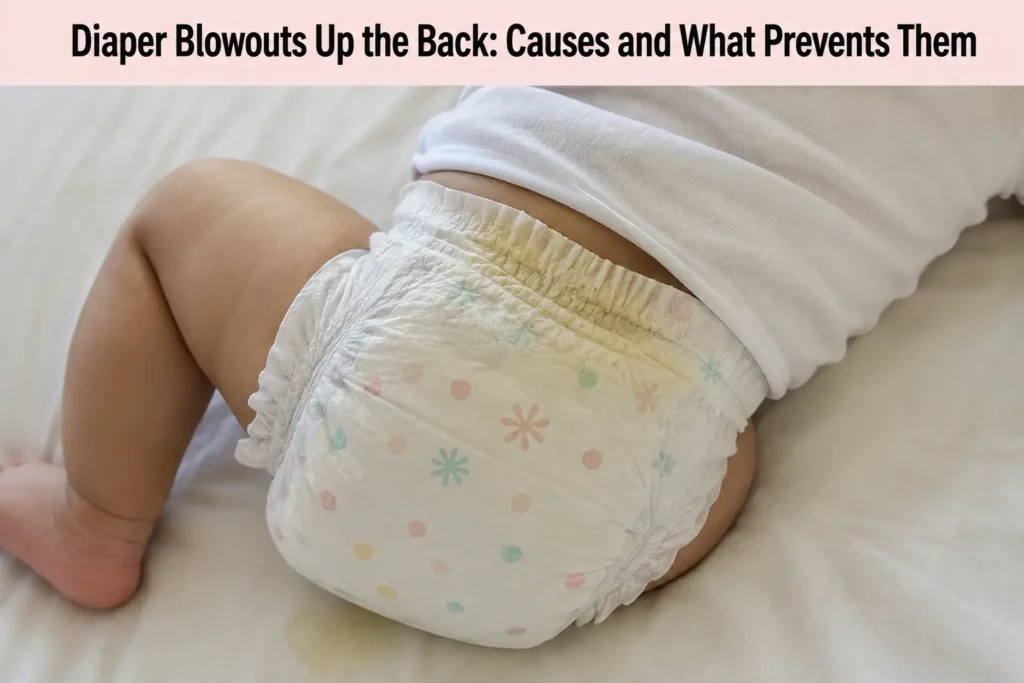
A blowout up the back happens when three things line up: a gap at the back waistband, a baby lying or reclining so that the back of the diaper is the lowest point, and stool that is liquid enough to travel. Fix the gap first, because it is free and it is the one you control. Raise the back panel higher than the front before you fasten, then check that the tabs are level and the leg cuffs are pulled out, then look at whether the diaper was already full before the mess happened. Size is the fourth thing to check, not the first, and buying a bigger diaper for a gap problem often makes the gap worse.
A note before the fixes. This page is about how a diaper sits. It is not medical advice and it does not diagnose anything. If there is blood in the stool, or your baby has a fever, or the stools have suddenly turned watery and frequent and stayed that way, that belongs with your pediatrician rather than with a fit checklist. The escalation section near the end quotes what the American Academy of Pediatrics actually says about that.
Manufacturer guidance below was read 2026-08-24. Pediatric guidance was read 2026-08-26.
“With blowouts up the back, I start by checking how the diaper sits rather than immediately moving to a larger size. I look for enough back coverage, an even waistband, properly positioned tabs, and cuffs that are fully pulled out. A secure back seal can often prevent the problem without changing the diaper size at all.”
Why It Goes Up the Back Specifically, and Not Anywhere Else
Almost every page on this topic gives you a list of tips. None of them explains the mechanism, which is a shame, because once you can picture it the list stops being something to memorize.
Three things are happening at once.
Gravity picks the exit. Your baby spends most of their sleeping and lying time on their back. In that position the back waistband is the lowest edge of the diaper. Anything liquid inside travels to the lowest edge and leaves through the first gap it finds. This is not a theory about diapers, it is what a manufacturer says about its own product: Kao, which makes Merries, states in its own leakage guidance that “when baby is lying on his tummy, pee tends to flow up towards baby’s tummy,” and gives a mirror image fix for that case. A brand telling parents that position decides direction is the clearest confirmation you will get that this is a geometry problem before it is a product problem.
The gap is at the top of the back panel. The waistband is a seal, and it seals only as high as the panel reaches. If the back of the diaper is sitting level with the front, there is nothing above the waist at the back to catch anything moving upward.
A full core has nowhere to put it. A diaper that has been on for hours is holding liquid already. There is no absorbency left in reserve for whatever arrives next, so it stays on the surface and moves.
Gap, gravity, capacity. Every fix below is aimed at exactly one of those three, which is why the order matters.
Fix 1: Raise the Back Panel Before You Fasten
This is the single highest-value change on the page and it costs nothing.
Most US brand pages describe where a diaper should end up and stop there. Pampers, for example, describes a correct fit as one that will “sit just under your baby’s belly button,” “feel snug at the waist without being too tight,” “allow you to fit two fingers under the waistband,” “have leg cuffs that wrap neatly without gaps,” and “fully cover your baby’s bottom.” That is a description of a target, and it is a good one, but it does not tell you what to do differently when the target is not being met at the back.
Kao’s guidance for taped diapers does. It tells parents to bias the fit toward wherever the leak is happening: for a leak up the back, raise the back portion higher than the front and fasten the tape diagonally downwards. The mirror image applies for a leak toward the tummy.
In practice: before you bring the front up, slide the back panel up your baby’s back so it sits noticeably higher than the front waistband will. Hold it there, bring the front up, and angle each tab slightly down as you fasten it. The tab angle is what holds the extra height in place instead of letting it slide back level.
Two honest limits on this. Merries is a Japanese brand and this guidance is written for its own taped diapers, so read it as a manufacturer describing how a taped diaper behaves rather than as a claim about any particular product on a US shelf. And it only works while there is rise left to use. If the back panel is already at its limit with the tabs fastened, angling them cannot create coverage the diaper does not have.
Fix 2: Tabs Level, Snug and Symmetric
Fasten one tab higher than the other and the whole back waistband tilts, which puts a low corner exactly where you were trying to raise it. This is easy to do and almost invisible unless you look for it.
Check three things with the baby lying flat: the two tabs land at the same height, they land at the same distance from the center, and the waistband sits flat all the way round rather than folding over on one side.
Snug matters too, but snug is not the same as tight, and this is the one place where the instinctive response makes things worse. See the next section.
Fix 3: Pull the Leg Cuffs Out
The inner ruffles around the legs are a second seal, and they only work facing out. Tucked inside, they stop being a barrier and become a channel.
Pampers gives this as an explicit routine instruction, telling parents to “untuck and smooth out leg cuffs during every change.” Worth noting what else the same brand says, because the two instructions are different on purpose: for thigh leaks it points at the cuffs, and for leaks that come up the back its guidance is “size up if leaks come up the back.” Same brand, two different failures, two different prescriptions. That is a useful signal in itself, and it is why running one generic checklist against every kind of leak does not work.
Run a finger around each leg opening after every change. It takes two seconds and it is the most commonly skipped step in the whole routine.
Fix 4: A Fresh Diaper Before the Car Seat, the Carrier and Naps
This one targets capacity rather than gap, and it explains why blowouts cluster in specific situations.
A strapped-in baby is semi reclined, with harness straps pressing on a diaper that may already be holding a good amount of liquid, and with the hips held in a fixed position that changes where the waistband sits. Kao’s guidance for leaks that continue after a child is strapped in is to “try to fasten the diaper tape at a lower level, slightly slanted at an angle.”
The cheaper test first: change right before you leave, before a nap and before the carrier goes on. If the blowouts follow the car seat rather than the pack of diapers, capacity and position were the problem and no amount of brand switching would have found it.
Fix 5: Then, and Only Then, Look at Size
Size is the fifth check because both directions of wrong size produce the same symptom, so “it blew out, buy the next size” is a coin flip rather than a diagnosis.
Too small means the back panel does not reach high enough to seal above the waist, and the tabs are already at their limit, so there is no rise left to raise. Sizing up genuinely fixes this.
Too big means the whole diaper sits loose against the body, so the waistband gaps even when it is high, and the leg openings gap at the same time. Sizing up makes this worse.
The way to tell them apart is coverage, not the number on the box. With your baby lying flat, does the diaper fully cover the bottom, and do the tabs reach the center comfortably with room to spare? If yes, the size is probably not your problem and the way the diaper is being put on is the cheaper thing to change. If the tabs are at their outermost usable position and the back panel still finishes low, that is a genuine size signal.
Tighter is the wrong direction either way, and there is a reason beyond comfort. The AAP notes on HealthyChildren.org that “wearing diapers that are fastened too tightly can trap moisture, which can cause diaper rash,” and advises that when “the elastic on your baby’s cloth or disposable diaper leaves red marks on their skin,” parents can “try fastening it more loosely or consider moving up to a larger size diaper.” Raising the back panel and angling the tabs downward is a different move from pulling everything tighter, and it is the one that works.
When It Is the Stool, Not the Diaper
This is the section that makes the whole thing make sense, and it is the one that reassures people most, so it is worth being precise about.
A blowout needs stool that is liquid enough to travel upward against a waistband. Very young babies produce exactly that, and it is normal. What changes it is solid food, and the AAP describes the change plainly: “When your baby starts eating solid foods, their stools will become more solid and variable in color. Because of the added sugars and fats, they will have a much stronger odor, too” (HealthyChildren.org, read 2026-08-26).
The AAP also states that it “recommends providing your baby only breast milk for approximately 6 months after birth,” and lists readiness signs for starting solids that include sitting with good head control, showing interest in food, and being able to move food from a spoon into the throat.
Put those two together and the shape of the thing becomes clear without anyone having to invent a statistic: the liquid-stool phase and the pre-solids phase are the same phase, and blowouts thin out as it ends. Nobody publishes a blowout frequency by age, and this page is not going to be the first to make one up. What is published is the direction of travel, and the direction is toward this getting easier.
If your baby is already on solids and blowouts are still routine, that points back at fit rather than at stool, so start again at Fix 1.
When to call the pediatrician
Loose stool that is normal for a young baby is not the same thing as diarrhea, and the AAP draws the line on its own diarrhea page: “When children suddenly get loose, watery and more frequent bowel movements, they have diarrhea.” It says to “Call your child’s doctor right away if your child shows any signs and symptoms of dehydration,” and to call if your child has a “Fever that lasts longer than 24 to 48 hours,” “Bloody stools,” or “Vomiting that lasts more than 12 to 24 hours” (HealthyChildren.org, read 2026-08-26).
Blood in the stool, a fever alongside the blowouts, or a sudden change in your baby’s usual pattern that stays changed are all reasons to call rather than to adjust a waistband. Anything that worries you is a reason to call, and you do not need this page’s permission.
Getting the Outfit Off Without Making It Worse
The last piece is the cleanup, and there is one trick that is genuinely known and genuinely buried.
Most baby bodysuits have envelope shoulders: those overlapping folds of fabric at the neckline are designed to stretch outward so the garment can come down instead of over the head.
- Lay your baby down before you lift anything.
- Hook a finger under each shoulder fold and pull outward and down, widening the neck opening.
- Slide the bodysuit down over the shoulders, then down the body and off past the legs, rolling it inward as it goes so the mess stays inside.
- Get one arm out at a time rather than both at once, and take the legs last.
Everything you were trying to avoid is now inside a rolled-up bundle instead of on your baby’s face and hair.
Keep a full change of clothes, not just a spare bodysuit, in the diaper bag and in the car. That is the difference between a five minute stop and driving home.
The Order, on One Line
Raise the back and angle the tabs down, level the tabs, pull the cuffs out, change before the car seat and naps, and check size last by coverage rather than by the number on the box.
Frequently Asked Questions
Do blowouts mean the diaper is too small?
Not necessarily, and this is the assumption that sends people shopping too early. Too small and too big both cause blowouts up the back, for opposite reasons. Check coverage with your baby lying flat first: if the diaper covers the bottom fully and the tabs reach the center with room to spare, size is probably not the problem.
Why does it only happen in the car seat?
Because a strapped-in baby is semi reclined, with harness straps pressing on the diaper and the hips held in one position, which changes where the waistband sits and how much room the core has left. Kao’s own guidance for leaks that continue after a child is strapped in is to fasten the tape “at a lower level, slightly slanted at an angle.” A fresh change immediately before you leave is the cheapest test.
When do blowouts stop?
They ease as stools stop being liquid, and the AAP states that stools “become more solid and variable in color” once a baby starts eating solid foods. No source publishes an age at which blowouts stop, so treat any page that gives you one as guessing.
Should I just fasten the diaper tighter?
No. It does not create coverage the diaper does not have, and the AAP notes that diapers “fastened too tightly can trap moisture, which can cause diaper rash,” suggesting a looser fastening or a larger size when the elastic is leaving red marks. Raising the back panel is the move, not squeezing.
Do cloth diapers blow out less?
They fail differently rather than less, because the seal is still a waistband and a leg opening and the same geometry applies. We have not tested any diaper of any kind, so this page compares nothing on performance.
Is a blowout the same as a back leak?
No. A back leak is urine escaping at the waistband. A blowout is stool. The waistband seal matters in both, and Fix 1 helps both, but they are different problems and the stool phase only applies to one of them.
Sources
- Kao, Merries “How to Prevent Leakage from Tape Diapers”, read 2026-08-24, for raising the back portion and fastening the tape diagonally downward, the mirror-image guidance for tummy leaks, and the lower, slanted tape position for leaks after a child is strapped in.
- Pampers, “Prevent Diaper Blowouts and Leaks”, read 2026-08-24, for “untuck and smooth out leg cuffs during every change” and “size up if leaks come up the back”.
- Pampers, “When to Size Up Diapers and Why Fit Matters”, read 2026-08-24, for the correct-fit description.
- HealthyChildren.org (American Academy of Pediatrics), “Starting Solid Foods”, read 2026-08-26, for the change in stools once solids begin, the approximately 6 months breast-milk recommendation, and the readiness signs.
- HealthyChildren.org (American Academy of Pediatrics), “Diarrhea”, read 2026-08-26, for the definition of diarrhea and the reasons to call the doctor right away.
- HealthyChildren.org (American Academy of Pediatrics), “Common Diaper Rashes & Treatments”, read 2026-08-24, for tight fastening, trapped moisture and red marks from elastic.
No manufacturer publishes an absorbency capacity, a rise measurement or a back waistband height for its US consumer diaper lines, so nothing here compares products on numbers. We have run no physical test on any diaper and this site does not claim to have done so. Read the pack in your hand, because feature sets differ by line and by size within the same brand.
This article is general information about diaper fit, not medical advice. Stool changes, blood, fever, or anything that worries you belongs with your pediatrician.
Author Profile
-
Saima Mostari is the founder and author of BelovedTots. She has raised two young children, Pona and Ruku, and spent years working in child development at Neurosparks, a therapy center that provides Speech Therapy, Occupational Therapy, and ABA Therapy for children with developmental needs.
It was there, watching long therapy sessions get interrupted by leaking, ill-fitting diapers, that she began researching which products actually perform under real-world conditions, not just on the packaging.
She holds a Master's in Psychology and Guidance from the University of Dhaka, and brings a behavioral observation lens to every product she reviews. When she's not testing diapers or writing guides, she's probably negotiating bedtime with a 4-year-old.
Latest entries
- September 30, 2026Diaper Brands and ComparisonsLuvs vs Pampers: P&G’s Budget vs Premium Line
- September 27, 2026Diaper Brands and ComparisonsKirkland Diapers vs Huggies: What’s Different in 2026
- September 26, 2026Diaper Brands and ComparisonsKirkland Diapers Review: What Costco’s Diaper Is Now
- September 24, 2026Diaper Brands and ComparisonsHuggies Little Snugglers vs Snug and Dry: Which Fits?