How Many Diapers of Each Size You Actually Need

Every registry list has a table. So many newborn, so many size 1, so many size 2, stated with a confidence that ought to be impossible, because the person writing it has never met your baby.
Here is what is actually knowable and what is not, so you can plan without overbuying the sizes you will use least.
The one number that decides most of it
Your baby’s birth weight, which you will not know in advance.
That sounds like a dead end and it is not, because it tells you exactly where the uncertainty sits: at the small end, and only at the small end. By the time a baby is in size 3 or 4 they are there for months, and buying for those sizes is easy. The hard part is the first six weeks, and it is hard for a specific reason.
This site’s own check of the published charts, recorded on 2026-08-23, found that the AAP puts average full-term birth weight at about 7 lb, while size 1 starts at 8 lb. The average newborn is born below the floor of the size most registry lists tell you to stock in bulk.
That is not an argument for buying a mountain of newborn size instead. It is an argument for buying small amounts of both and finding out.
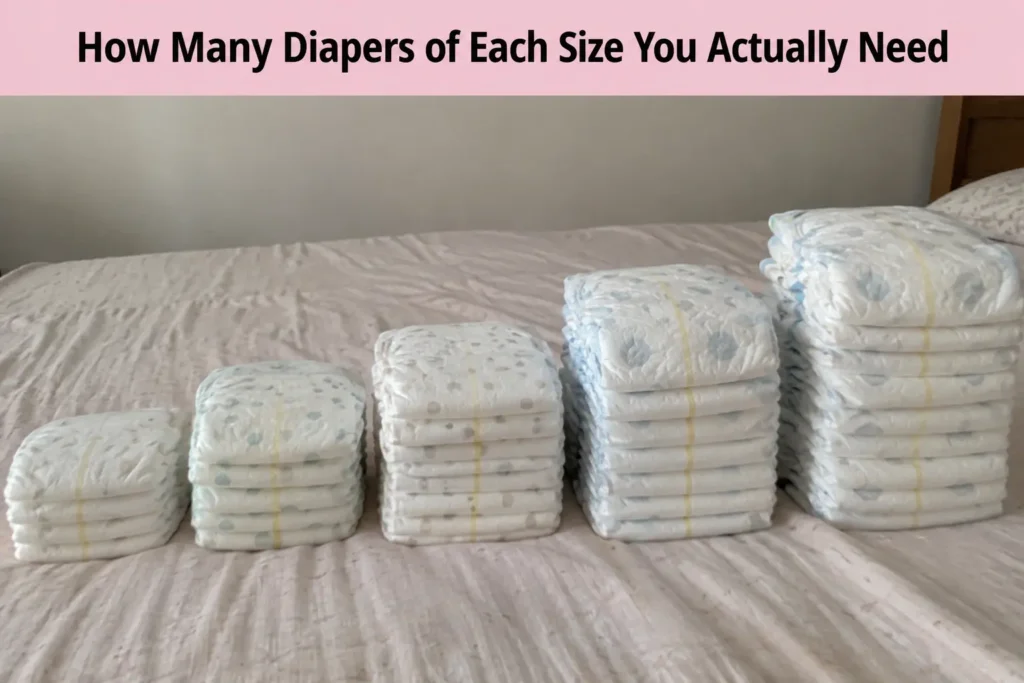
“I do not try to predict an exact number of diapers for every size before the baby arrives, because birth weight makes the first few weeks impossible to forecast precisely. I prefer starting with one pack of newborn and one pack of size 1, then buying from the fit I actually see. Once my baby reaches the larger sizes, I am much more comfortable buying in bulk, while keeping one unopened pack of the next size ready instead of stocking cases too far ahead.”
Why the chart stops being useful after size 2
The same check found something that changes how you should read any sizing table.
At 27 lb, three different sizes all claim the same baby: size 3 runs to 28 lb, size 4 starts at 22 lb, and size 5 starts at 27 lb. The overlap between adjacent sizes is about 2 lb early on, widens to roughly 10 lb at sizes 4 and 5, and is open-ended at size 6.
From about size 3 onward the chart is not a decision tool. It is a range of possibilities, and any page that names a confident size for a 27 lb toddler is guessing between three answers.
The practical consequence for stocking: the later sizes last longer, so you can buy them as you go and you will not get caught out. When to size up diapers covers how to decide inside that overlap using fit rather than weight.
Newborn size, and the deadline nobody mentions
The reason a newborn diaper is not just a smaller size 1 is a feature with a time limit.
Newborn-size diapers have a notch or a dipped front cut to sit below the umbilical cord stump. That is the actual difference, and it stops mattering once the stump is gone. Pampers’ own guidance, per this site’s record from 2026-08-24, puts a typical stay in newborn size at 2 to 4 weeks.
So the question is not really “do I need newborn size”, it is “do I need a product with a two-to-four-week window”. Newborn vs size 1 works through that decision in full.
The stocking answer that follows: one pack, maybe two. Not a case. A baby born at 9 lb may never wear the size at all, and a large pack of newborns is the single most common thing parents end up giving away.
If your baby may arrive early or small
This is a different situation and it needs a different page rather than a paragraph. Preemie and micro-preemie diaper sizes covers what exists below newborn size, including the finding that the smallest tiers are distributed to hospitals and NICUs through healthcare channels rather than to retail, which is why a parent searching for the size their baby is actually wearing finds nothing to buy.
If your baby is in neonatal care, the unit supplies what they need and the sizing question is theirs, not a shopping decision.
Brand quantity does not need to be a separate decision
One finding removes a whole worry from your planning. This site checked Pampers and Huggies weight bands at Walmart, Kroger and Fred Meyer on 2026-08-23 and found that they printed matching weight ranges at every size checked.
So the question “if I switch brands, will the sizes line up” has a published answer for those two, and the answer is that the numbers on the boxes match. Whatever differs between brands, and things do differ, it is not the weight band.
That means you can buy across brands without recalculating your plan, which makes small quantities much less risky than they look.
The number nobody publishes
You will find pages comparing how much each brand holds. This site does not, and the reason is worth stating.
On 2026-08-24 we checked the consumer pages of both major US brands for an absorbency capacity figure, in milliliters or grams. Neither publishes one.
That means every cross-brand absorbency comparison on the internet is unverifiable, by anyone, including the people writing it. So if a stocking guide tells you to buy more of one brand because it holds more, that recommendation is not resting on a published number.
One further note in the interest of being straight with you: Huggies’ consumer and healthcare pages returned access errors to our fetcher on 2026-08-24. That is our retrieval failing, not the company withholding anything, and it is a gap we should close rather than something to read into.
A planning approach that survives being wrong
Rather than a table of quantities, here is a method, because the table is what fails.
Before the birth: one pack of newborn, one pack of size 1. That is it. You will be buying things for months and diapers are available everywhere.
In the first week: you will now know the birth weight and you will have seen how the first pack fits. Buy accordingly. Red marks and tabs that will not reach mean too small; how to tell if a diaper is too small covers what to look for, including the sign most people miss.
From size 2 onward: buy in larger quantities, because the sizes last longer and the overlap gives you room. This is where bulk buying actually pays.
At every size: keep one pack of the next size up unopened. A growth spurt does not schedule itself around your shopping.
Never: buy a case of a size your baby is not yet wearing. The overlap arithmetic above means you cannot predict when they will reach it, and unopened packs are usually returnable while opened ones are not.
What to do with the extras
You will end up with leftovers. Everyone does, and it is not a planning failure, it is the consequence of a growth curve nobody can predict.
Unopened packs can often be returned or exchanged for a different size at the same retailer, and many chains will do this without a receipt for the same product. Diaper banks accept opened packs. Other parents will take them gratefully.
The short version
- The uncertainty is all at the small end. Later sizes are easy to buy for.
- The AAP average birth weight of about 7 lb sits below size 1’s 8 lb floor, so newborn size is more likely to be needed than registry lists imply, and for a shorter time.
- Newborn size exists for the cord notch. Pampers puts a typical stay at 2 to 4 weeks.
- From size 3 the chart overlaps too much to be a decision tool. Fit decides.
- Pampers and Huggies printed matching bands at every size checked on 2026-08-23, so switching brands does not change your arithmetic.
- Buy one pack each of newborn and size 1 before the birth, then buy from what you observe. The diaper fit and leaks guide is where to start once the baby is here.
Author Profile
-
Saima Mostari is the founder and author of BelovedTots. She has raised two young children, Pona and Ruku, and spent years working in child development at Neurosparks, a therapy center that provides Speech Therapy, Occupational Therapy, and ABA Therapy for children with developmental needs.
It was there, watching long therapy sessions get interrupted by leaking, ill-fitting diapers, that she began researching which products actually perform under real-world conditions, not just on the packaging.
She holds a Master's in Psychology and Guidance from the University of Dhaka, and brings a behavioral observation lens to every product she reviews. When she's not testing diapers or writing guides, she's probably negotiating bedtime with a 4-year-old.
Latest entries
- September 30, 2026Diaper Brands and ComparisonsLuvs vs Pampers: P&G’s Budget vs Premium Line
- September 27, 2026Diaper Brands and ComparisonsKirkland Diapers vs Huggies: What’s Different in 2026
- September 26, 2026Diaper Brands and ComparisonsKirkland Diapers Review: What Costco’s Diaper Is Now
- September 24, 2026Diaper Brands and ComparisonsHuggies Little Snugglers vs Snug and Dry: Which Fits?