
Why Diapers Leak at the Legs (and Why Sizing Up Fails)

Sources checked 2026-08-24.
Wet thighs with a dry waistband is a seal failure at the leg cuff, and the first thing to rule out is a cuff that was tucked inward at the last change instead of sitting out against the skin. Pampers asks parents to untuck and smooth the leg cuffs at every change, which tells you how routine that fault is. The important thing about a leg leak, though, is that it is the one leak pattern where sizing up usually makes things worse, because a larger diaper has a larger leg opening. A back leak and a leg leak look like the same complaint and get opposite prescriptions.
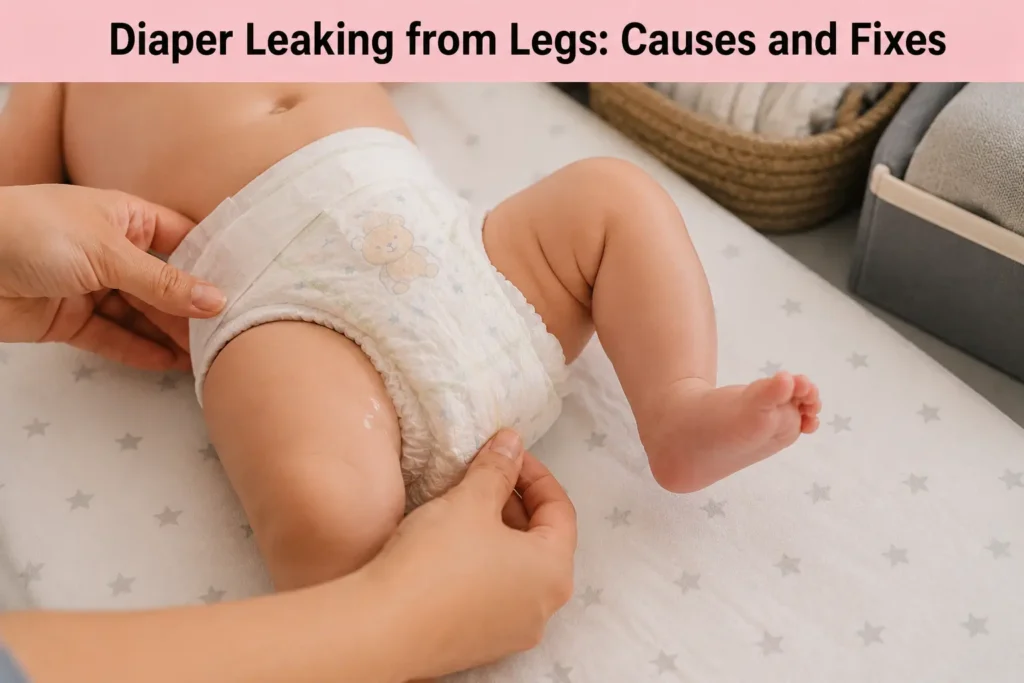
“When a diaper leaks around the thighs, I check the leg cuffs and seal before changing size. A tucked cuff, a visible gap, or a diaper shape that does not match the thighs can let urine escape even when the rest of the diaper fits well. Sizing up can actually make that opening wider, so I fix the cuff position first.”
Look at a clean diaper before you diagnose anything
Take one out of the pack and hold it open at the leg opening. On most disposable diapers you will find two elastics on each side rather than one.
The outer elastic runs along the edge and holds the diaper body against your baby’s leg. Inside it, a second ruffle stands up away from the diaper, free along most of its length and anchored only at the ends. That inner cuff is the barrier. It is supposed to stand upright inside the leg opening and rest against the skin, so that anything traveling sideways hits a wall.
When that inner ruffle gets folded inward during a change, it stops being a wall. It becomes a fold lying flat along the inside of the diaper, and a fold running from the middle of the diaper to the leg opening is a channel. It does not merely fail to stop liquid, it guides it out. This is why the same diaper leaks at one change and not the next with nothing else different.
The cuff sweep, and why it is the first thing to try
Pampers’ own leak guidance is where the instruction comes from, telling parents to “untuck and smooth out leg cuffs during every change” and describing a correct fit as having leg cuffs that wrap neatly without gaps.
The sweep takes about two seconds. After both tabs are fastened, run a fingertip around the inside of each leg opening from front to back, flicking the inner ruffle outward as you go. You are feeling for a ruffle that is standing up, not lying flat.
Do it at every single change for a full day before you conclude anything. One good change proves nothing, because a leak can be hours behind the change that caused it. A full day of correctly seated cuffs with no leaks is the answer, and a full day of correctly seated cuffs with leaks anyway is a genuine finding that moves you to the next section.
Why sizing up usually makes a leg leak worse
Here is the split that most leak advice blurs by putting every symptom in one list.
Pampers advises sizing up when leaks come up the back, and lists frequent leaks, red marks and gaps at the legs or waist among the signs it is time to move up. Note the direction of the logic: a back leak is a rise and coverage problem, and rise and coverage are exactly what the next size number adds.
A leg leak is not that. It is a circumference problem at the thigh. The next size up is longer, wider and cut for a bigger baby all round, which means the leg opening is bigger too. If your baby’s thigh was already leaving a visible gap inside the cuff, a wider opening widens the gap. You have added absorbent capacity to a diaper that is failing before the capacity is ever used, and capacity only counts inside a seal.
That is the whole delta on this page. Same complaint, opposite fix, depending on where the wet lands. The broader version of that map, across every leak location, is in our diaper fit and leak troubleshooting guide.
Marks at the thigh with gaps elsewhere: shape, not size
There is one confusing case, and it is common enough to name.
Sometimes you find pressure lines on the thighs after a change and a visible gap at the same time. That combination looks contradictory, and it usually means the size number is right and the cut is wrong for your baby’s shape. A leg opening can be tight in circumference while the cuff still fails to follow the curve of a fuller thigh, and both symptoms appear together.
The fix there is a different line at the same size number rather than a different number. Brands and lines within brands are cut differently even where the printed weight ranges match, so treat a new line as a fresh fitting rather than an equivalent swap. Before you go down that road, rule out the imitations: our guide to the signs a diaper is too small covers the application faults that produce marks without the size being wrong, and the tab and coverage checks that tell them apart.
When the leaks only happen in the car seat or the carrier
Watch for a pattern that tracks the situation rather than the change.
If the thigh leaks cluster around long car rides, stretches in a carrier or a bouncer, or a snug outfit over the diaper, note that down before you blame the pack. Two things happen when a baby is strapped in. The straps and the seat press against a diaper that may already be holding a lot of liquid, and the legs are held in a fixed bent position that changes where the cuff sits against the thigh.
We are not going to give you a number for how much pressure a saturated core can take, because we could not find one published. What we can tell you is what to do with the observation. Keep a note for a week of where your baby was when each leak happened. If the leaks are situational, a fresh change before you set off is a more direct answer than a different size, and it costs nothing to test.
Boys, positioning and the leak that lands at the leg
A front leak in boys is often reported as a leg leak, because the wet arrives at the thigh even though the failure happened at the front.
The tell is which part of the clothing is wet. Wet at the front of the thigh with a wet front waistband is a positioning question at the moment of fastening. Wet on the outside or back of the thigh with a dry waistband is a cuff seal question and belongs to this page. They get different fixes, and running the cuff sweep on a positioning problem will leave you convinced that nothing works.
The one time a leg leak really does mean size
The cuff sweep is not a universal answer, and there are two cases where the size is genuinely the problem.
The first is a diaper that has become too small. If the tabs need a stretch to meet in the middle, the back no longer covers the whole bottom lying flat, and pressure lines survive a deliberately looser fastening, the diaper has run out and the leg leak is a symptom of that. Our page on how the weight overlaps between sizes work sets out the tie-breakers in the order that costs least.
The second is a diaper that is too big, which is the case people miss because it looks like room to grow. A gap at the leg opening with no pressure marks anywhere, tabs landing well past the center and a diaper that sags while still dry are the signature, and the full list is in our guide to the signs a diaper is too big. If you sized up to stop a leg leak and the leaks got worse, that is not bad luck, it is the predictable result, and going back down is a normal correction.
Red marks, chafing and broken skin at the thigh crease
The leg opening is also where fit and skin genuinely meet, so one boundary is worth stating.
The AAP notes on HealthyChildren.org that diapers “fastened too tightly can trap moisture, which can cause diaper rash”, and asks parents not to fasten too tightly, especially overnight. That rules out the instinctive response to a leg leak, which is to pull the whole diaper tighter. Tightening the waist does not close a leg gap; it presses the waistband harder while leaving the cuff exactly where it was.
Skin that is broken, weeping, blistered or spreading is not a fit problem. The AAP asks parents to call the pediatrician about a rash that “is not going away, or it is getting worse after two to three days”, one that “includes pimples, peeling skin, blisters, pus-filled or oozing or crusty sores”, one that is “especially painful”, or a rash with a fever. That is a call, not a product change, and this page is general information rather than medical advice.
FAQ
Why does my baby’s diaper leak at the legs but not the back?
Because the two seals are independent. The waistband seal and the leg cuff seal fail for different reasons, and a diaper can hold perfectly at one while failing at the other. A dry waistband with wet thighs is good news in a sense: it has already ruled out half the possible causes.
Should I size up if the diaper leaks at the legs?
Usually not, at least not first. A larger size has a larger leg opening, so it tends to widen the gap that is causing the leak. Size up when the evidence points at size itself, meaning tabs that will not reach the middle, lost coverage at the back or pressure lines that survive a looser fastening.
How do I know if the leg cuffs are tucked in?
By feel, not by sight. After fastening, run a fingertip around the inside of each leg opening. A correctly seated inner cuff stands up against the skin and you can feel its free edge; a tucked one lies flat inside the diaper. Check both legs at every change for a day, until you know what the right one feels like.
My baby has chunky thighs and every brand leaks. What now?
Treat it as shape rather than size. Try a different line at the same size number rather than the same line one size up, and give each one a full week with the cuff sweep running at every change. If the leg cuff still leaves a visible gap with the legs straight and the cuffs out, that cut does not match your baby, and the number on the pack cannot fix it.
Can a leaking leg cuff be a faulty diaper?
It happens, and it is worth considering if a leak arrives suddenly from a specific new pack with nothing else changed. Note the lot code on the pack before you decide, because that is the first thing a manufacturer will ask for. It is a rarer explanation than a tucked cuff, so run the sweep for a day first.
Sources
- Pampers, “Prevent Diaper Blowouts and Leaks”, read 2026-08-24, for untucking and smoothing leg cuffs at every change, cuffs that wrap without gaps, the waistband position, and the guidance to size up when leaks come up the back.
- Pampers, “When to Size Up Diapers and Why Fit Matters”, for the size-up signals.
- HealthyChildren.org (American Academy of Pediatrics), “Diaper Rash”, for tight fastening and trapped moisture, and for the reasons to call a pediatrician.
- The two-elastic leg cuff described above is the construction Pampers’ own untucking guidance assumes, and it is visible on a diaper from your own pack. We have not run any physical test on any diaper, and no manufacturer publishes a leg opening measurement, so no measurement is quoted here.
This article is general information about diaper fit, not medical advice. Any concern about your baby’s skin, comfort or growth belongs with your pediatrician.
Author Profile
-
Saima Mostari is the founder and author of BelovedTots. She has raised two young children, Pona and Ruku, and spent years working in child development at Neurosparks, a therapy center that provides Speech Therapy, Occupational Therapy, and ABA Therapy for children with developmental needs.
It was there, watching long therapy sessions get interrupted by leaking, ill-fitting diapers, that she began researching which products actually perform under real-world conditions, not just on the packaging.
She holds a Master's in Psychology and Guidance from the University of Dhaka, and brings a behavioral observation lens to every product she reviews. When she's not testing diapers or writing guides, she's probably negotiating bedtime with a 4-year-old.
Latest entries
- September 30, 2026Diaper Brands and ComparisonsLuvs vs Pampers: P&G’s Budget vs Premium Line
- September 27, 2026Diaper Brands and ComparisonsKirkland Diapers vs Huggies: What’s Different in 2026
- September 26, 2026Diaper Brands and ComparisonsKirkland Diapers Review: What Costco’s Diaper Is Now
- September 24, 2026Diaper Brands and ComparisonsHuggies Little Snugglers vs Snug and Dry: Which Fits?