
How Often to Change a Newborn Diaper, Day and Night

Two questions live inside this one, and they have different answers.
The daytime question is about skin. The night question is about weighing a wet diaper against waking a sleeping baby, and it is not a question a web page should settle for you.
This page reports what the American Academy of Pediatrics publishes and says plainly where it publishes nothing. Where a decision is yours to make with your pediatrician, it says that instead of supplying a number.
What the AAP actually publishes about changing
The AAP’s HealthyChildren.org page “Common Diaper Rashes & Treatments” (last updated 12/18/2024) sets out the reason changing matters at all. On what causes irritant dermatitis, the page states: “The diaper area spends much of the day in contact with two very irritating substances: urine and stool.”
Among its prevention and treatment guidance, the AAP lists “Change diapers frequently” and “Choose a highly absorbent diaper” to keep skin dry, alongside “Keep the area clean” with daily baths during irritation.
Notice what that guidance is and is not. It is a direction, frequently, and a purpose, keeping the skin away from urine and stool. It is not an interval in hours.
We looked for one. The AAP’s page “Diapers: Disposable or Cloth?” (last updated 5/17/2021) was read on 2026-08-28 specifically to see whether it publishes a change-frequency figure, and it does not. What it does say on the subject is that cloth diapers “need to be changed more frequently” than disposables, and that with disposables “your baby’s skin has less contact with pee and poop.”
So this page publishes no number of hours, because we did not find one published by the authority it would need to come from. Every article that gives you a confident interval got it from somewhere else.
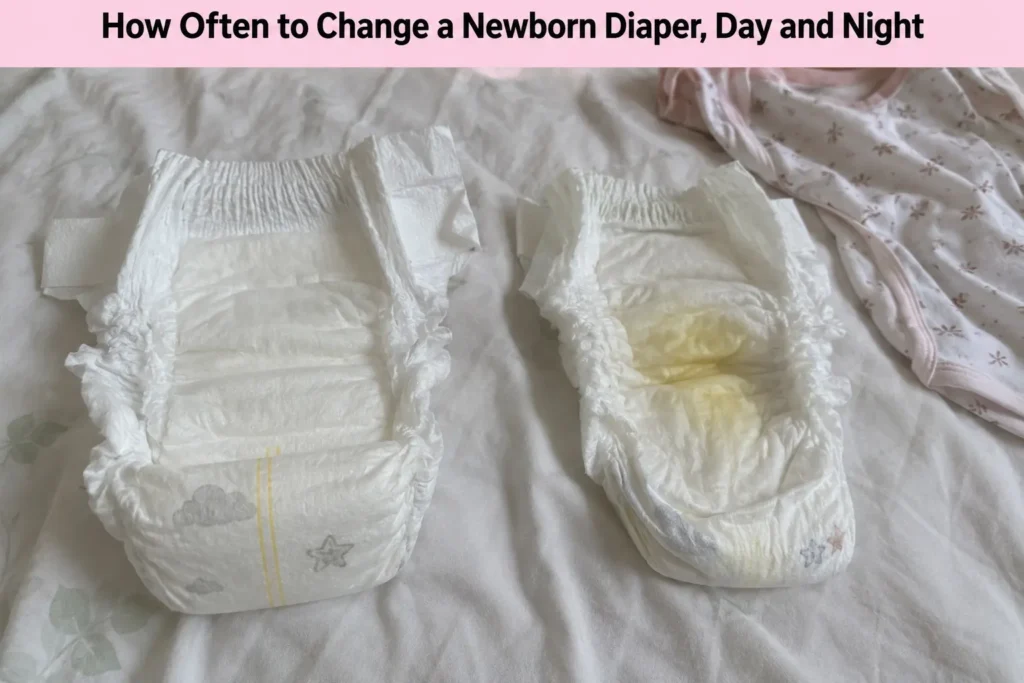
“With my newborns, I quickly stopped thinking of diaper changes as something that belonged to a strict hourly schedule. During the day, I found it more practical to check around feeds and sleep and change wet diapers when I noticed them, while soiled diapers came off promptly. Nights felt different because waking a sleeping newborn for a wet-only diaper was never such a simple decision, especially in those early weeks, so that was something I preferred to handle according to my baby’s needs and the guidance we had from our pediatrician.”
Why “when it is wet or soiled” is the practical answer
Working from the AAP’s stated purpose rather than from an invented interval, the everyday version is straightforward.
Soiled diapers come off promptly. Stool is named by the AAP as one of the two irritating substances, and there is no version of this where waiting is better.
Wet diapers come off when you notice them. In practice that means checking at natural moments: at every feed, before and after sleep, before going out, and when you pick your baby up.
Newborns produce a lot of both, which is why the number of changes in the newborn period is high and then falls. That is not a rule anybody set; it is a consequence of how often a newborn feeds.
If a diaper feels dry but the wetness indicator line has changed, that is a common source of confusion and it has its own page: wetness indicators, how they work and when to ignore them.
The wet diaper count, and why it belongs to your pediatrician
There is a second reason changes get counted in the newborn period, and it has nothing to do with skin.
The AAP’s page on diapers notes, in the context of cloth versus disposable, that it “may also be more difficult to monitor exactly how much your baby is peeing”, and describes this as “a task that is especially important during the newborn period.”
That is the AAP naming the monitoring as important. What it is being monitored for, what count is expected at what age, and what to do about a change in it are questions your pediatrician answers, and they are usually part of the early visits already scheduled.
This page publishes no wet-diaper threshold, and the reason is specific rather than general caution. A number read on a website by a tired parent at 3 a.m., applied to a baby that page has never seen, either reassures somebody who should be calling or alarms somebody who should not be. Your pediatrician sets what to watch for and what to report, and if you are unsure what you were told, that is a phone call, not a search.
If you are counting because you are worried about feeding or output, call. That is what the number is for.
The night question
Here is the trade honestly, without a recommendation attached, because the balance depends on things this page cannot know: your baby’s age, how their skin is doing, whether they are gaining as expected, and what your pediatrician has said.
On one side: the AAP’s own guidance names frequent changing and keeping skin dry as prevention, and a soiled diaper is not something to leave.
On the other: a baby who has been woken and fully changed may take a long time to resettle, and sleep matters for both of you.
What is not in dispute: a soiled diaper is changed. That side of it is not a trade-off.
For a wet-only diaper in the middle of the night, the honest position is that this is a conversation with your pediatrician, particularly in the first weeks when output is being monitored and skin is at its most delicate. They know your baby. This page does not.
What this page can usefully offer is the mechanical half. If the diaper is soaked through by morning, that is a capacity and fit question rather than a frequency one, and it has its own page: why diapers leak at night and how to stop it. Fixing the leak often removes the reason you were considering a night change in the first place.
What to do when a rash is already there
If skin in the diaper area is already irritated, the AAP’s guidance changes the picture, and the page above is where it comes from.
The AAP lists coating the skin with “a thick layer of barrier paste” using zinc oxide or petrolatum among its recommendations, along with keeping the area clean with daily baths during irritation.
And it publishes when to stop managing it at home. Per the same page, the AAP advises contacting your doctor if “The rash is not going away, or it is getting worse after two to three days of treatment”, if “The rash includes pimples, peeling skin, blisters, pus-filled or oozing or crusty sores”, if “Your baby is taking an antibiotic medicine and develops a bright pink or red rash”, or if “The rash is especially painful” or is accompanied by fever.
That is the AAP’s list, quoted, and this site composes no list of its own alongside it.
Fit matters more than frequency for some problems
Two situations that look like a frequency problem and are not.
Persistent leaks. A diaper that leaks before it is full is a seal problem. The diaper fit and leaks guide is the starting point, and the most common single fix is untucking the leg cuffs at every change.
Marks and redness at the waist or thighs. That is a fit sign rather than a wetness one, and how to tell if a diaper is too small covers what to look for.
The short version
- The AAP names urine and stool as the irritants and lists “Change diapers frequently” and “Choose a highly absorbent diaper” among its prevention guidance.
- We looked for an AAP interval in hours on 2026-08-28 and did not find one published. This page therefore does not give you one.
- Soiled comes off promptly. Wet comes off when you notice, and feeds are the natural checkpoints.
- The AAP calls monitoring newborn urine output especially important. What count to expect is your pediatrician’s, not this page’s.
- The night trade-off is real and it is a conversation with your pediatrician, not a rule.
- The AAP’s own when-to-call list is quoted above. If a rash matches it, call.
Author Profile
-
Saima Mostari is the founder and author of BelovedTots. She has raised two young children, Pona and Ruku, and spent years working in child development at Neurosparks, a therapy center that provides Speech Therapy, Occupational Therapy, and ABA Therapy for children with developmental needs.
It was there, watching long therapy sessions get interrupted by leaking, ill-fitting diapers, that she began researching which products actually perform under real-world conditions, not just on the packaging.
She holds a Master's in Psychology and Guidance from the University of Dhaka, and brings a behavioral observation lens to every product she reviews. When she's not testing diapers or writing guides, she's probably negotiating bedtime with a 4-year-old.
Latest entries
- September 30, 2026Diaper Brands and ComparisonsLuvs vs Pampers: P&G’s Budget vs Premium Line
- September 27, 2026Diaper Brands and ComparisonsKirkland Diapers vs Huggies: What’s Different in 2026
- September 26, 2026Diaper Brands and ComparisonsKirkland Diapers Review: What Costco’s Diaper Is Now
- September 24, 2026Diaper Brands and ComparisonsHuggies Little Snugglers vs Snug and Dry: Which Fits?