
Dyper Diapers Review: Bamboo Viscose and Composting

This Dyper diapers review checks the two claims that sell the brand, bamboo and composting, against Dyper’s own product page, read on September 25, 2026. The short answer: both claims are real, and both are narrower than the box suggests. The “bamboo” is bamboo viscose, which the Federal Trade Commission treats as rayon, a processed fiber, not raw bamboo. And the diaper gets composted only if you sign up for ReDyper, a separate pickup service that takes used diapers to an industrial composting facility. Without that service, Dyper’s pages describe no other composting route.
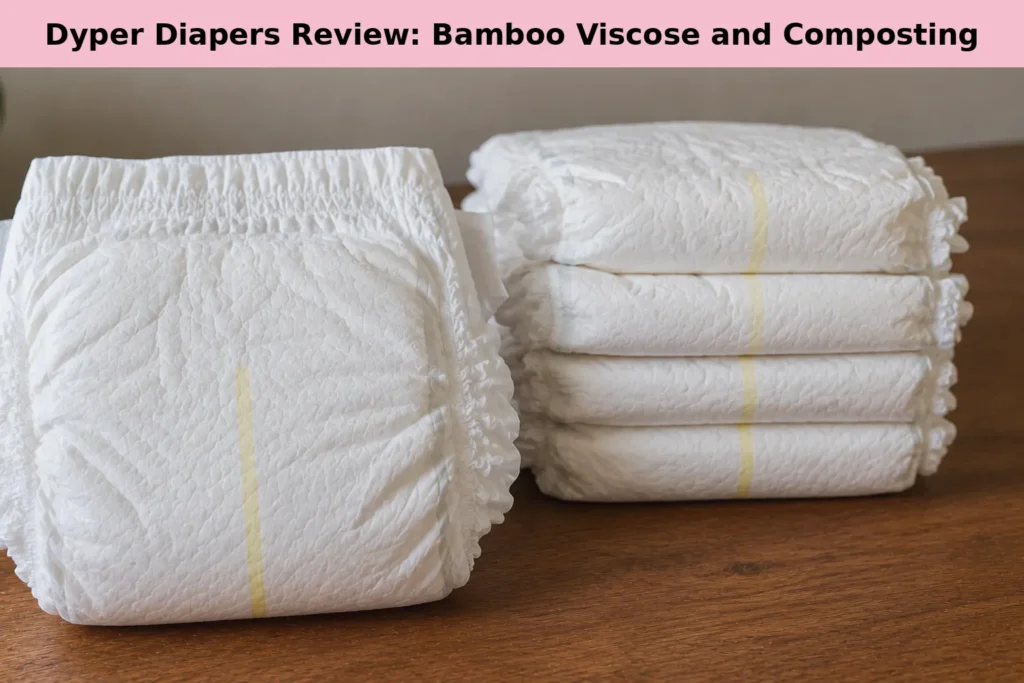
“What caught my attention with Dyper was the composting promise, but I would only count that as a real benefit if ReDyper actually serves my address and I planned to use the separate pickup service. I also look at the “bamboo” wording more carefully now, because the diaper uses bamboo viscose rather than raw bamboo fiber. For me, that makes Dyper less about an automatic eco win and more about whether its materials, fit, and composting service genuinely match how my family would use the diapers.”
How this review was done
Nothing here was tested on a baby. This is a research-based review: we read Dyper’s own product and service pages, copied the wording, dated the read, and checked each claim against the public body that defines the term. Where someone else ran a hands-on test, they are named and dated.
Dyper’s site lists an Original diaper, a Charcoal diaper and training pants. This page covers the Original diaper sold through its monthly box, because that is the product carrying the bamboo and composting claims.
You will not find a price, a star rating or a ranking here. Prices change, star ratings belong to retailers, and a ranking would need a test we have not run. What you will find is each claim in Dyper’s words, what it actually measures, and what it leaves out.
What Dyper says the diaper is made of
Every quote below comes from the Dyper Original monthly diaper box page, read September 25, 2026. Brands revise these pages, so the pack you receive wins if it differs.
| Part or claim | Dyper’s wording | What it tells you |
|---|---|---|
| Topsheet and backsheet | “Backsheet and topsheet nonwoven made from bamboo viscose.” | The outer layers are viscose whose plant source is bamboo. |
| Skin-facing layer | “Made entirely of plant-based materials so no plastic touches your baby’s sensitive skin.” | The plant-based wording is attached to what touches skin. |
| Absorbent core | “Absorbent core made of sodium polyacrylate (SAP) and pulp from sustainably managed forests.” | The core pairs pulp with a superabsorbent polymer. |
| Biobased share | “Our diapers are USDA-certified to be 55% biobased, more than twice the leading competitors.” | A carbon-source measure, explained below. |
| Leak claim | “Ultra-absorbent core for up to 12 hours of leak protection” | A duration, with no volume or test method on the page. |
| Made without | “No added fragrance, lotion, latex, rubber, dyes, alcohol, parabens, phthalates, pesticides, chlorine bleaching, VOCs, or optical brighteners.” | A list of absences, not a health claim. |
| Skin seal | “Hypoallergenic, clinically tested, 5-Star Dermatest® Approved” | Label wording, discussed in the skin section. |
| Composting | “Eligible for composting with ReDyper composting program.” | Composting depends on a separate service. |
Read the table as a whole and one pattern stands out. The plant-based and composting language is real, but each piece is attached to a specific part or a specific condition. None of it says the whole diaper is bamboo, or that the whole diaper breaks down wherever it ends up.
“Bamboo viscose” is rayon, and the FTC says so
Bamboo in a diaper is not bamboo stalk shredded into fluff. The FTC’s Bamboo Textiles page, read September 25, 2026, states that “Textiles can only be called bamboo if they are made directly from actual bamboo fiber.” It adds that rayon, “or viscose, which is the same thing,” made using bamboo as a plant source may be described as “rayon (or viscose) made from bamboo.”
The FTC has also said why the naming matters. In an April 8, 2022 press release announcing penalties against Kohl’s and Walmart over textiles marketed as bamboo, the agency stated that “converting bamboo into rayon requires the use of toxic chemicals and results in hazardous pollutants.” That case concerned those two retailers and textile products. It did not involve Dyper.
Two things follow, and both deserve fair wording. First, Dyper’s own phrase, “made from bamboo viscose,” names the fiber the way the FTC’s guidance describes it. That is more precise than a box that just says “bamboo,” and it is to the brand’s credit. Second, the FTC guidance is written about textile products, and this page does not claim to know how the agency would apply it to a diaper.
What the FTC gives you is the vocabulary. When a diaper says bamboo, the fiber against your baby’s skin is viscose that started as bamboo. Whether it feels softer in your hand is a matter of touch. It is not a property of the plant surviving the process.
What “55% biobased” actually measures
The 55% figure sounds like a share of the diaper that is natural or will break down. It is neither. The USDA BioPreferred program, whose certification Dyper cites, says its label “assures a consumer that the product contains a verified amount of renewable biological ingredients (referred to as biobased content).” It defines biobased content as “A ratio of a product’s new organic carbon to total organic carbon, as measured by the ASTM D6866 test method, expressed as a percentage.” Both read September 25, 2026.
So 55% biobased means that just over half of the diaper’s organic carbon came from recently grown plants rather than older sources. By the same measure, the rest did not. The USDA’s description speaks to content. It says nothing about how fast a product breaks down, whether it composts, or how well it absorbs.
Dyper’s page keeps the two ideas on separate lines too: biobased on one, composting on another. A parent who reads “55% plant-based” as “55% compostable” has joined two claims the page never joins. The “more than twice the leading competitors” comparison is Dyper’s own, and the sentence does not name which competitors it means.
The composting claim: what ReDyper actually is
Here is exactly what Dyper’s ReDyper page, read September 25, 2026, says about composting.
Who collects: “ReDyper pickups are powered by our logistics partner, Recyclops, a company that brings recycling and composting access to communities not served by traditional waste programs.” Where diapers go: “We collect your bags weekly and take them to an industrial composting facility, where they’re broken down into compost used in non-food landscaping projects.” Where it runs: the page asks you to “Enter your home address to see if ReDyper composting is in your area,” and does not list the areas. ReDyper is sold as its own subscription, separate from the diapers.
The same page explains why this is not a backyard job: “Composting of human waste requires specialized conditions, including safe material handling procedures and specific pre-processing steps. Very few composting facilities exist around the country that are properly licensed and equipped to handle this type of waste stream.” An outside reviewer reached the same practical point. BabyGearLab, in a review dated June 2, 2023, wrote that the diapers “cannot be tossed in your compost pile out back or at your neighborhood composting station.”
Federal guidance sets the frame. The FTC’s Green Guides (16 CFR 260.7), read September 25, 2026, state that “It is deceptive to misrepresent, directly or by implication, that a product or package is compostable,” and say compostable claims should be qualified when an item cannot be composted safely at home, or when suitable facilities are not available to a substantial majority of consumers or communities where the item is sold. Dyper’s footnote tying composting to ReDyper is a qualification of that kind. Whether its wording is enough is a regulator’s call, not ours.
The practical reading is simpler. The composting benefit exists only at an address ReDyper serves, only while you subscribe, and only for the diapers you bag and hand over. A Dyper diaper in the household trash goes where household trash goes.
The skin claims: hypoallergenic, Dermatest and the made-without list
“Hypoallergenic” is the least informative word on the page. The FDA’s Hypoallergenic Cosmetics page, read September 25, 2026, states: “There are no Federal standards or definitions that govern the use of the term ‘hypoallergenic.’ The term means whatever a particular company wants it to mean.” That page is written about cosmetics, and we did not find a separate US definition covering diapers.
Dyper describes its Dermatest seal as “Clinically assessed for skin compatibility.” The line on the product page does not say what that assessment involved, how many people took part, or whether any were infants, so we cannot tell you more about it than Dyper does.
The made-without list is easier to read. It is a list of things Dyper says it does not add, and it includes dyes. On its HealthyChildren.org page, the American Academy of Pediatrics, read September 25, 2026, says that “Common allergens include dyes or elastics in the diaper, and fragrances or preservatives in diaper wipes or creams.” Dyper’s list names dyes; it does not mention elastics. None of this tells you how your own baby’s skin will respond, and an absence on a label is not a promise about a rash.
The AAP also describes what can help sort out an allergy: clues include “a rash that happens after every exposure to that product and a rash that shows up everywhere that product is applied,” and “Switching brands or types of products for a 2-week period can sometimes help sort this out.” If you are weighing Dyper because of a rash, that is a conversation to have with your pediatrician first, who can tell an irritant rash from an allergic one. Our diaper rash guide sets out the AAP’s list of when to call, and our guide to what “sensitive” means on each diaper box reads the same label words across other brands.
Dyper sizes, as printed on its own page
These weight ranges come from the same Dyper product page, read September 25, 2026.
| Dyper size | Dyper’s weight range |
|---|---|
| N | Under 10 lbs |
| 1 | 8-14 lbs |
| 2 | 12-18 lbs |
| 3 | 16-28 lbs |
| 4 | 22-37 lbs |
| 5 | Over 27 lbs |
| 6 | Over 35 lbs |
| 7 | Over 41 lbs |
The overlaps are normal, and they are where fit, not weight, decides. A baby at 9 lbs sits inside both N and size 1. Size numbers also do not line up exactly from brand to brand, so the Dyper size that fits may not match the number you buy elsewhere. The cross-brand diaper size chart puts Dyper’s neighbors side by side.
What an outside tester found, and what we cannot add
We ran no absorbency test, so the only performance finding on this page belongs to someone else. BabyGearLab tested the product it called Dyper Bamboo in a review dated June 2, 2023. It reported “one of the worst absorption test results in the group,” and noted that users report more leaks than most of the competition. The same review called the diapers “super soft and comfortable.”
That test predates our read of the current product page by more than three years, and Dyper’s site now lists an Original diaper rather than a product named Bamboo. We cannot tell you whether the diaper changed in between. The “up to 12 hours of leak protection” line is Dyper’s claim; the absorption result is BabyGearLab’s; neither is ours.
Dyper diapers review: what it concedes and who it suits
Every product concedes something. Here is Dyper’s list, drawn only from the sources above.
- The bamboo is viscose. Under the FTC’s naming, it is rayon made from bamboo, a manufactured fiber.
- Composting is conditional. It needs ReDyper, a separate subscription, at an address the service covers.
- 55% biobased describes carbon, not breakdown. By USDA’s measure, the rest of the carbon is not biobased.
- The leak claim has no stated method. “Up to 12 hours” is a duration with no test or volume on the page.
- The one independent absorption test we found scored it poorly. That was BabyGearLab in 2023, on the Bamboo-named version.
- “Hypoallergenic” has no federal definition, per the FDA.
Who it suits: a parent whose deciding factor is plant-based material against the skin, who lives where ReDyper runs, and who wants a documented composting route rather than a vague “eco” label. Who it may not suit: a parent whose main problem is leaks. That is usually a fit problem first, and no fiber choice fixes a diaper that is the wrong size. Our map of diaper brands and who makes what shows where Dyper sits among the mainstream and store-brand lines.
FAQ
Are Dyper diapers really made of bamboo?
Partly, and in processed form. Dyper’s product page, read September 25, 2026, says the “Backsheet and topsheet nonwoven made from bamboo viscose.” The FTC says viscose is the same thing as rayon and that such fibers should be described as “rayon (or viscose) made from bamboo,” not simply as bamboo. The absorbent core is pulp and sodium polyacrylate.
Can I compost Dyper diapers at home?
Dyper’s own ReDyper page says composting human waste “requires specialized conditions” and that very few facilities are equipped for it. Its route is ReDyper, a separate pickup service run with Recyclops that takes bags to an industrial composting facility. BabyGearLab’s 2023 review also said the diapers cannot go in a backyard compost pile.
Are Dyper diapers hypoallergenic?
Dyper’s page says “Hypoallergenic, clinically tested.” The FDA states there are no federal standards or definitions for the term and that it “means whatever a particular company wants it to mean.” Questions about your own baby’s skin belong with your pediatrician.
What size Dyper does a newborn need?
Dyper’s page lists size N for “Under 10 lbs” and size 1 for “8-14 lbs,” read September 25, 2026. A baby between 8 and 10 lbs falls inside both, so the fit at the legs and waist decides, not the number on the box.
Does “55% biobased” mean the diaper is 55% compostable?
No. The USDA defines biobased content as the share of a product’s organic carbon that is new, plant-derived carbon, measured by ASTM D6866. It describes where the material came from, not how it breaks down. Dyper makes its composting claim separately, through ReDyper.
Author Profile
-
Eamin Hosen is the founder and author of BelovedTots. He has raised two young children, Pona and Ruku, and spent years working in child development at Neurosparks, a therapy center that provides Speech Therapy, Occupational Therapy, and ABA Therapy for children with developmental needs.
It was there, watching long therapy sessions get interrupted by leaking, ill-fitting diapers, that he began researching how products perform during everyday use and where their performance falls short of packaging claims.
He holds a Master’s in Psychology and Guidance from the University of Dhaka and brings a behavioral observation lens to every product he reviews. When he’s not testing diapers or writing guides, he’s probably negotiating bedtime with a 4-year-old.
Latest entries
- November 13, 2026Diaper Brands and ComparisonsBamboo Diapers: Viscose, Rayon and the Box Claims
- November 12, 2026Diaper Rash and SkinHypoallergenic Diapers: What the Word Really Promises
- November 11, 2026Diaper Brands and ComparisonsChlorine Free Diapers Meaning: TCF vs ECF Explained
- November 10, 2026Diaper Brands and ComparisonsEco Friendly Diapers: What the Labels Actually Mean