
Wetness Indicators: How They Work and When to Ignore Them

The stripe has changed colour. The diaper feels dry. You are standing there at midnight trying to decide whether the diaper is lying to you or your hand is.
Neither, really. They are answering different questions, and once you see which question each one answers, the confusion mostly goes away.
What the stripe is and is not
A wetness indicator is a strip printed on the outside of the diaper, usually running down the middle, that changes colour when it gets wet. Yellow to blue is the common pairing.
Two things follow from that description, and they are the whole of the practical advice.
It reports contact, not quantity. The stripe changes because liquid reached it. It is a yes-or-no signal about whether the diaper has been used, not a gauge of how full it is.
It reports at one location. It is a strip in one place. A diaper is a three-dimensional object with a core that distributes liquid unevenly, and the stripe knows about the part of the diaper it is printed on.
So a changed stripe means “this diaper has been wet at some point since it went on.” It does not mean “this diaper is now full”, and it never claimed to.
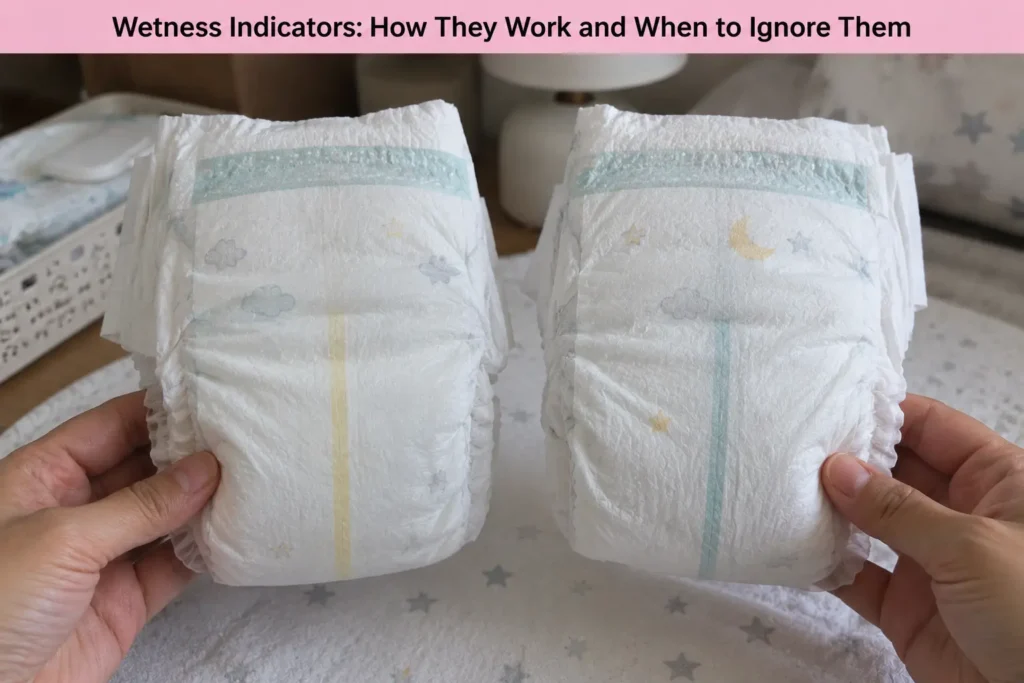
“I used to treat the wetness stripe almost like a fullness meter, especially during those tired newborn nights, but I eventually realized it was answering a much simpler question: whether moisture had reached it at all. I’ve seen the stripe turn blue while the diaper still felt surprisingly dry and light, which makes sense once the core has pulled moisture away from the surface. Now I use the indicator as a useful quick check, but I trust the diaper’s weight and thickness much more when deciding how full it actually is.”
Why it can be blue while the diaper feels dry
This is the specific confusion that brings people to this page, and there are several ordinary explanations. None of them means anything is wrong.
Modern cores are built to feel dry. The absorbent material draws liquid away from the surface and holds it. A diaper that has done its job well feels drier than the amount inside it would suggest. That is the design working.
A small amount can trigger it. The stripe reacts to liquid reaching it. The quantity required to change a colour and the quantity required to make a diaper heavy are not the same quantity.
It happened a while ago. Colour changes do not reverse. A stripe that changed at 11 p.m. still reads changed at 3 a.m., and it cannot tell you which.
Weight is the better gauge. If you want to know how full a diaper is, lift it, or feel its thickness at the front and between the legs. Your hand measures mass; the stripe measures an event.
The number nobody publishes
Here is the checkable fact that sits under this whole subject.
On 2026-08-24 this site checked the consumer pages of both major US brands for a published absorbency capacity figure, in milliliters or grams. Neither publishes one.
That matters for the indicator question specifically, because it means there is no published figure for how full “full” is. So even if a stripe could report quantity, there would be nothing to compare the quantity against.
It also means something for the comparison articles you will find. Any page telling you one brand’s indicator is more sensitive, or triggers at a particular amount, is not resting on a published specification, because the specification is not published. This site does not make that comparison for that reason, and diaper fit for chunky thighs vs skinny babies makes the same argument about the fit measurements, which are equally unpublished.
Being straight about our own limits: this page also makes no claim about what chemistry any particular brand uses in its stripe, or what triggers the change, because we have not read a manufacturer’s technical statement of it. Where this page says what the stripe cannot tell you, that is an argument from the absence of a published figure, not a description of a mechanism.
When to trust it
Newborns, in the first weeks. This is where the indicator earns its place. A newborn’s output is being tracked, and a stripe that changed is objective evidence that something happened since the last change, which is more reliable than a tired parent’s memory at 4 a.m.
When several caregivers are involved. The stripe is a shared record. It survives handovers in a way that “I think I changed her” does not.
When you are checking without disturbing. Glancing at a stripe through a leg opening wakes nobody. Investigating by hand often does.
On a baby who is not obviously wet. Some babies give very little away, and the stripe catches what you would otherwise miss.
When to ignore it
When you can feel that it is heavy. Your hand outranks the stripe. A heavy diaper with an unchanged stripe still needs changing.
For soiled diapers. The indicator is a wetness indicator. Stool is detected the way it always has been.
When it has been hours. The colour tells you nothing about when.
When you are trying to judge night capacity. Whether a diaper will survive the night is a capacity question and the stripe is not a gauge. If your baby is soaked by morning, why diapers leak at night and how to stop it is the page.
When it did not change and the diaper leaked. That happens, because the liquid took a route past the stripe, or the seal failed before the core did anything. A leak with an unchanged stripe is a fit problem, and the diaper fit and leaks guide is where to start.
Counting wet diapers
The indicator is often used for this in the newborn period, and it is genuinely helpful for it.
What this page will not do is tell you what count to expect or what a change in the count means. That is something your pediatrician sets and monitors, usually as part of the early visits already scheduled, and it depends on your baby’s age and how feeding is going. A number read on a website and applied to a baby that website has never seen either reassures somebody who should be calling or alarms somebody who should not be.
If you are counting because you are worried, that is the moment to call rather than to search.
Diapers without one
Not every diaper has an indicator, including several store brands and most cloth systems. That is not a shortcoming to work around.
Before indicators existed, everyone judged by weight, by feel and by time since the last change, and all three still work. On a cloth diaper you are checking by hand anyway, and on a disposable, thickness at the front and between the legs tells you most of what the stripe would have.
If the absence of a stripe is a reason you are considering switching brands, it is worth knowing there is no published spec to choose between them by, and no reason to expect the sizes to differ either: this site checked Pampers and Huggies weight bands at three retailers on 2026-08-23 and found matching ranges at every size checked. When to size up diapers covers the sizing decision itself.
The short version
- The stripe reports contact at one location. It is not a fullness gauge and never claimed to be.
- Blue and dry is normal: the core is built to keep the surface dry, and colour changes do not reverse.
- Weight and feel are the better measure of how full a diaper is.
- Nobody publishes an absorbency capacity, so there is no published standard for what full means or which indicator is more sensitive.
- Most useful in the newborn period, across caregivers, and for checking without waking.
- Ignore it when the diaper is heavy, when it is soiled, and when you are judging a whole night.
- What wet-diaper count to expect is your pediatrician’s question, not this page’s.
Author Profile
-
Saima Mostari is the founder and author of BelovedTots. She has raised two young children, Pona and Ruku, and spent years working in child development at Neurosparks, a therapy center that provides Speech Therapy, Occupational Therapy, and ABA Therapy for children with developmental needs.
It was there, watching long therapy sessions get interrupted by leaking, ill-fitting diapers, that she began researching which products actually perform under real-world conditions, not just on the packaging.
She holds a Master's in Psychology and Guidance from the University of Dhaka, and brings a behavioral observation lens to every product she reviews. When she's not testing diapers or writing guides, she's probably negotiating bedtime with a 4-year-old.
Latest entries
- September 30, 2026Diaper Brands and ComparisonsLuvs vs Pampers: P&G’s Budget vs Premium Line
- September 27, 2026Diaper Brands and ComparisonsKirkland Diapers vs Huggies: What’s Different in 2026
- September 26, 2026Diaper Brands and ComparisonsKirkland Diapers Review: What Costco’s Diaper Is Now
- September 24, 2026Diaper Brands and ComparisonsHuggies Little Snugglers vs Snug and Dry: Which Fits?