Preemie Diaper Size: What You Can Buy, What You Cannot

Sources checked 2026-08-24. This page is general information about diaper sizing, not medical advice.
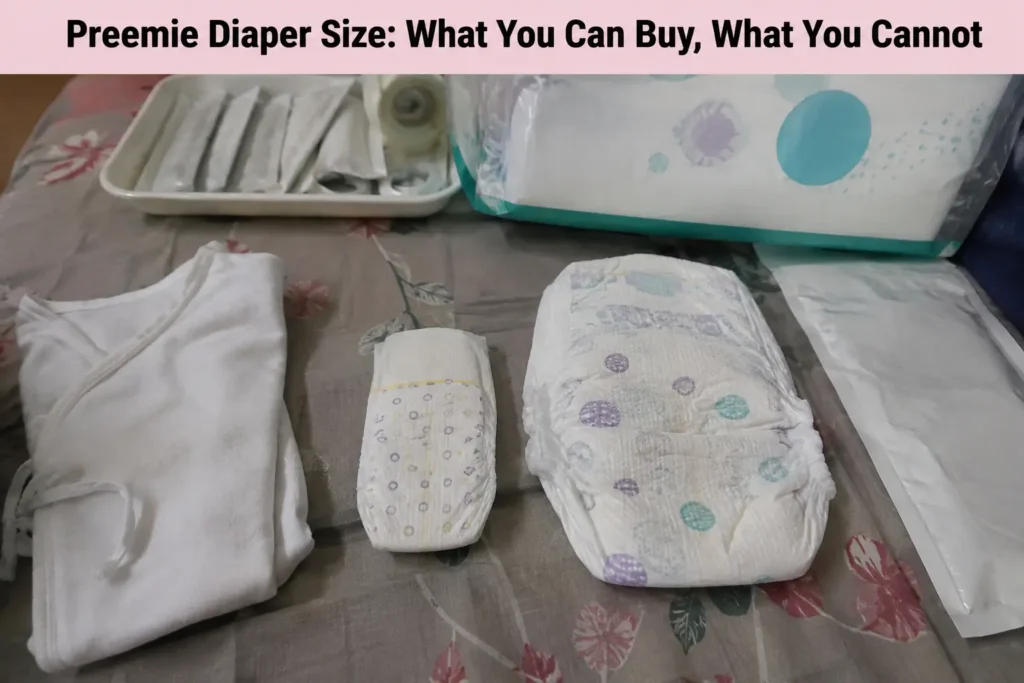
The preemie size you can buy in a store means roughly “under 6 lb”, and everything smaller than that is a hospital product rather than a retail one. Pampers publishes four sub-newborn tiers, and the smallest is described on its own page as being for “extremely premature babies in NICU care”. Families usually cannot buy those at all. Before you buy anything, ask your baby’s NICU team: Pampers says on that same page to “consult your baby’s healthcare provider or NICU team” if you are unsure about sizing or skin, and they are the people who know what your baby is wearing today.
“For preemie diapers, I would not stock up based on size charts alone. Retail preemie sizes usually cover only the upper end of very small babies, while the tiniest hospital-grade sizes are often supplied through NICUs rather than ordinary stores. I prefer checking what the care team is actually using and buying only what will realistically be needed after discharge.”
Ask the NICU team and your pediatrician first, and keep asking them
This is the part that matters more than any chart on this page, so it goes first.
Your baby’s size, skin, feeding and readiness to leave the hospital are clinical questions, and they belong to the people looking after your baby. The American Academy of Pediatrics, on HealthyChildren.org, tells parents of premature babies that “your own pediatrician may participate in, or at least will be informed about, your infant’s immediate care” and that “he will be able to answer most of your questions”. Neopedia, a neonatal parent resource published by the Global Foundation for the Care of Newborn Infants and reviewed by neonatologists including Professor Nicholas Embleton, tells parents that “if you are unsure about what clothing your little one needs, you can always ask the NICU care team or the hospital’s social worker for advice”.
Nothing on this page is a substitute for that conversation, and none of it is advice about your baby. It is a description of what the manufacturers publish and where those products are sold.
The sizes below newborn, as the manufacturers publish them
Pampers lists four tiers below its newborn size on its preemie diapers guide. These are the figures printed on that page, read on 2026-08-24.
| Tier | Weight, as published | How Pampers describes it |
|---|---|---|
| Pxxs | Under 500 g | “Extremely premature babies in NICU care” |
| P3 | Under 800 g (about 1.8 lb) | “Tiny preterm babies needing the smallest standard preemie fit” |
| P2 | Under 1,800 g (about 4 lb) | “Very small premature babies” |
| P1 | Under 2,700 g (about 6 lb) | “Premature or low birth weight babies transitioning toward newborn sizing” |
| Newborn | Under 4.5 kg (about 10 lb) | Standard retail newborn size |
Read the grams, not the pounds. Neonatal units work in grams, your baby’s chart is in grams, and the conversions on the page do not all line up: the smallest tier is given as “under 1 pound (under 500 grams)”, but 500 g is closer to 1 lb 2 oz. That single row is internally inconsistent, which is exactly why the gram figure is the one to carry into a conversation with the unit.
For the smallest Huggies sizes we have one figure we can stand behind. Kimberly-Clark’s own press release of 1 February 2017 announcing the Little Snugglers Nano Preemie diaper describes it as being for “babies weighing less than two pounds (900 grams)”, distributed to hospitals and NICUs rather than to stores and ordered through the company’s healthcare channel. The release quotes Anjanette Lee, an infant development specialist at Memorial Hermann Southwest Hospital in Houston, saying the diapers “conformed to the baby’s bottom without gapping or limiting leg movement”.
What we could not verify. The Huggies size chart page and the Huggies Healthcare product pages both refused to load for us on 2026-08-24, returning an access error. Search listings describe a Micro Preemie size in the 2 to 4 lb band, but we could not read that on the manufacturer’s own page, so we are not printing it as a fact here. Read the pack, or ask the unit.
Hospital-grade and retail are not the same product
This is the sentence that saves parents an evening of fruitless searching.
The tiers below retail preemie size are made for and sold into hospitals. The Nano Preemie release says so directly, naming hospitals and NICUs as the channel. Pampers describes its smallest tier by clinical setting rather than by store shelf. So the diaper your baby is wearing in the NICU today may not have a retail equivalent, and the size number on it may not appear on anything you can put in a cart.
That has two practical consequences. If you want to know what your baby is in, ask the nurse to show you the pack rather than searching for the size online. And if you need a supply of that size after discharge, that is a question for the unit or the discharge planner, because it is a supply question rather than a shopping question.
Most families never need to buy preemie diapers at all
The instinct after a premature birth is to buy the smallest diaper you can find. Two neonatal sources say plainly that this is usually money spent early on a size that will not be needed.
Melissa Braun, a neonatal nurse practitioner writing for NEOwell, states that “most families do not need to spend money on preemie diapers” because “the majority of babies, even many NICU graduates, fit into newborn diapers by discharge”, and that babies going home “are often already in the 5 to 8 lb range, which fits comfortably in newborn diapers”. Neopedia makes the same observation about clothing and diapers, saying “by the time babies go home, most of them will be in normal newborn size”. A baby sitting between the top of preemie size and the bottom of newborn size is in the same kind of overlap every parent meets later on, and the tie-breakers are the same ones set out in our page on how the diaper weight overlaps work.
Both sources add the same qualifier, and it is the important one. NEOwell says “if your baby is being discharged weighing under 5 pounds, your care team will guide you”, and “if you’re unsure, ask your NICU nurse or provider before purchasing”. The AAP describes discharge itself in clinical terms rather than by weight, saying a baby “will be ready to come home once she’s breathing on her own, able to maintain her body temperature, able to be fed by breast or bottle, and gaining weight steadily”. None of those four things is something you can plan a shopping list around, which is why the list waits.
Fit on a very small baby
Fit language on preemie sizes is the same language as anywhere else, with one difference in what is at stake.
Pampers describes a good fit as one that “should feel secure around the waist and legs without gaps, slipping, or tight red marks on the skin”. That is the same standard as any other size, and the general version of it is in our diaper fit and leak troubleshooting guide. Those two failure modes have opposite signatures. Gaps at the leg opening and a waistband above the belly button, with no pressure marks anywhere, is the pattern our page on the signs a diaper is too big walks through. Marks without gaps runs the other way, and the signs a diaper is too small covers that side along with the application faults that imitate it.
The difference is the skin. The AAP writes that in a premature baby, “with so little fat, her skin will seem thinner and more transparent, allowing you actually to see the blood vessels beneath it”. Red marks, broken skin, a rash or anything that looks like a reaction are not a sizing problem to solve with a different pack. Pampers routes skin concerns to the healthcare provider or NICU team on its own page, and that is the right route. If your baby is home, that is a call to your pediatrician, the same way the AAP asks parents to call about a diaper rash that “is not going away, or it is getting worse after two to three days”, one that “includes pimples, peeling skin, blisters, pus-filled or oozing or crusty sores”, or a rash accompanied by a fever.
Where to find them
Retail preemie size sits alongside newborn size at the mass retailers and pharmacies, in small packs rather than boxes, and stock varies by store far more than newborn size does. Medical supply retailers carry a wider range of small sizes than a grocery store will.
Below that band, the answer is the unit. Ask the NICU whether they can supply a starter quantity at discharge, ask what they use, and ask the discharge planner or social worker how families in your situation usually source it. That is a routine question for them and an impossible one for a search engine, because the products are not stocked where you are looking.
FAQ
What weight is preemie diaper size?
At retail it means up to about 6 lb. Pampers publishes its P1 tier as under 2,700 g, which is roughly 6 lb, and describes it as the tier for babies “transitioning toward newborn sizing”. Smaller tiers exist but are hospital products. Read the pack in front of you, because bands differ by manufacturer and change between production runs.
Can I buy micro-preemie or nano-preemie diapers in a store?
Generally no. Kimberly-Clark’s announcement of its smallest size describes distribution to hospitals and NICUs through its healthcare channel rather than to retail. If your baby needs that size, the supply conversation is with the unit.
My baby is home and still under 6 lb. What size?
That is a question for your pediatrician and the NICU team who discharged your baby, not for a chart. What we can say is what the sources say: NEOwell notes that most NICU graduates fit newborn size by discharge and that a care team guides families whose baby goes home under 5 lb.
Do preemie diapers have an umbilical cord notch?
Some lines do and some do not, and it is a line feature rather than a property of the size, so check the pack. The AAP asks parents to “keep the diaper folded below the cord to keep urine from soaking it” while the stump is healing, which is the job the notch is designed to make easier.
Should I stock up on preemie size before a premature birth?
Two neonatal sources argue against it. NEOwell says most families do not need to spend money on preemie diapers, and Neopedia says most babies are in normal newborn size by the time they go home. Both send the same question to the same place: ask the NICU nurse or provider before buying.
Sources
- Pampers, “Preemie Diapers Guide: Sizes, Fit and Tips”, read 2026-08-24, for the Pxxs, P3, P2 and P1 weight tiers, the fit description and the routing to a healthcare provider or NICU team.
- Kimberly-Clark / Huggies press release, “New Huggies Brand Diaper Innovation to Help the Smallest Babies”, 1 February 2017, for the Nano Preemie weight figure, its hospital and NICU distribution, and the quote from Anjanette Lee, MS, CCC/SLP, Memorial Hermann Southwest Hospital.
- HealthyChildren.org (American Academy of Pediatrics), “Caring for a Premature Baby” for skin and discharge readiness, “Umbilical Cord Care in Newborns” for cord care, and “Diaper Rash” for the reasons to call a pediatrician.
- NEOwell, “Skip the Preemie Diapers: Why Most Families Only Need Newborn Size”, by Melissa Braun, neonatal nurse practitioner, read 2026-08-24.
- Neopedia (Global Foundation for the Care of Newborn Infants), going-home checklist, reviewed by Prof. Nicholas Embleton, Dr Angela Gregoraci and Dr Kai König, updated May 2025.
Author Profile
-
Saima Mostari is the founder and author of BelovedTots. She has raised two young children, Pona and Ruku, and spent years working in child development at Neurosparks, a therapy center that provides Speech Therapy, Occupational Therapy, and ABA Therapy for children with developmental needs.
It was there, watching long therapy sessions get interrupted by leaking, ill-fitting diapers, that she began researching which products actually perform under real-world conditions, not just on the packaging.
She holds a Master's in Psychology and Guidance from the University of Dhaka, and brings a behavioral observation lens to every product she reviews. When she's not testing diapers or writing guides, she's probably negotiating bedtime with a 4-year-old.
Latest entries
- September 30, 2026Diaper Brands and ComparisonsLuvs vs Pampers: P&G’s Budget vs Premium Line
- September 27, 2026Diaper Brands and ComparisonsKirkland Diapers vs Huggies: What’s Different in 2026
- September 26, 2026Diaper Brands and ComparisonsKirkland Diapers Review: What Costco’s Diaper Is Now
- September 24, 2026Diaper Brands and ComparisonsHuggies Little Snugglers vs Snug and Dry: Which Fits?