Kirkland Diapers vs Huggies: What’s Different in 2026

Kirkland diapers vs Huggies used to be an easy comparison to answer: for close to two decades, Costco’s Kirkland Signature diapers and Huggies were made by the same company, Kimberly-Clark, in the same plants. That changed in January 2025, when Costco moved Kirkland diaper production to a different manufacturer, First Quality. The two brands still look and fit similarly in a lot of ways, but they are no longer built by the same hands, and the differences that matter to a parent standing in the aisle are sizing range, fit, and how each brand documents what is in the diaper.
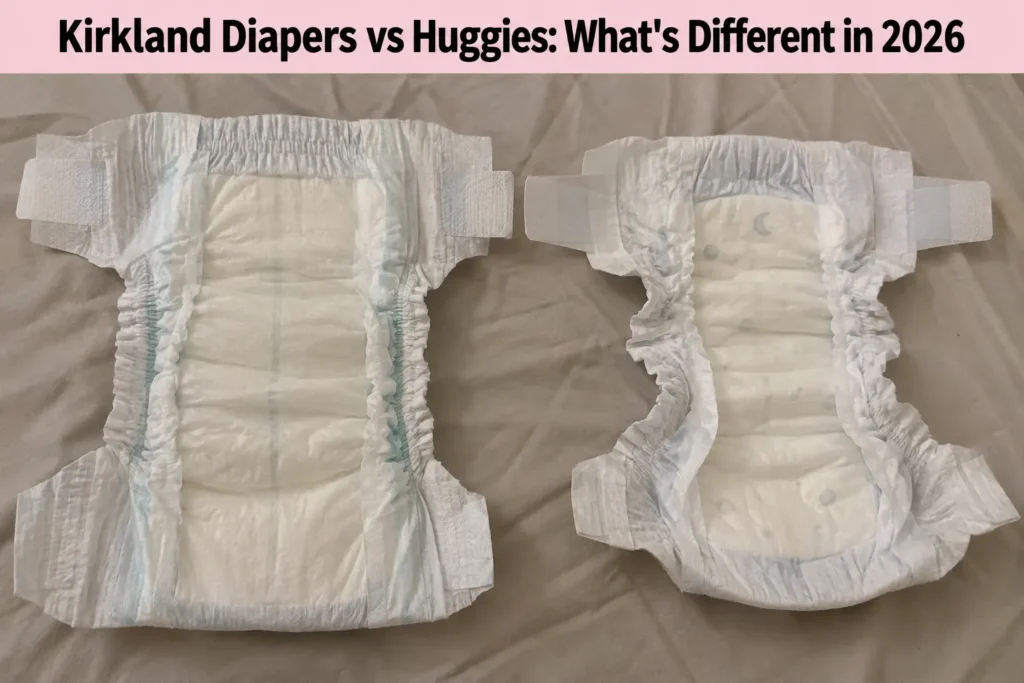
“Switching between Kirkland and Huggies in the same size taught me to pay much more attention to the actual fit than the number printed on the box. Since Kirkland changed manufacturers, I no longer assume it will sit on the waist and legs the way an older Kirkland diaper did, or the way Huggies does now. I check for gaps, red marks, and how the cuffs sit after a few changes before deciding whether the new box really works for my child.”
Who Actually Makes Kirkland Diapers and Huggies Now
For years, the “same maker” claim was true and it explained why Kirkland diapers felt like a lower-cost cousin of Huggies: similar core construction, similar fastening style, a familiar fit. Industry trade press reporting in December 2024 confirmed that Kimberly-Clark, the maker of Huggies, was ending its private-label diaper contract with Costco to focus on its own branded products, and that First Quality took over Kirkland Signature diaper production starting in January 2025.
That switch matters more than it sounds. A new manufacturer means a new production line, its own material sourcing, and its own quality process, even if Costco kept the Kirkland Signature name and packaging style. Any parenting article that still describes Kirkland and Huggies as “the same diaper” is describing how things were before 2025, not how they are now. Neither company has published a side-by-side spec sheet showing exactly what changed in the switch, so the honest answer is that Kirkland is a related design lineage, not a current twin.
Sizing: Where Kirkland Diapers vs Huggies Really Diverge
The clearest, easiest-to-verify difference is the size range each brand actually covers. As listed on Costco’s own product pages (checked September 18, 2026), Kirkland Signature diapers run from size 1 (up to 14 lbs) through size 7 (41+ lbs), with no dedicated newborn or preemie size. If you have a baby under about 8 to 10 lbs, Kirkland is not an option on day one; you would start there once your baby reaches size 1. For a full breakdown of how every major brand’s sizes line up against each other by weight, the cross-brand size chart is the fastest way to check before you buy a case.
Huggies covers more of the newborn window under its Little Snugglers line, which the brand’s own site lists as running from Preemie (up to 6 lbs) through Newborn (up to 10 lbs) and sizes 1 through 6. That means a family bringing home a smaller newborn has a Huggies option Kirkland does not offer at all. On the other end, Kirkland’s jump to a size 7 is notable because relatively few mainstream brands go that large; if your toddler has outgrown standard size 6 diapers, Size 7 and Size 8 Diapers: Who Makes Them and When You Need Them explains which brands offer that size and when a family actually needs it versus when a fit fix would solve the problem instead.
Fit and the Leak Mechanism
Sizing on the box is only half the story. Most leaks are not really a “wrong size” problem, they are a fit problem: gaps at the leg cuffs, a waistband that sits too low or too high, or a diaper left on past the point the absorbent core can keep up. On its own Little Snugglers product page (checked September 18, 2026), Huggies describes baby-shaped curves and stretchy leg cuffs designed to contain mess at the points where leaks typically start. Kirkland’s own product listings describe a more basic elastic waistband and leg fastening design with a breathable, partly plant-based outer cover, without the same level of contoured design detail published on the box or product page.
In practice, this is why two diapers in the “same” size number can behave differently on the same baby. Before assuming a diaper is defective or a brand is “bad,” it’s worth checking that the diaper itself is on correctly: How to Put a Diaper On So It Does Not Leak walks through the waistband and leg-cuff positioning that causes most preventable leaks, regardless of which brand is in the box.
Skin, Labels, and What “Hypoallergenic” Actually Means
Both brands use language like “hypoallergenic” or “gentle on sensitive skin” on their packaging, and both list themselves as free of certain additives such as fragrance, lotion, or latex depending on the specific line. It’s worth knowing that “hypoallergenic” is a marketing term, not a regulated one: the FDA has stated it has no formal definition or standard for the word when it appears on a consumer product, and a company can apply it without submitting testing to back it up. That does not mean the claim is meaningless, only that it should be read as “this company chose not to include some common irritants,” not as a guarantee that a specific baby will not react.
Diaper rash itself is usually about moisture and friction more than the diaper brand. The American Academy of Pediatrics’ HealthyChildren.org (checked September 18, 2026) notes that changing a wet or soiled diaper promptly, roughly every three to four hours or sooner, is one of the most effective ways to prevent most diaper rash, regardless of which brand is used. If a rash shows up, persists, or looks unusual, that is a question for your pediatrician, not a diaper choice. The site’s diaper rash guide covers what the condition actually is, what generally helps, and when a rash needs medical attention rather than a different box of diapers.
Absorbency and Overnight Use
Neither Kirkland nor Huggies publishes a directly comparable absorbency capacity figure on its own site, so any specific number you see quoted online (cups of liquid held, hours of protection) should be treated as an estimate from an independent reviewer, not a verified spec from either company. What each brand does publish is a wetness indicator on most of its lines, which tells you when a diaper is wet rather than how much more it can hold. If overnight leaks are the actual problem you’re trying to solve, the size or brand switch may not be the fix at all; a size-specific overnight line or a booster pad often solves it more reliably than swapping brands.
Price and Everyday Value
Kirkland Signature diapers are sold in larger case sizes and are generally positioned by Costco as the lower-cost-per-diaper option, which lines up with the store-brand role Kirkland plays across Costco’s product lineup generally. Huggies, sold at a wider range of retailers in smaller pack sizes, is priced as a name-brand product with more line variations (overnight, sensitive-skin, training pants) to choose from. Because both retailers and manufacturers adjust pricing and pack sizes often, treat any specific per-diaper cost you see quoted as a snapshot in time rather than a fixed number, and check current pricing at the store or site before you buy a case based on price alone.
Which One Actually Fits Your Baby
There is no single “better” answer here, because fit is specific to a baby’s body shape, not just their weight. A baby with slim legs and a Huggies box built around a snugger contoured cuff may do fine, while a baby with more room in the thighs or a wider torso may fit a Kirkland diaper’s more basic elastic band just as well, or better. The most reliable way to decide is a small test pack of each in your baby’s current size, worn for a day, checking for gapping at the legs and waist rather than judging by the brand name on the box.
FAQ
Are Kirkland diapers still made by the same company as Huggies?
No, not anymore. Kimberly-Clark, which makes Huggies, ended its Kirkland Signature diaper contract with Costco, and First Quality became the new manufacturer starting in January 2025, per industry trade press reporting from December 2024.
Does Kirkland make a newborn or preemie diaper?
No. Based on Costco’s own product listings, Kirkland Signature diapers start at size 1 (up to 14 lbs); there is no dedicated newborn or preemie Kirkland size. Huggies’ Little Snugglers line covers Preemie and Newborn sizes in addition to sizes 1 through 6.
Is Kirkland or Huggies more absorbent?
Neither company publishes a directly comparable absorbency spec, so there is no verified figure to compare. If leaking is the problem, checking fit and change frequency first is more reliable than assuming one brand holds more than the other.
Can I switch between Kirkland and Huggies in the same size?
Generally yes, since both use standard US sizing by weight, but because the two brands now come from different manufacturers, fit at the leg and waist can differ even in the same labeled size. Watch for gapping or marks on the skin when you switch and adjust size if needed.
Does “hypoallergenic” on the box mean my baby won’t react to it?
No. The FDA has said there is no formal, regulated definition of “hypoallergenic,” so it is a marketing claim rather than a tested guarantee. If your baby shows signs of a reaction to any diaper, that is a question for your pediatrician.
Author Profile
-
Saima Mostari is the founder and author of BelovedTots. She has raised two young children, Pona and Ruku, and spent years working in child development at Neurosparks, a therapy center that provides Speech Therapy, Occupational Therapy, and ABA Therapy for children with developmental needs.
It was there, watching long therapy sessions get interrupted by leaking, ill-fitting diapers, that she began researching which products actually perform under real-world conditions, not just on the packaging.
She holds a Master's in Psychology and Guidance from the University of Dhaka, and brings a behavioral observation lens to every product she reviews. When she's not testing diapers or writing guides, she's probably negotiating bedtime with a 4-year-old.
Latest entries
- September 30, 2026Diaper Brands and ComparisonsLuvs vs Pampers: P&G’s Budget vs Premium Line
- September 27, 2026Diaper Brands and ComparisonsKirkland Diapers vs Huggies: What’s Different in 2026
- September 26, 2026Diaper Brands and ComparisonsKirkland Diapers Review: What Costco’s Diaper Is Now
- September 24, 2026Diaper Brands and ComparisonsHuggies Little Snugglers vs Snug and Dry: Which Fits?