Honest Diapers vs Pampers Pure: What Changed in 2026

Short answer: Honest diapers vs Pampers Pure is no longer a like-for-like shelf choice. Honest Clean Conscious Diapers are still on Honest’s own site, in sizes Newborn to 7, made without fragrance, elemental chlorine, parabens and natural rubber latex. Pampers Pure is not on Pampers’ US site: when we checked on September 24, 2026, its product page returned a not-found error and the Pampers lineup did not list it. Procter & Gamble describes its newer Pampers AMORE as “an evolution” of Pure. So today the real comparison is Honest against leftover Pure stock, or Honest against AMORE.
Nothing on this page was tested on a baby. Every product claim below was read from the makers’ own pages on September 24, 2026, and the skin statements come from the American Academy of Pediatrics. Where a maker no longer publishes something, we say so instead of filling the gap.
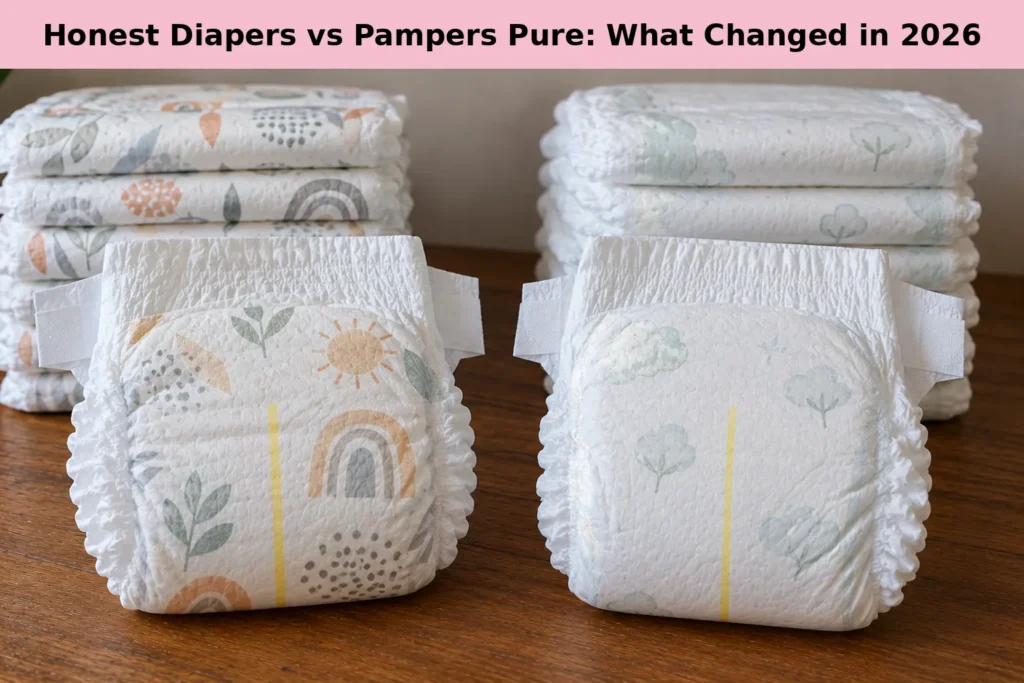
“Seeing a familiar diaper line disappear from the current lineup would make me much more careful about buying leftover stock based on old reviews. If I were choosing between Honest and an older pack of Pampers Pure now, I would read that exact pack rather than assume the old Pure details still apply, because Pampers has moved on to AMORE with its own size chart and materials. Honest feels simpler to compare today because its current page still spells out the sizes, fragrance-free claim, umbilical cutout, and materials, while any remaining Pure pack has to be judged by the label in my hand.”
What happened to Pampers Pure
Pampers Pure launched in 2018 as P&G’s sensitive-skin diaper. That date comes from P&G itself. Its March 16, 2026 launch release for AMORE, as published on Yahoo Finance and read September 24, 2026, calls AMORE “the brand’s first new diaper for newborns and toddlers since the launch of Pampers Pure® in 2018.”
The same release describes AMORE as “an evolution to the trusted foundation of Pampers Pure” and adds: “While both Pampers AMORE and Pampers Pure are designed for sensitive skin, Pampers AMORE offers a more advanced design with enhanced absorbency.”
Here is what Pampers’ own US site showed on September 24, 2026:
- The Pampers Pure product page returned a not-found error.
- An older Pampers Pure Protection address opened the AMORE page instead.
- The “All Diapers and Wipes” page listed AMORE, Swaddlers, Swaddlers 360, Cruisers 360, Zzz, Baby-Dry and Swaddlers Ultra Day + Night, plus Easy Ups, Easy Ups Ultra and Splashers. Pure was not on it.
What we did not find is a statement from P&G that Pure is discontinued, and the launch release does not say so either way. Packs may still sit on some shelves. With no current maker page, though, the label on the pack in your hand is the only up-to-date source for that pack, so read its size chart and materials list instead of relying on an older review.
Honest Diapers vs Pampers Pure at a glance
Because Pampers no longer publishes a Pure page, the Pampers column below is AMORE, the line P&G calls Pure’s evolution. Honest’s details come from the Honest Clean Conscious Diapers page and Pampers’ from its AMORE product page, both read September 24, 2026.
| Honest Clean Conscious Diapers | Pampers AMORE | |
|---|---|---|
| Current maker page | Yes | Yes (no current page found for Pure) |
| Sizes | Newborn to 7 | Newborn to 7 |
| Made without / free of | Fragrance, elemental chlorine, parabens, natural rubber latex | Fragrance, parabens, elemental chlorine and latex (no natural rubber) |
| Layer against skin | Inner layer listed as polyethylene and polypropylene | Polypropylene and polyethylene topsheet with an added “Emollient/Balm” |
| Wood pulp | “Elemental Chlorine Free (ECF)” | Cellulose, listed as elemental chlorine-free and FSC-certified |
| Skin wording | “dermatologist tested, hypoallergenic, and fragrance-free” | “Hypoallergenic”; “Dermatologically accredited by the Skin Health Alliance” |
| Chemical testing claim | OEKO-TEX STANDARD 100, “3rd party tested for 350 harmful chemicals” | “Third party lab tested for 1000+ chemicals” |
| Wetness indicator | All sizes | Yes, a water-soluble colorant |
| Umbilical cutout | Newborn and size 1 | Not mentioned on the page |
| Leak or dryness claim | “up to 100% leak protection,” sizes 3 to 7, versus Honest’s old diaper | Claims against Coterie and Huggies, not Honest |
Sizing: where the two weight bands split
The smallest sizes match. Honest lists Newborn up to 10 lb and size 1 at 8 to 14 lb. AMORE lists Newborn under 10 lb and size 1 at 8 to 14 lb. From size 2 on, the charts go separate ways.
| Size | Honest | Pampers AMORE |
|---|---|---|
| 2 | 12 to 18 lb | 10 to 22 lb |
| 3 | 16 to 28 lb | 13 to 26 lb |
| 4 | 22 to 37 lb | 15 to 34 lb |
| 5 | 27+ lb | 20 to 37 lb |
| 6 | 35+ lb | 23 to 44 lb |
| 7 | 41+ lb | 26 to 50 lb |
Read the chart at 20 lb. On Honest’s chart, a 20 lb baby fits one size: size 3. On AMORE’s chart, the same baby falls inside four: sizes 2, 3, 4 and 5. Neither chart is wrong. AMORE’s bands are wide and overlap heavily, so weight alone does not pick the size; the fit on your baby does. Honest’s bands are narrower, which makes the box easier to choose and means your baby crosses into the next size sooner.
That matters most when you move between the brands. The size number does not carry across. Start from your baby’s weight on the new chart, then check the fit: gaps at the legs, red marks at the waist or thighs, and how far the tabs have to stretch to close. Our guide on when to size up diapers explains how to read an overlap like AMORE’s without guessing.
What touches your baby’s skin
On paper, this is where the two lines differ most, and it is not where the marketing points.
Honest’s page promotes a “Plant-Based Inner Liner” for “gentle skin contact where it matters most.” Its full materials list, on the same page, names the inner layer as “Polyethylene & Polypropylene” and attaches the plant-based label to the outer layer: “Plant-Based PLA & Polyethylene.” The page does not say what share of the liner is plant-derived. The core is “Elemental Chlorine Free (ECF) Wood Pulp” with “Sodium Polyacrylate Containing Renewable Materials & Odor Inhibitors Including Citrus Extract & Liquid Chlorophyll,” and the prints sit on the backsheet as inks.
AMORE’s list differs in a way some parents care about. Pampers says its topsheet includes an “Emollient/Balm,” which it describes as “a cosmetic ingredient added to the topsheet.” Honest’s materials list names no lotion or balm. If you are trying to keep lotions off your baby’s skin, this is a real difference, and it sits on the one layer that touches skin. Pampers also lists pigments in the cuffs and outer cover and says they are positioned away from the baby’s skin.
Neither of these facts makes one diaper better. They tell you what to look for on the pack if your pediatrician has asked you to rule out a specific ingredient.
“Hypoallergenic” and the other label claims
Both brands print “hypoallergenic,” so that word will not separate them. The FDA’s page on hypoallergenic cosmetics, read September 24, 2026, states: “There are no Federal standards or definitions that govern the use of the term ‘hypoallergenic.'” It adds that manufacturers of cosmetics labeled hypoallergenic “are not required to submit substantiation of their hypoallergenicity claims to FDA.” That page covers cosmetics, and we did not find a separate US definition for diapers.
The claims that can separate them are the specific ones:
- Honest names four things it is made without, an OEKO-TEX STANDARD 100 certification that its page describes as “3rd party tested for 350 harmful chemicals,” and FSC certification for its fluff pulp.
- AMORE names four things it is free of, says it is “Third party lab tested for 1000+ chemicals,” and cites accreditation by the Skin Health Alliance.
The two “made without” lists overlap almost completely: fragrance, parabens, elemental chlorine and natural rubber latex appear on both. The testing claims do not compare as neatly. The 350 and the 1000+ come from different programs checking against different lists, so they are not a score. Each tells you the maker had its diaper screened against a named list. Neither tells you how your baby’s skin will respond.
Reading the leak and dryness claims
Honest’s page claims “up to 100% leak protection.” Two footnotes narrow it: “sizes 3-7 only” and “compared to our old diaper.” The comparison is with Honest’s own earlier diaper, not with Pampers or anyone else.
Pampers makes two comparison claims for AMORE, and neither involves Honest. It says AMORE diapers “absorb 3X faster vs Huggies Skin Essentials” and keep baby “3X drier vs Coterie.” Both footnotes describe size 4 diapers given three 75 ml loads under 0.5 psi of pressure. Those are Pampers’ own lab results. Neither maker’s page, as we read it, publishes a head-to-head of Honest against AMORE.
Lab loads measure the core. Many leaks happen at the edges instead: a gap at the thigh, a waist sitting low at the back, a leg ruffle tucked inside. That is why a diaper with a strong lab number can hold on one baby and leak on another. If your leaks come from the legs, why diapers leak at the legs walks through the fit causes before you blame the brand.
Which one fits your situation
| If this is you | What the maker pages point to | Check before you buy |
|---|---|---|
| Newborn with the cord stump still healing | Honest publishes an umbilical cutout in Newborn and size 1 | AMORE’s page did not mention one; look at the pack |
| You want no lotion or balm on the liner | Honest’s list names none; AMORE adds an emollient/balm | The materials list on the pack |
| Your baby sits between sizes | AMORE’s overlapping bands give more than one size to try | Fit at the legs and waist, not the number |
| You prefer a simpler chart | Honest’s bands are narrower | Expect to size up sooner |
| You found Pure and it works | Only that pack’s label is current | AMORE has its own chart and materials |
| You want a wetness indicator | Both list one | Nothing extra |
If you are still weighing the wider shelf, the “sensitive” wording on each box means different things from brand to brand, and best diapers for sensitive skin sets those claims side by side.
Skin reactions, switching and when to call
Some parents compare these two because of their baby’s skin. The American Academy of Pediatrics’ HealthyChildren.org diaper rash page, written by Ingrid Polcari, MD, FAAP, last updated December 18, 2024, and read September 24, 2026, notes: “Common allergens include dyes or elastics in the diaper, and fragrances or preservatives in diaper wipes or creams.” It adds: “Switching brands or types of products for a 2-week period can sometimes help sort this out.”
The same page lists when to contact your pediatrician: a rash that is not clearing or gets worse after 2 to 3 days of treatment; a rash with pimples, peeling, blisters, or pus-filled or crusty sores; a bright pink or red rash with red spots at the edges in a baby taking antibiotics; a rash that is especially painful; or a fever with the rash.
Neither Honest nor AMORE treats or prevents diaper rash. If your baby’s skin is not settling, your pediatrician is the next step, not the next box. Our diaper rash guide covers what the AAP says about causes and when to call.
FAQ
Is Pampers Pure discontinued?
We found no statement from P&G saying so. On September 24, 2026, Pampers’ US site did not list Pure, its product page returned a not-found error, and P&G’s March 2026 release describes Pampers AMORE as “an evolution” of Pure. Some stores may still carry packs.
Is Pampers AMORE the same diaper as Pampers Pure?
Not by P&G’s own description. Its release says AMORE “offers a more advanced design with enhanced absorbency.” AMORE has its own size chart, from Newborn under 10 lb to size 7 at 26 to 50 lb, and its topsheet includes an emollient or balm.
Are Honest diapers plant-based?
In part, by Honest’s own list. It labels the outer layer “Plant-Based PLA & Polyethylene” and says its absorbent polymer contains renewable materials. The inner layer is listed as polyethylene and polypropylene, and the page promotes a plant-based inner liner without saying what share of it is plant-derived.
Do Honest diapers and Pampers AMORE have a wetness indicator?
Yes, both do, according to their pages. Honest lists one on all sizes. Pampers says AMORE uses a water-soluble colorant that changes color when wet with urine.
Does “hypoallergenic” on either box mean anything?
Not by any US standard we found. The FDA states there are no federal standards or definitions for the term, on a page written about cosmetics. The specific “made without” lists tell you more.
Last checked
Every claim on this page was read from its source on September 24, 2026: Honest’s product page, Pampers’ AMORE page and US lineup page, P&G’s March 16, 2026 release, the FDA’s hypoallergenic cosmetics page and the AAP’s HealthyChildren.org diaper rash page. Pampers Pure had no current maker page that day. Packs already on shelves can differ from what a maker publishes now, so the pack label is the final word for the box you buy.
Author Profile
-
Eamin Hosen is the founder and author of BelovedTots. He has raised two young children, Pona and Ruku, and spent years working in child development at Neurosparks, a therapy center that provides Speech Therapy, Occupational Therapy, and ABA Therapy for children with developmental needs.
It was there, watching long therapy sessions get interrupted by leaking, ill-fitting diapers, that he began researching how products perform during everyday use and where their performance falls short of packaging claims.
He holds a Master’s in Psychology and Guidance from the University of Dhaka and brings a behavioral observation lens to every product he reviews. When he’s not testing diapers or writing guides, he’s probably negotiating bedtime with a 4-year-old.
Latest entries
- November 13, 2026Diaper Brands and ComparisonsBamboo Diapers: Viscose, Rayon and the Box Claims
- November 12, 2026Diaper Rash and SkinHypoallergenic Diapers: What the Word Really Promises
- November 11, 2026Diaper Brands and ComparisonsChlorine Free Diapers Meaning: TCF vs ECF Explained
- November 10, 2026Diaper Brands and ComparisonsEco Friendly Diapers: What the Labels Actually Mean