Kudos Diapers Review: The Cotton Topsheet Explained

This Kudos diapers review answers one question: what does “100% cotton” actually cover? Per Kudos’s own product page, read September 25, 2026, the cotton is the topsheet, the single layer that sits against your baby’s skin. The core underneath is wood pulp and a superabsorbent polymer, and the backsheet, outer cover and tabs are listed as polyethylene and polypropylene. So Kudos is a cotton-lined disposable, not a cotton diaper. That is a real difference from most boxes, and it is also narrower than “cotton diaper” suggests.
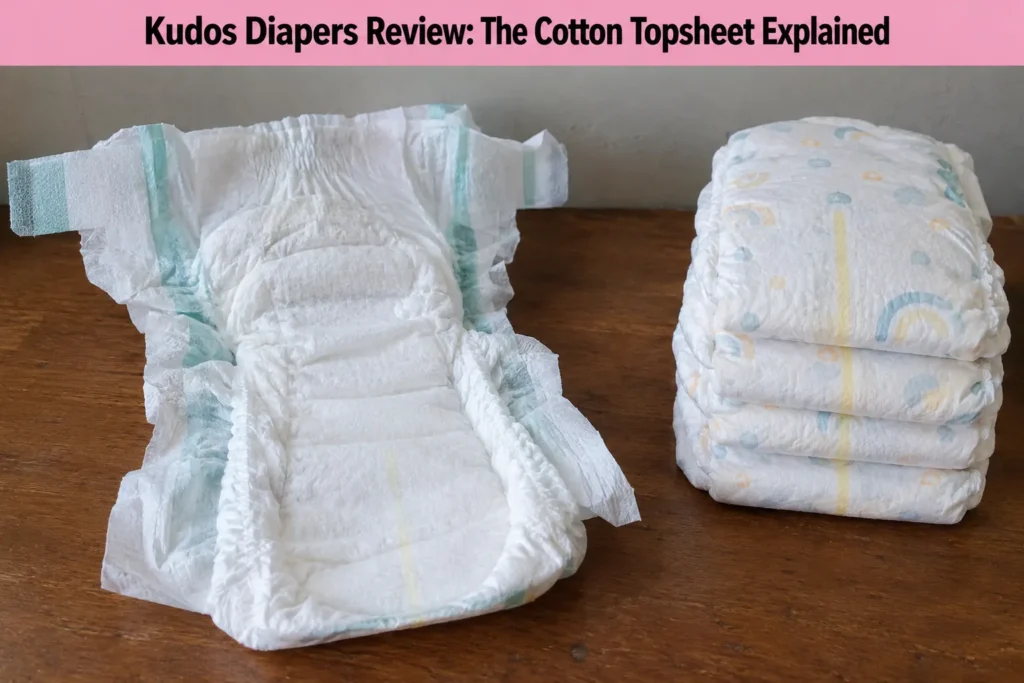
“The cotton topsheet is the part of Kudos that would matter most to me, because that is the layer actually touching my child’s skin. I would not treat it as an all-cotton diaper or assume cotton automatically means fewer rashes, though, since the absorbent core and outer shell still use the usual pulp, polymer, and plastic materials. I would also watch the waist fit closely near the top of a size range, because the stiffer feel and less-stretchy tabs could make sizing up sooner the more comfortable choice.”
How this review was done
Nothing on this page was tested on a baby. This is a research-based review. We read Kudos’s own product page, quoted its wording, dated the read, and checked each label term against the body that defines it. Where an outside reviewer ran a hands-on test, that reviewer is named and dated, and the finding stays theirs.
You will not find a price, a star rating or a ranking here. Prices change, star ratings belong to retailers, and a ranking would need a test we have not run. What you will find is each claim in Kudos’s words, what it covers, and what it leaves out.
What Kudos says each layer is made of
Every quote in this table comes from the Kudos diaper product page, read September 25, 2026. Brands revise these pages, so the pack in your hands wins if it differs.
| Part | Kudos’s wording | What it tells you |
|---|---|---|
| Topsheet (against skin) | “100% U.S.-sourced cotton” | The skin-facing layer is cotton. |
| Absorbent core | “Total Chlorine Free (TCF), FSC-certified sustainably harvested wood pulp; Premium SAP” | Pulp plus a superabsorbent polymer. |
| Backsheet | “Breathable Film: Polyethylene” | A plastic film holds the wetness in. |
| Outer cover | “PE/PP blend” | Polyethylene and polypropylene on the outside. |
| Tabs | “Closure system: Standard polypropylene materials” | Plastic fasteners. |
| Made without | “Made without lotions, fragrances, natural latex, parabens, phthalates, and chlorine” | A list of absences, not a health claim. |
| Absorbency | “12+ hour absorbency to outsmart leaks day + night” | A duration, with no test method or volume given on the page. |
Read top to bottom, the table makes the design clear. Kudos changed the layer your baby touches and kept a pulp-and-polymer absorbent core and a plastic outer shell. That is not a criticism. A disposable diaper needs something waterproof on the outside, and Kudos lists its materials plainly rather than hiding them behind one word.
What the cotton topsheet changes in practice
The topsheet is the layer a baby’s skin rests on for hours a day, so it is a reasonable place for a brand to focus. Kudos made that layer cotton. Three practical things follow.
It feels different. Parents who choose Kudos usually do so for the feel and the idea of a plant fiber against skin. That is a preference, and a legitimate one. It is not, on its own, evidence of fewer rashes.
It may hold a little more dampness at the surface. PureWow’s reviewer, Pamela Masin, in a review dated February 5, 2026, found the diapers “slightly more damp than other diapers” she tested, noting that “synthetic materials tend to hold liquid better.” She did not describe it as a problem in her use. It is one tester’s observation, not a measurement.
It is a little stiffer. The same PureWow review said the cotton topsheet makes the material “a bit more stiff than your average diaper,” so the tabs “don’t stretch as much across the waist.” That matters for fit, which is the next section.
Kudos sizes, and the stiffness question
Kudos lists these weight ranges on the same product page, read September 25, 2026. There is no Newborn size on the page; the range starts at Size 1.
| Kudos size | Kudos’s weight range |
|---|---|
| 1 | 7 to 12 lbs |
| 2 | 9 to 16 lbs |
| 3 | 14 to 24 lbs |
| 4 | 20 to 32 lbs |
| 5 | 25+ lbs |
| 6 | 32+ lbs |
Two fit points come out of this. First, if your baby is born under 7 lbs, Kudos’s own chart does not cover them yet. Our guide to newborn vs size 1 diapers explains what to buy for the first weeks when a brand starts at Size 1.
Second, the ranges overlap, and overlap is where fit decides. PureWow’s advice was direct: “If your child is on the higher end of a size bracket, I would size up,” because the tabs give less. That fits the mechanism. A diaper that stretches less at the waist has less room to cover a baby at the top of its range, so tabs that barely reach the landing zone, or marks at the waist and legs, are the cue to check the next size rather than tighten harder.
The label words: cotton seal, OEKO-TEX, hypoallergenic
Kudos’s page carries three kinds of label language. Each one says something specific, and none of them says “this diaper will suit your baby’s skin.”
The cotton seal. Kudos’s page says it carries the “Cotton Natural Seal from Cotton Inc.” Cotton Incorporated’s CottonWorks licensing page, read September 25, 2026, describes its Seal of Cotton program as helping “consumers to easily identify products made with cotton,” and says brands submit a product information sheet covering “cotton content and material composition” plus a sample. In plain terms, the seal is about cotton being in the product. It is not a skin test or an absorbency rating.
OEKO-TEX STANDARD 100. Kudos’s page lists this certification. We did not read the certificate for this product, so we can tell you only that Kudos claims it, not what the certificate covers.
Hypoallergenic. Kudos describes the liner as “100% breathable, hypoallergenic cotton.” The FDA’s Hypoallergenic Cosmetics page, read September 25, 2026, states: “There are no Federal standards or definitions that govern the use of the term ‘hypoallergenic.'” It adds: “The term means whatever a particular company wants it to mean.” That page is written about cosmetics, and we did not find a separate US definition for diapers.
What pediatric sources say about diapers and skin
A material choice is not a rash plan, and no brand’s label can tell you how your own baby’s skin will respond. On its diaper rash page, the American Academy of Pediatrics on HealthyChildren.org, read September 25, 2026, names irritant dermatitis as the most common type of diaper rash and says “Common allergens include dyes or elastics in the diaper, and fragrances or preservatives in diaper wipes or creams.”
Kudos’s made-without list names fragrances and lotions. Its page does not say whether the diaper contains dyes or elastics. The AAP page also says: “Change diapers frequently. Moisture from leaving a wet or soiled diaper on too long can cause skin to chafe.” That applies whatever the topsheet is made of.
If your baby has a rash and you are weighing a switch to Kudos, bring that question to your pediatrician first, who can tell an irritant rash from an allergic one or a yeast rash. Our diaper rash guide sets out the AAP’s list of when to call, and our guide to what “sensitive” means on each diaper box reads the same label words across other brands.
What an outside tester found
We ran no leak or absorbency test, so the only hands-on findings on this page belong to someone else. PureWow’s February 5, 2026 review describes a year of comparing diaper brands, with Kudos used on a 14-month-old. The reviewer said the diapers “definitely lived up to the brand’s claim that they were leakproof,” and credited “wide inner and outer ruffles.” On the other side of the ledger, she noted the dampness and stiffness covered above.
PureWow’s page says “some items may be gifted to us” and that it uses affiliate links. Read any diaper review, this one included, with its disclosure and its method in mind: one baby, one household and one reviewer’s judgment are a data point, not a verdict.
Kudos diapers review: what it concedes and who it suits
Every product concedes something. Here is Kudos’s list, drawn only from the sources above.
- The cotton is one layer. The topsheet is cotton; Kudos lists the backsheet, outer cover and tabs as polyethylene and polypropylene.
- The core is pulp and polymer. Kudos lists wood pulp and “Premium SAP,” the same basic absorbent approach most disposables describe.
- No Newborn size. Kudos’s chart starts at Size 1, 7 to 12 lbs.
- Stiffer, with less tab stretch. Per PureWow’s tester, which can push some babies up a size sooner.
- Slightly damper surface. Also per PureWow, who said synthetics tend to hold liquid better.
- “Hypoallergenic” has no federal definition, per the FDA.
- “12+ hour absorbency” has no stated method on the page.
Who it suits: a parent whose deciding factor is a plant fiber against the skin, who reads labels closely, and whose baby is already at least 7 lbs. Who it may not suit: a parent chasing a leak problem. Leaks are usually a fit problem first, and a stiffer diaper at the top of its size range can make fit harder, not easier. Our map of diaper brands and who makes what shows where Kudos sits among the premium and mainstream lines.
FAQ
Are Kudos diapers 100% cotton?
No. Kudos’s product page, read September 25, 2026, says the topsheet is “100% U.S.-sourced cotton.” The core is wood pulp and a superabsorbent polymer, the backsheet is polyethylene film, the outer cover is a polyethylene and polypropylene blend, and the tabs are polypropylene.
Do Kudos diapers make a newborn size?
Not on the product page we read on September 25, 2026. The chart starts at Size 1 for 7 to 12 lbs. A baby under 7 lbs is below the first listed range.
Do Kudos diapers run small?
Kudos does not say so. PureWow’s February 5, 2026 review found the cotton topsheet makes the diaper stiffer, so the tabs stretch less across the waist, and the reviewer advised sizing up when a child is near the top of a size range.
Are Kudos diapers good for sensitive skin?
No diaper label can answer that for your baby. Kudos calls its liner “hypoallergenic,” and the FDA says the term has no federal definition. The AAP lists dyes and elastics in diapers among common allergens. A rash or skin question belongs with your pediatrician.
What is the Cotton Natural Seal on Kudos?
It is a Cotton Incorporated mark that Kudos says it carries. Cotton Incorporated describes its seal program as a way for shoppers to identify products made with cotton. It speaks to cotton content, not to absorbency or skin performance.
Author Profile
-
Eamin Hosen is the founder and author of BelovedTots. He has raised two young children, Pona and Ruku, and spent years working in child development at Neurosparks, a therapy center that provides Speech Therapy, Occupational Therapy, and ABA Therapy for children with developmental needs.
It was there, watching long therapy sessions get interrupted by leaking, ill-fitting diapers, that he began researching how products perform during everyday use and where their performance falls short of packaging claims.
He holds a Master’s in Psychology and Guidance from the University of Dhaka and brings a behavioral observation lens to every product he reviews. When he’s not testing diapers or writing guides, he’s probably negotiating bedtime with a 4-year-old.
Latest entries
- November 13, 2026Diaper Brands and ComparisonsBamboo Diapers: Viscose, Rayon and the Box Claims
- November 12, 2026Diaper Rash and SkinHypoallergenic Diapers: What the Word Really Promises
- November 11, 2026Diaper Brands and ComparisonsChlorine Free Diapers Meaning: TCF vs ECF Explained
- November 10, 2026Diaper Brands and ComparisonsEco Friendly Diapers: What the Labels Actually Mean