
How to Prevent Diaper Rash: The AAP-Based Routine

If you want to know how to prevent diaper rash, the American Academy of Pediatrics’ answer is a short routine repeated at every change. Its HealthyChildren.org guidance says to change diapers frequently, clean the skin gently, and use a fragrance-free diaper cream such as a zinc oxide-based product. Its diaper rash page adds letting skin air-dry and making sure the diaper is not too tight. Each step targets one cause: moisture, rubbing, or an irritant. This is general information; your pediatrician knows your baby’s skin.
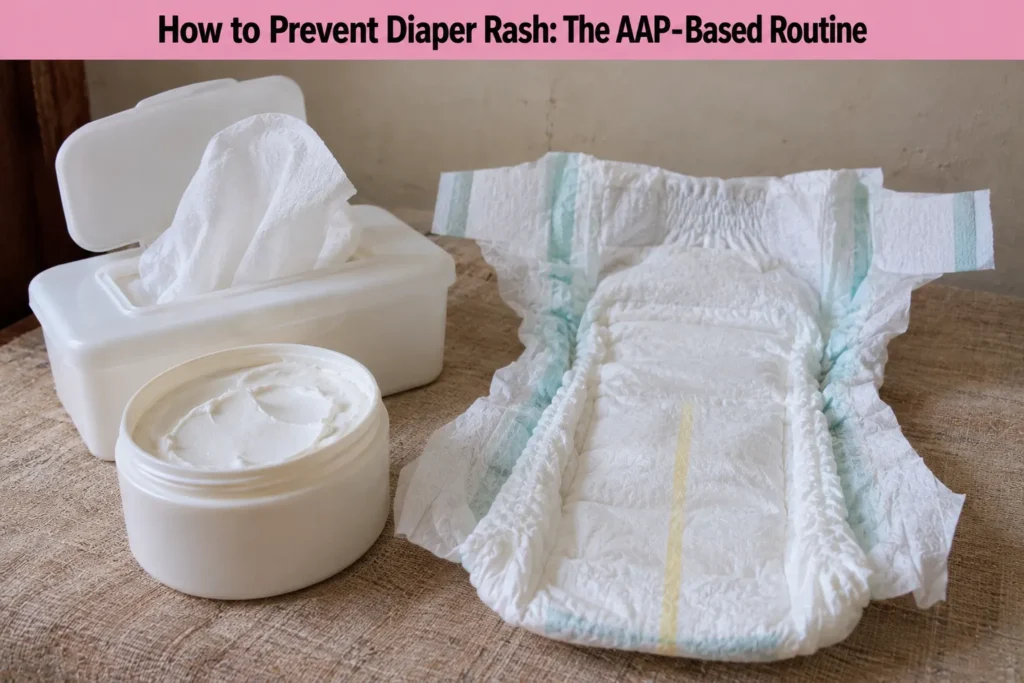
“The routine that has worked best for me is keeping every change simple and gentle: changing promptly, cleaning without fragrance or alcohol, patting instead of rubbing, and giving the skin a moment to dry before the next diaper goes on. I also like using a fragrance-free barrier cream when my baby’s skin seems prone to irritation and making sure the diaper is secure without being tight enough to leave marks. Those small habits matter more to me than chasing a “sensitive” label after a rash has already started.”
Why diaper rash starts in the first place
A routine makes more sense once you know what it is working against. The AAP’s diaper rash page on HealthyChildren.org, updated December 18, 2024 and read September 25, 2026, says “The most common type of diaper rash is ‘irritant dermatitis.'” It also lists yeast, bacterial infections and allergies among the causes.
Nemours KidsHealth, in a page reviewed by Michelle P. Tellado, MD, in September 2023 and read September 25, 2026, describes the same picture in three parts:
- Irritation: “Most diaper rashes are caused by irritation of the skin from contact with urine (pee), poop, and sweat.”
- Infection: “Pee changes the skin’s pH levels, and that lets bacteria and fungi grow more easily.”
- Allergies: “Some types of detergent, soaps, diapers (or dyes from diapers), or baby wipes can affect sensitive skin, causing a rash.”
Put simply, skin under a diaper is warm, damp, rubbed and in contact with waste. Every step below reduces one of those.
The prevention routine, one change at a time
What follows is what named pediatric and dermatology sources say, in the order a change actually happens. None of it replaces advice from your own pediatrician, who may adjust it for your baby.
1. Change the diaper often, including when it is only wet
The AAP says: “Change diapers frequently. Moisture from leaving a wet or soiled diaper on too long can cause skin to chafe.” KidsHealth is more specific, suggesting changes “ideally every 2 hours or so” and “after every poop.” The American Academy of Dermatology’s diaper rash tips, read September 25, 2026, make the same point about wet diapers, advising a change “even if they are just wet,” and “as soon as possible.”
For the first weeks, when output is frequent and hard to predict, our guide to how often to change a newborn diaper covers the day and night rhythm.
2. Clean gently, without fragrance or alcohol
The AAP’s diaper rash page says: “For wipes, choose a product that is free of alcohol and fragrance. You can also cleanse the skin with water and a non-soap/gentle cleanser.” The AAD’s tips describe “water and a soft washcloth or baby wipes that are alcohol and fragrance-free,” and suggest a squirt bottle of water for a severe rash because it is gentler on the skin.
The common thread is less friction and fewer added ingredients. Scrubbing a clean-looking area harder does not make it cleaner, and it adds rubbing to skin that is already under strain.
3. Pat dry and give the skin a moment
The AAP advises: “Pat gently and allow skin to air-dry.” KidsHealth says to let the skin “dry completely before you put on another diaper,” and to pat it “gently with a soft cloth,” because “rubbing can irritate skin.”
This is the cheapest step in the routine and the one most often skipped in a hurry. A fresh diaper closed over damp skin starts the next change with moisture already in place.
4. A barrier layer between skin and diaper
This is where the AAP’s two pages line up. Its safer personal care products page, from the AAP Council on Environmental Health and Climate Change, updated October 31, 2024 and read September 25, 2026, lists “use a fragrance-free diaper cream (such as zinc oxide-based products)” as part of preventing diaper rash. Its diaper rash page says “Zinc oxide and petrolatum are both good choices, and fragrance-free products are best.”
KidsHealth adds a measured note: “Applying diaper cream or ointment with each diaper change can help some babies.” The AAD says the cream does not need to be fully removed at every change, only at the end of the day. A barrier works by keeping moisture off the skin; it is not a substitute for changing the diaper. Which product and how much are questions for your pediatrician, especially for a newborn.
5. A diaper that fits without squeezing
The AAP says: “Make sure the diaper isn’t too tight, especially overnight. A diaper that is loose will be less likely to rub against the skin.” KidsHealth’s version is “Put the diaper on loosely to prevent chafing.”
This is where the diaper itself matters. Loose here does not mean oversized; a diaper that is too big gaps and leaks, and leaks leave skin wet. What the sources are warning against is squeeze: red marks at the waist or legs, or tabs pulled hard to close. Our guide on how to tell if a diaper is too small gives the four signs and one check to confirm it.
6. Diaper-free time when you can manage it
KidsHealth says: “Some experts suggest letting your baby go without diapers for several hours each day.” The AAD’s tips describe letting a child go diaper-free as long as possible so the skin can dry. Neither page sets a required amount, so treat it as a helpful extra rather than a rule you are failing if a busy day does not allow it. A waterproof mat or an old towel keeps it practical.
What the sources say to leave out
Prevention is also about what you skip. Three items come up in the sources we read:
| Item | What the source says |
|---|---|
| Fragrance | The AAP recommends fragrance-free wipes and fragrance-free creams, and lists “fragrances or preservatives in diaper wipes or creams” among common allergens. |
| Baby powder | The AAP’s safer products page says talc-based powder “can contain asbestos fibers,” that inhaling large amounts “can lead to a severe lung disease,” and that cornstarch powder still carries “a risk of respiratory tract irritation if cornstarch baby powder is inhaled.” |
| Fabric softener on cloth diapers | KidsHealth advises against fabric softeners and dryer sheets, noting that “even these can irritate skin.” |
The AAP’s diaper rash page also names “dyes or elastics in the diaper” as common allergens. That does not mean a particular diaper will cause a rash. It means that if a rash appears after a switch, the diaper is one variable worth raising with your pediatrician. Our guide to what “sensitive” means on each diaper box explains how to read those label words.
Cloth or disposable: does it change the routine?
The routine is the same for both. The one difference the AAP draws is absorbency: “cloth diapers typically are less absorbent than most disposable brands. If you use cloth diapers, you may want to consider using disposable diapers until the rash heals.” Read plainly, that is about managing an active rash, not a verdict that cloth causes one. With cloth, changing on schedule matters even more because the fabric holds moisture against the skin, and KidsHealth’s note on fabric softeners applies to how the diapers are washed.
Times when the routine needs extra care
Some situations raise the odds of a rash even with a good routine:
- Diarrhea. KidsHealth lists diarrhea among the factors behind diaper rash. More frequent stools mean more contact with irritants, so changes and drying matter more.
- Antibiotics. The AAP lists “Bright pink/red rash after antibiotics” among reasons to call the pediatrician, which is why a rash in that window deserves a call rather than a new cream.
- New foods. KidsHealth notes dietary changes as a factor. If skin changes show up when solids start, it is worth mentioning to your pediatrician.
- Overnight. The AAP’s note on tightness specifically mentions overnight, when one diaper stays on longest.
When prevention is not enough: when to call
Even a careful routine does not stop every rash. The AAP’s diaper rash page lists these reasons to call your pediatrician: a rash not clearing after two to three days; pimples, peeling, blisters or pus-filled sores; a bright pink or red rash after antibiotics; an especially painful rash; or a fever with the rash. KidsHealth adds getting medical care if pus is draining from the rash or your child is fussier than usual.
If any of those apply, the next step is your pediatrician, not a different product. Our diaper rash guide explains the main rash types and what to expect from that visit.
FAQ
What is the best way to prevent diaper rash?
The AAP’s HealthyChildren.org guidance comes down to changing diapers frequently, cleaning gently with fragrance-free wipes or water, letting skin dry, using a fragrance-free barrier cream such as a zinc oxide-based product, and keeping the diaper from being too tight. Your pediatrician can adjust this for your baby.
How often should diapers be changed to prevent rash?
The AAP says to change diapers frequently. Nemours KidsHealth suggests “ideally every 2 hours or so” and after every poop, and the AAD says to change even diapers that are only wet as soon as possible.
Should diaper cream go on at every change?
KidsHealth says cream or ointment at each change “can help some babies.” The AAP names zinc oxide and petrolatum as good choices and prefers fragrance-free products. Whether your baby needs it every time is a question for your pediatrician.
Is baby powder a good way to keep the diaper area dry?
The AAP’s safer personal care products page warns that talc-based powder can contain asbestos and that inhaling talc can cause severe lung disease. It says cornstarch powder avoids the asbestos concern but can still irritate the airway if inhaled.
Do cloth diapers cause more diaper rash?
The AAP says cloth diapers are typically less absorbent than most disposables and suggests considering disposables while a rash heals. It does not say cloth causes rash. With either type, frequent changes and drying are the core of the routine.
Author Profile
-
Eamin Hosen is the founder and author of BelovedTots. He has raised two young children, Pona and Ruku, and spent years working in child development at Neurosparks, a therapy center that provides Speech Therapy, Occupational Therapy, and ABA Therapy for children with developmental needs.
It was there, watching long therapy sessions get interrupted by leaking, ill-fitting diapers, that he began researching how products perform during everyday use and where their performance falls short of packaging claims.
He holds a Master’s in Psychology and Guidance from the University of Dhaka and brings a behavioral observation lens to every product he reviews. When he’s not testing diapers or writing guides, he’s probably negotiating bedtime with a 4-year-old.
Latest entries
- November 13, 2026Diaper Brands and ComparisonsBamboo Diapers: Viscose, Rayon and the Box Claims
- November 12, 2026Diaper Rash and SkinHypoallergenic Diapers: What the Word Really Promises
- November 11, 2026Diaper Brands and ComparisonsChlorine Free Diapers Meaning: TCF vs ECF Explained
- November 10, 2026Diaper Brands and ComparisonsEco Friendly Diapers: What the Labels Actually Mean