
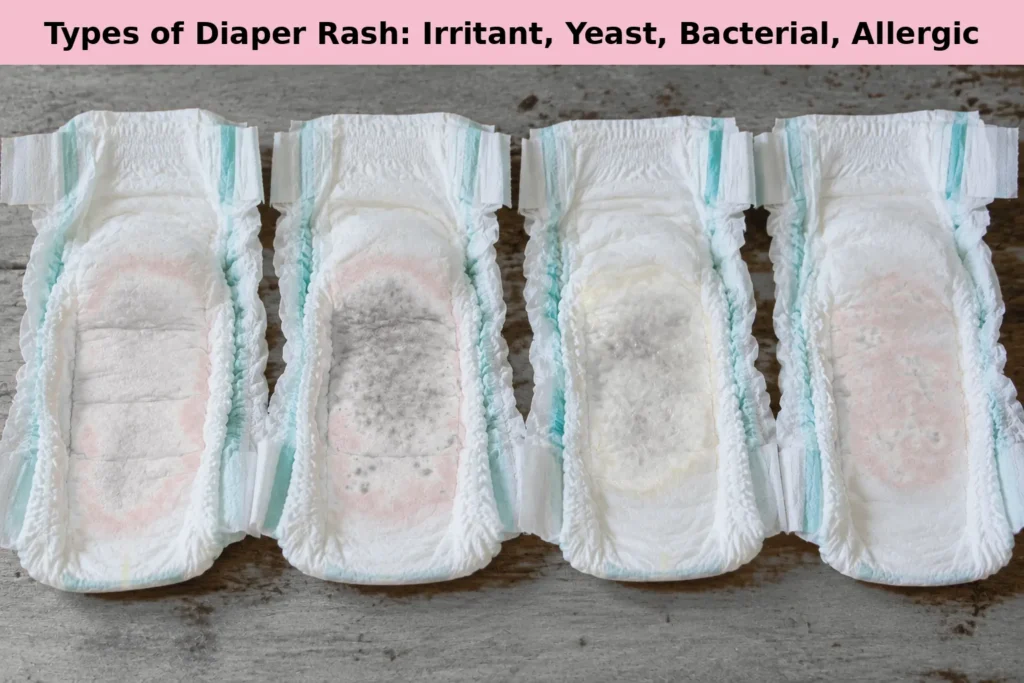
Types of Diaper Rash: Irritant, Yeast, Bacterial, Allergic

Short answer: the American Academy of Pediatrics describes four main types of diaper rash. Irritant rash, the most common, shows as pink or red patches where the diaper touches, with the groin folds usually spared. Yeast (candida) rash is usually worse inside the folds, shiny and bright red with sharp edges. Bacterial rash can show yellow crusting, weeping or pimples, or bright red skin around the anus. Allergic rash appears after every exposure to a particular product. A few rarer conditions also show up in the diaper area. Where the rash sits is often the most useful home clue, and a pediatrician makes the call.
The rest of this page sorts the types by location, because “the pictures do not match” is usually a location problem, not a color problem. It is general information only.
“What helps me most when a diaper rash appears is looking at the pattern and timing instead of trying to match the color to a photo online. Irritation usually makes me think about moisture and friction first, while redness deep in the folds, crusting, weeping, or a rash that appears every time I use one product makes me much more cautious. If it is getting worse, looks painful, or is not settling after a couple of days, I would rather call the pediatrician than keep experimenting with creams or diaper brands.”
Signs that need a pediatrician before any sorting
Symptom pages should start with the escalation rule, so here it is. The AAP parent site, HealthyChildren.org, on common diaper rashes (updated December 18, 2024, read September 25, 2026), lists these reasons to call the pediatrician:
- The rash is not going away, or is getting worse after two to three days.
- There are pimples, peeling, blisters, or sores that are pus-filled, oozing or crusty.
- A baby on antibiotics develops a bright pink or red rash with red spots at the edges.
- The rash seems especially painful, which can be a sign of cellulitis.
- There is a fever with the rash.
Seattle Children’s diaper rash guide (last reviewed May 5, 2025, read September 25, 2026) adds several “seek care now” signs: bright red skin that peels off in sheets, fever with spreading redness that looks infected, a child who looks very ill, and, in a baby under 1 month old, water blisters, grouped pimples, yellow scabs, spreading redness or anything that looks abnormal. For the overview of what usually helps, see our diaper rash guide.
The four main types of diaper rash
These descriptions come from the AAP page above unless another source is named.
1. Irritant diaper rash
This is the everyday rash. The AAP describes it as pink or red patches on the skin covered by the diaper, caused by contact with urine and stool, and notes that the groin folds, being more protected, usually look normal. The AAP says it is more likely when a baby has diarrhea or is teething.
Seattle Children’s splits this family further, listing irritant, stool-related, ammonia and diarrhea rashes as separate entries. They share the same basic mechanism: something wet and irritating stays against the skin.
2. Yeast (candida) diaper rash
The AAP describes shiny, bright red or pink patches with sharp edges, often with little pink bumps or pimples, and in severe cases sores or cracking skin that oozes or bleeds. Unlike irritant rash, it is usually worse in the groin folds. The AAP notes it may develop after a baby has taken antibiotics.
Nemours KidsHealth (reviewed September 2023) adds that a yeast rash often starts in the deep creases of the skin and has small red dots spreading beyond the main rash.
3. Bacterial diaper rash
The AAP names two bacteria. A staph infection can show yellow crusting, weeping or pimples. A strep infection can show as bright red skin around the anus. Seattle Children’s lists cellulitis and staph scalded skin syndrome among the more serious diaper-area conditions. Any of these patterns is a reason to call the pediatrician rather than to try another cream.
4. Allergic diaper rash
The AAP’s clue for allergy is a rash that happens after every exposure to a particular product and shows up wherever that product is applied. It lists dyes or elastics in the diaper, and fragrances or preservatives in diaper wipes or creams, as common triggers. Nemours KidsHealth adds detergents and soaps to the list of things sensitive skin can react to.
Rarer types
The AAP also names seborrheic dermatitis, psoriasis and acrodermatitis enteropathica as less common causes of rash in the diaper area. These need a clinician to identify.
Types of diaper rash by location: the map most articles skip
Most “types of diaper rash” pages are organized by name. Parents, though, are looking at a location. Here is the same information sorted by where the redness sits, using only the descriptions above.
| Where the rash is | Type the sources link to that location | What the source says |
|---|---|---|
| Buttocks, outer thighs, flat surfaces the diaper presses on; folds look normal | Irritant | AAP: patches on skin covered by the diaper, groin folds usually normal |
| Deep groin folds, worse than the flat skin; dots scattered past the edge | Yeast | AAP: usually worse in the folds, sharp edges; KidsHealth: starts in deep creases |
| Tightly around the anus | Diarrhea-related irritant rash, or strep | Seattle Children’s: rashes just around the anus are common during diarrhea; AAP: strep shows as bright red skin around the anus |
| Yellow crusts, weeping, pimples anywhere in the area | Bacterial (staph) | AAP: yellow crusting, weeping or pimples |
| Exactly where one product touches, every time it is used | Allergic | AAP: rash after every exposure, wherever the product is applied |
Two cautions. First, the anus row has two very different possibilities, which is one reason redness there during or after a stomach bug deserves a pediatrician’s look if it does not settle. Second, the diaper edges are a fit question too: the AAP’s repeat-rash article (updated December 18, 2024) notes that a diaper fastened too tightly traps moisture and rubs, and that red marks mean it is time to loosen or size up. Our guide on how to tell if a diaper is too small covers those marks.
Why the pictures in your head do not match
Three reasons come up across the sources.
Types overlap. The AAP states that an irritant rash can become infected with yeast, and that any diaper rash lasting more than a couple of days can. So a rash can start as one type and become two.
Sources draw the categories differently. The AAP groups rashes into four main types plus rarer ones. Seattle Children’s lists eight entries, splitting stool, ammonia and diarrhea rashes out from general irritation and naming cellulitis and staph scalded skin syndrome separately. Neither is wrong. They are different levels of detail.
Color is unreliable. Descriptions differ between sources, and redness shows differently on different skin tones. Location and timeline travel better than color.
Timeline: the second sorting clue
The AAP and Seattle Children’s both state that, with proper care, most diaper rashes are better in about three days, and that a rash which does not respond has probably picked up yeast. The AAP’s call list begins with a rash that is not going away, or is worse, after two to three days.
That makes the calendar a practical tool. Noting the day a rash appeared, and what else changed that week (new foods, antibiotics, a stomach bug, a new diaper or wipe), gives the pediatrician a clearer history than a description of the color.
What the diaper routine can influence
The routine does not decide the type of rash, but it shapes the conditions. The AAP’s prevention advice includes frequent changes, gentle cleaning with alcohol-free and fragrance-free wipes or water with a gentle cleanser, a highly absorbent diaper, and a diaper that fits loosely. The American Academy of Dermatology calls prompt changes, even of wet-only diapers, the most important step.
For allergy specifically, the AAP suggests that switching brands or types of products for a two-week period can sometimes help sort out a trigger. If you are looking at gentler options, our guide to diapers for sensitive skin and what the box claims explains how to read those labels. For newborns, timing matters too: see how often to change a newborn diaper.
What this page cannot do
Sorting by location narrows possibilities. It does not diagnose. The AAP’s rarer types, the bacterial infections and anything on the call lists above need a clinician’s eyes, and the pediatrician is the right person to decide which type your baby has.
FAQ
What is the most common type of diaper rash?
The AAP describes irritant diaper rash, caused by contact with urine and stool, as the everyday type. It shows as pink or red patches on skin the diaper covers, with the groin folds usually looking normal.
How can I tell a yeast rash from other types of diaper rash?
The AAP says a yeast rash is usually worse in the groin folds, looks shiny and bright red or pink with sharp edges, and often has small bumps or pimples. It often does not improve with routine care over about three days.
What does a bacterial diaper rash look like?
According to the AAP, a staph infection can cause yellow crusting, weeping or pimples, and a strep infection can show as bright red skin around the anus. Both are reasons to contact the pediatrician.
Can a baby be allergic to diapers?
The AAP lists dyes or elastics in the diaper among common triggers of allergic diaper rash, along with fragrances or preservatives in wipes and creams. Its clue is a rash that appears after every exposure to the same product.
Can a baby have more than one type of diaper rash at once?
Yes. The AAP notes that an irritant rash can become infected with yeast, and any diaper rash lasting more than a couple of days can. That overlap is one reason a pediatrician’s exam matters.
Author Profile
-
Eamin Hosen is the founder and author of BelovedTots. He has raised two young children, Pona and Ruku, and spent years working in child development at Neurosparks, a therapy center that provides Speech Therapy, Occupational Therapy, and ABA Therapy for children with developmental needs.
It was there, watching long therapy sessions get interrupted by leaking, ill-fitting diapers, that he began researching how products perform during everyday use and where their performance falls short of packaging claims.
He holds a Master’s in Psychology and Guidance from the University of Dhaka and brings a behavioral observation lens to every product he reviews. When he’s not testing diapers or writing guides, he’s probably negotiating bedtime with a 4-year-old.
Latest entries
- November 13, 2026Diaper Brands and ComparisonsBamboo Diapers: Viscose, Rayon and the Box Claims
- November 12, 2026Diaper Rash and SkinHypoallergenic Diapers: What the Word Really Promises
- November 11, 2026Diaper Brands and ComparisonsChlorine Free Diapers Meaning: TCF vs ECF Explained
- November 10, 2026Diaper Brands and ComparisonsEco Friendly Diapers: What the Labels Actually Mean