Diaper Rash From Diapers Brand: Test One Change at a Time

Short answer: diaper rash from diapers brand changes is possible, but it is not the most common explanation. The American Academy of Pediatrics lists dyes or elastics in the diaper among triggers of allergic diaper rash, and its clue for allergy is a rash that appears after every exposure to that product. Most diaper rash, though, is irritant rash from urine and stool contact. A brand switch also changes fit and absorbency, and often lands the same week as new foods, antibiotics or a stomach bug. The AAP suggests switching brands or types of products for about two weeks to sort it out. Changing one thing at a time is what makes that test mean something.
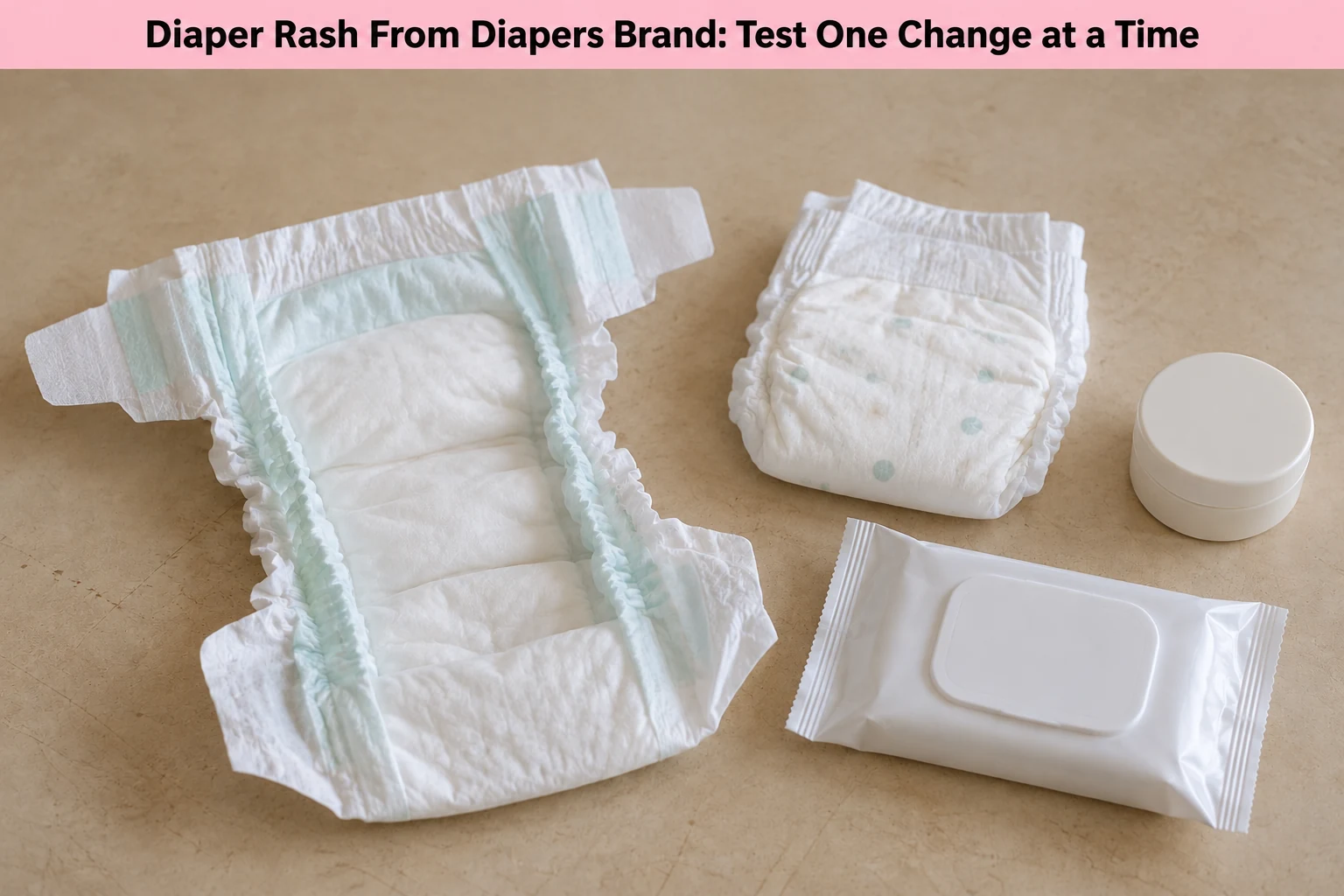
This page explains why a switch is rarely a clean experiment, and how to structure one. It is general information, not medical advice.
Before testing anything: the call list
A product test is for a mild, puzzling rash. It is not for a rash that needs a doctor. The AAP parent site, HealthyChildren.org, in its page on common diaper rashes (updated December 18, 2024, read September 25, 2026), lists these reasons to call the pediatrician:
- The rash is not going away, or is getting worse after two to three days.
- There are pimples, peeling, blisters, or sores that are pus-filled, oozing or crusty.
- A baby on antibiotics develops a bright pink or red rash with red spots at the edges.
- The rash seems especially painful.
- The baby has a fever with the rash.
If any of these apply, the pediatrician comes before any brand experiment. Our diaper rash guide covers the full picture.
"I keep a diaper-brand change separate from changes to wipes, cream, and the rest of the routine, because otherwise I cannot tell what made the difference. I note the product line, size, fit, and any other changes rather than blaming the brand alone. A rash that worsens or is not improving after two to three days takes priority over finishing a product trial, so I would bring those notes to the pediatrician."
Why a brand switch is rarely a clean experiment
"We switched brands and the rash started" feels like proof. Usually, several things changed at once.
The materials changed. This is the allergy possibility. The AAP names dyes or elastics in the diaper as common allergic triggers, and Nemours KidsHealth (reviewed September 2023) lists dyes among the things sensitive skin can react to.
The fit changed. A size 3 from one maker does not fit like a size 3 from another. The AAP's repeat-rash article (updated December 18, 2024) notes that a diaper fastened too snugly traps moisture and rubs, and that red marks mean it is time to loosen or size up. Our cross-brand diaper size comparison shows why the same number can fit differently.
The absorbency changed. The AAP's rash page advises choosing a highly absorbent diaper, because moisture against the skin drives irritant rash. A different core can mean a different amount of wetness on the skin between changes.
Something else changed that week. The AAP's repeat-rash article lists antibiotics and starting solid foods as common causes of repeat rashes, alongside diaper or wipe changes. Diarrhea also raises the risk of irritant rash, according to the AAP. If any of these overlapped with the switch, the brand may be a bystander.
Where the rash sits tells you what to suspect
Before blaming the diaper, look at the rash's location. These patterns come from the AAP's descriptions, plus Seattle Children's guidance (last reviewed May 5, 2025) for the last row.
| Where the rash is | What the sources link it to | Is the diaper brand a likely suspect? |
|---|---|---|
| Everywhere the diaper touches, appearing with every use of that product | Allergic reaction (AAP) | Yes, this is the pattern the AAP describes for allergy |
| Waistband or leg openings, in lines | Elastics (AAP allergy triggers) or a too-tight fit (AAP repeat-rash article) | Possibly; check fit first |
| Flat skin under the diaper, folds normal | Irritant rash from urine and stool (AAP) | Only indirectly, through fit and absorbency |
| Deep in the groin folds, shiny, with spots past the edge | Yeast (AAP) | No; the AAP describes this as an infection for the pediatrician |
| Tightly around the anus | Diarrhea-related irritation (Seattle Children's) or a strep infection (AAP) | Unlikely |
If the rash matches only the last two rows, a new diaper brand is unlikely to answer the question.
The one-variable method
The AAP's own suggestion is that switching brands or types of products for a two-week period can sometimes help sort out an allergic trigger. The method below is simply a way to make that two weeks readable.
Step 1: Pick one variable
Choose the single thing you suspect: the diaper, the wipe, the cream or the laundry detergent (for cloth). The AAP names all of these as possible sources, noting fragrances or preservatives in wipes and creams alongside diaper dyes and elastics. Only one changes.
Step 2: Freeze everything else
Keep the same wipes, the same cream, the same change routine and, if you can, the same size. If the new diaper forces a size change, write that down, because it is a second variable.
Step 3: Run it for the AAP's two weeks
A two-week window matches the AAP's suggestion. A day or two tells you very little, because rashes come and go for many reasons.
Step 4: Keep a short daily log
A simple table is enough:
| Date | Diaper (line and size) | Wipe | Cream | Other changes (food, illness, medicine) | Rash location | Better, same or worse |
|---|
Record the product line and size, not just the brand name. Brands make several lines with different materials, and the line is the product your baby actually wore.
Step 5: Read the result carefully
- Rash clears on the new product and returns when the old one comes back: this is the "after every exposure" pattern the AAP associates with allergy. Share the log with your pediatrician.
- Rash clears, but something else also changed: the result is uncertain. It may have cleared for the other reason.
- No change: the brand probably is not the variable. The pediatrician is the next step, especially if the rash has lasted more than two to three days.
Reading the box: what labels do and do not tell you
When parents look for a replacement diaper, the packaging is full of words like "hypoallergenic", "fragrance-free", "dermatologist tested", "gentle" and "natural". These are marketing labels, and it helps to know what stands behind them.
For cosmetics, the FDA's page on hypoallergenic claims (content current as of February 25, 2022, read September 25, 2026) states that there are no federal standards or definitions governing the term "hypoallergenic", and that manufacturers are not required to submit substantiation of those claims to the FDA. Diapers are not cosmetics, so that page does not govern diaper boxes directly, but it shows the word is a claim made by the maker, not a certified standard.
Specific labels are more useful than general ones. "Fragrance-free" and "dye-free" name something that is absent, and Nemours KidsHealth suggests considering fragrance-free and dye-free diapers where a baby's skin is sensitive. For how these claims appear on real packages, our guide to diapers for sensitive skin and what the box claims goes through them line by line. No label can promise that a particular baby will not react.
Cloth diapers: the detergent is a variable too
For cloth, the "brand" question often turns out to be a laundry question. The AAP's repeat-rash article recommends presoaking soiled diapers, washing in hot water, double rinsing and avoiding fabric softeners, which may irritate sensitive skin. Nemours KidsHealth adds avoiding dryer sheets and using extra rinse cycles. If the detergent changed when the rash started, that is the variable to test, one at a time, just like a disposable brand.
What this test cannot do
A home product test narrows suspects. It does not diagnose. The AAP's call list still applies throughout, a yeast or bacterial rash will not respond to a brand swap, and sometimes no single cause turns up at all. If the log does not point to anything, bringing it to your pediatrician still helps, because it rules things out.
FAQ
Can switching diaper brands cause a rash?
It can. The AAP lists dyes or elastics in the diaper among triggers of allergic diaper rash, and its repeat-rash article includes diaper or wipe brand changes among common causes. A switch also changes fit and absorbency, which affect irritant rash.
How long should I test a new diaper brand?
The AAP suggests that switching brands or types of products for a two-week period can sometimes help identify a trigger. Changing only one product during that time makes the result easier to read.
What does a diaper allergy rash look like?
The AAP's clue is a rash that happens after every exposure to a particular product and appears wherever that product touches. Rashes in the deep skin folds or tightly around the anus point to other causes.
Are "hypoallergenic" diapers guaranteed not to cause a rash?
No. For cosmetics, the FDA states there are no federal standards or definitions for "hypoallergenic", and manufacturers do not have to submit proof to the FDA. On any package, the word is a marketing claim from the maker.
When should I stop testing and call the pediatrician?
The AAP lists a rash not improving or getting worse after two to three days, blisters or oozing sores, marked pain, fever, or a bright red rash with spots at the edges in a baby on antibiotics as reasons to call.
Author Profile
-
Eamin Hosen is the founder and author of BelovedTots. He has raised two young children, Pona and Ruku, and spent years working in child development at Neurosparks, a therapy center that provides Speech Therapy, Occupational Therapy, and ABA Therapy for children with developmental needs.
It was there, watching long therapy sessions get interrupted by leaking, ill-fitting diapers, that he began researching how products perform during everyday use and where their performance falls short of packaging claims.
He holds a Master’s in Psychology and Guidance from the University of Dhaka and brings a behavioral observation lens to every product he reviews. When he’s not testing diapers or writing guides, he’s probably negotiating bedtime with a 4-year-old.
Latest entries
- November 13, 2026Diaper Brands and ComparisonsBamboo Diapers: Viscose, Rayon and the Box Claims
- November 12, 2026Diaper Rash and SkinHypoallergenic Diapers: What the Word Really Promises
- November 11, 2026Diaper Brands and ComparisonsChlorine Free Diapers Meaning: TCF vs ECF Explained
- November 10, 2026Diaper Brands and ComparisonsEco Friendly Diapers: What the Labels Actually Mean