
Zinc Oxide vs Petroleum Jelly Diaper Rash: Barrier Guide

Short answer: in the zinc oxide vs petroleum jelly diaper rash question, both ingredients do the same basic job. They sit on the skin as a barrier between it and urine and stool. The American Academy of Pediatrics calls zinc oxide and petrolatum "both good choices" and says the ingredients matter more than the brand. The practical differences are texture and cleanup: zinc oxide pastes are thick, white and cling, while petroleum jelly is clear, softer and wipes off more easily. Lanolin, the third common barrier, comes from sheep's wool and is a known contact allergen for some people.
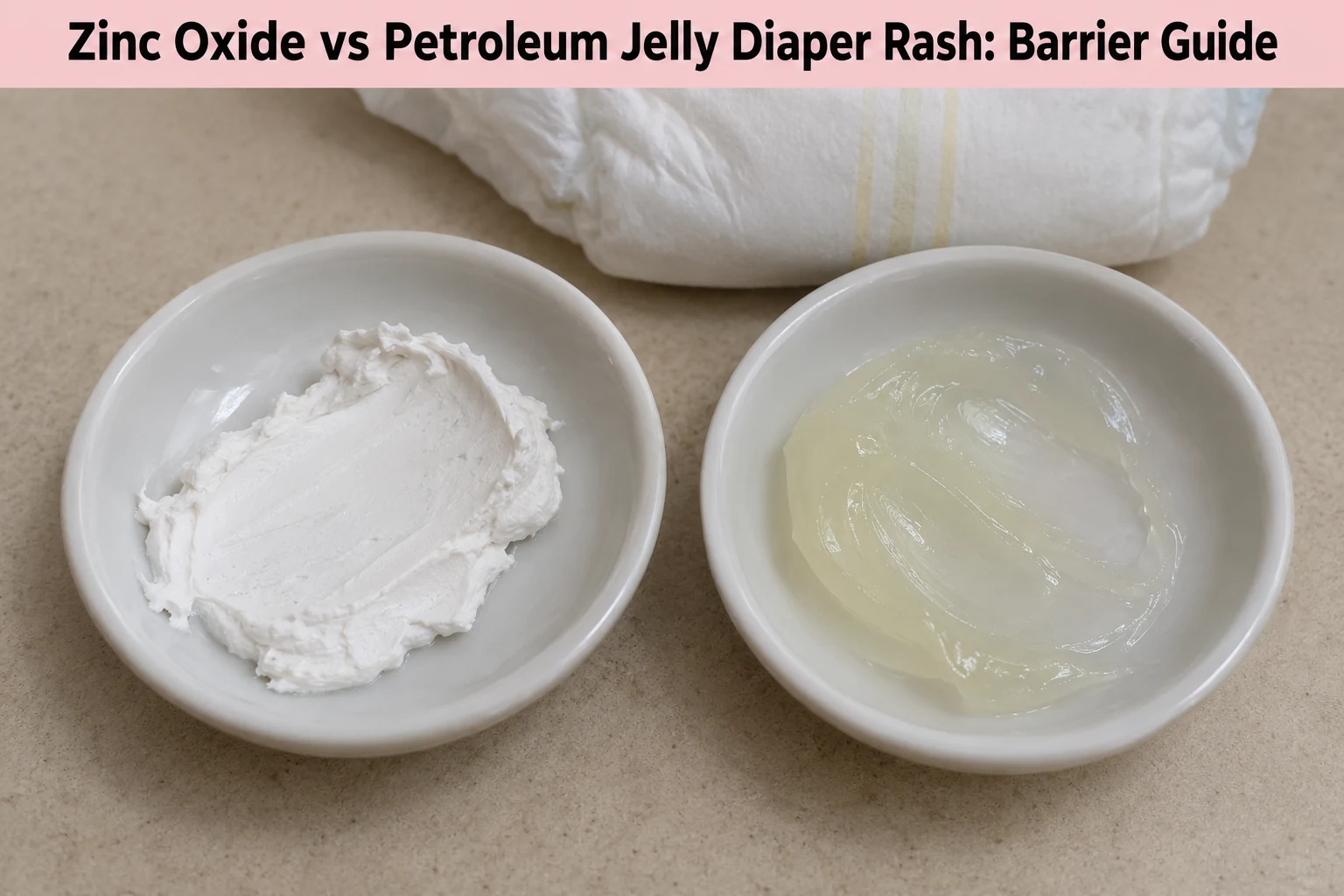
This page explains what each barrier is, what real product labels list, and what to watch for. It is general information, not medical advice.
First: when a cream is not the answer
A barrier is for everyday irritation. Some rashes need a doctor, not a different tube. The AAP's parent site, HealthyChildren.org, in its page on diaper rash (last updated December 18, 2024, read September 27, 2026), lists these reasons to call the pediatrician:
- The rash does not clear after two to three days of treatment.
- There are pimples, peeling, blisters or oozing sores.
- A baby on antibiotics develops a bright pink or red rash.
- The rash seems especially painful.
- The baby has a fever with the rash.
If any of these apply, your pediatrician is the next step, whatever barrier is in the cabinet. Our diaper rash guide covers the types of rash and how they differ.
"I look at how a barrier spreads and stays in place, rather than expecting the highest zinc percentage to be the best choice. Thick white paste and clearer petroleum jelly handle differently, but both serve as barriers. I also read the inactive ingredients for fragrance or lanolin, because the front of the tube does not tell me everything that is in it."
What a barrier actually does
HealthyChildren.org describes diaper paste as a shield that sits between the skin and the contents of the diaper. A barrier does not so much add something to the skin as keep things off it: moisture, urine and stool.
That shared job is why the three ingredients in this article are grouped together. The FDA's skin protectant regulation, 21 CFR 347.10, names zinc oxide, petrolatum and lanolin among its permitted skin protectant active ingredients, each with its own concentration range. On the US drug labels quoted below, zinc oxide and petrolatum carry the purpose "Skin Protectant", and lanolin appears as an active ingredient alongside petrolatum.
What differs is how each one forms that shield, how long it stays put, and how easy it is to remove.
Zinc oxide: the white paste
Zinc oxide is a white mineral powder. In a diaper cream it is suspended in a base of oils and waxes, which is why zinc products look white and feel thick.
What it is like to use. Zinc pastes are sticky by design. That cling is the point of a barrier, and it is also the main complaint about them: thick zinc paste can be hard to clean off, especially from skin folds.
What the labels show. On DailyMed, the National Library of Medicine's database of US drug labels, zinc oxide diaper rash products come in quite different strengths:
- Desitin Daily Defense cream lists zinc oxide 13% (label updated December 11, 2024).
- Aquaphor Healing Diaper Rash cream lists zinc oxide 15% (label updated December 15, 2025).
- Desitin Maximum Strength paste lists zinc oxide 40% (label updated November 15, 2024).
The strength number is only part of the story. The base around the zinc changes how a product spreads and how long it stays, which is why two creams with similar percentages can feel very different on the changing table.
Petrolatum (petroleum jelly): the clear ointment
Petrolatum is the pharmacy name for petroleum jelly. It is a semi-solid blend of hydrocarbons that does not mix with water, so it forms a greasy, water-repelling layer.
What it is like to use. Petrolatum is clear, so you can see the skin underneath, and it spreads easily. It also comes off more easily than a thick zinc paste. The trade-off is that a softer layer can rub or wipe away sooner.
What the labels show. The FDA regulation lists petrolatum at 30 to 100 percent as a skin protectant. On DailyMed, Aquaphor Healing Ointment lists petrolatum 41% and names diaper rash among its purposes (label updated December 15, 2025). Plain petroleum jelly is simply petrolatum with nothing else in it.
Lanolin: the wool-derived ointment
Lanolin is a greasy, yellow, fatlike substance from the oil glands of sheep, collected from wool. In diaper products it usually appears alongside petrolatum rather than on its own.
What the labels show. The FDA regulation lists lanolin at 12.5 to 50 percent. On DailyMed, A+D Original Ointment lists two active ingredients: lanolin 15.5% and petrolatum 53.4% (label updated October 11, 2023).
The allergy point. Lanolin is a recognized contact allergen. The American Contact Dermatitis Society named it the 2023 Allergen of the Year, and a review in the journal Cutis (Johnson and colleagues, August 2023) identified children, people with atopic dermatitis, and people with perianal or genital dermatitis among higher-risk groups. The same review notes that some people use lanolin products on healthy skin without issue but react when a lanolin product goes on inflamed skin. A rash under a diaper is inflamed skin. That does not mean lanolin will cause a reaction in any given baby. It means it is worth knowing when it is in a product, and worth mentioning to your pediatrician if a rash gets worse after a new cream.
Zinc oxide vs petroleum jelly diaper rash labels, side by side
This table uses only the active ingredients and strengths printed on each product's DailyMed label, read September 27, 2026. It compares ingredients, not quality, and no product here is ranked.
| Product (as labeled) | Active ingredient(s) | Form | Label updated |
|---|---|---|---|
| Desitin Daily Defense | Zinc oxide 13% | Cream | Dec 11, 2024 |
| Aquaphor Healing Diaper Rash | Zinc oxide 15% | Cream | Dec 15, 2025 |
| Desitin Maximum Strength | Zinc oxide 40% | Paste | Nov 15, 2024 |
| Aquaphor Healing Ointment | Petrolatum 41% | Ointment | Dec 15, 2025 |
| A+D Original | Lanolin 15.5%, petrolatum 53.4% | Ointment | Oct 11, 2023 |
Formulas change. The Drug Facts panel on the package in your hand is the label that applies to it.
The hidden overlap: inactive ingredients
Here is what the zinc vs petroleum jelly comparison usually misses. Most diaper creams are not one barrier. They are one active barrier inside a base that often contains the others.
Reading the same DailyMed labels:
- Desitin Maximum Strength lists petrolatum, cod liver oil, lanolin, talc and fragrance among its inactive ingredients.
- Aquaphor Healing Ointment lists lanolin alcohol among its inactive ingredients.
- A+D Original lists cod liver oil, fragrance and mineral oil among its inactive ingredients.
- Desitin Daily Defense lists petrolatum, mineral oil and dimethicone among its inactive ingredients.
Two practical consequences follow.
"Zinc or petroleum jelly?" is often a false choice. A zinc paste may already contain petrolatum in its base. The real choice is often between a thick, zinc-led paste and a clearer petrolatum-led ointment.
Lanolin can be present even when it is not the active ingredient. If your pediatrician has raised a lanolin or fragrance concern, the inactive ingredient list is where to look, not just the big print on the front. HealthyChildren.org adds that fragrance-free products are best. Our guide to diapers for sensitive skin and what the box claims covers the same label-reading habit for the diaper itself.
How the three compare in everyday use
The differences below are about handling, not about which one is better for a rash. Which suits a particular baby is a question for your pediatrician.
| Zinc oxide paste or cream | Petrolatum ointment | Lanolin plus petrolatum ointment | |
|---|---|---|---|
| Look | White, opaque | Clear | Clear to yellowish |
| Texture | Thick, sticky | Greasy, spreads easily | Greasy, soft |
| Cleanup | Harder, clings to skin | Easier | Easier |
| See the skin underneath? | No | Yes | Mostly |
| Allergy note | Check inactive ingredients | Check inactive ingredients | Lanolin is a known contact allergen (ACDS, 2023) |
How much and how often. The diaper rash directions on these labels follow the same pattern: change wet and soiled diapers promptly, cleanse the diaper area, allow it to dry, and apply liberally with each diaper change. HealthyChildren.org describes a thick layer "like icing on a cupcake" and says paste that is not soiled does not need to be rubbed off at a change. Frequent changes are part of the same routine; see how often to change a newborn diaper.
What none of these barriers can do
A barrier protects the skin. It is not an antifungal and it is not an antibiotic. HealthyChildren.org also warns against over-the-counter antibiotic ointment for diaper rash, because ingredients in these products can sometimes worsen skin irritation.
Each label's own warning points the same way: stop use and ask a doctor if the condition worsens, or if symptoms last more than seven days or clear up and return within a few days. A rash that behaves like that is a reason to see the pediatrician, not to switch to a different barrier.
A barrier also cannot make up for a diaper that holds moisture against the skin for too long. If rash keeps returning after nights, the diaper side of the problem is covered in our guide to why diapers leak at night.
FAQ
Is zinc oxide or petroleum jelly better for diaper rash?
The AAP's HealthyChildren.org calls zinc oxide and petrolatum both good choices and says the ingredients matter more than the brand. The differences parents notice are texture and cleanup. Which suits a particular baby's rash is a question for the pediatrician.
Is petroleum jelly the same as petrolatum?
Yes. Petrolatum is the ingredient name for petroleum jelly. Plain petroleum jelly is petrolatum on its own, while ointments such as Aquaphor Healing Ointment list petrolatum as the active ingredient along with other inactive ingredients.
Why is lanolin a concern?
The American Contact Dermatitis Society named lanolin its 2023 Allergen of the Year. A 2023 review in Cutis noted that children and people with genital or perianal dermatitis are among higher-risk groups, and that some people react only when lanolin is applied to inflamed skin.
Can a zinc oxide cream contain lanolin?
Yes. The DailyMed label for Desitin Maximum Strength lists lanolin among its inactive ingredients, along with petrolatum and fragrance. The inactive ingredient list is where to check, not just the active one.
When should I stop and call the pediatrician?
HealthyChildren.org lists a rash that does not clear after two to three days, blisters or oozing sores, a bright red rash during antibiotics, marked pain, or a fever with the rash as reasons to call.
Author Profile
-
Eamin Hosen is the founder and author of BelovedTots. He has raised two young children, Pona and Ruku, and spent years working in child development at Neurosparks, a therapy center that provides Speech Therapy, Occupational Therapy, and ABA Therapy for children with developmental needs.
It was there, watching long therapy sessions get interrupted by leaking, ill-fitting diapers, that he began researching how products perform during everyday use and where their performance falls short of packaging claims.
He holds a Master’s in Psychology and Guidance from the University of Dhaka and brings a behavioral observation lens to every product he reviews. When he’s not testing diapers or writing guides, he’s probably negotiating bedtime with a 4-year-old.
Latest entries
- November 13, 2026Diaper Brands and ComparisonsBamboo Diapers: Viscose, Rayon and the Box Claims
- November 12, 2026Diaper Rash and SkinHypoallergenic Diapers: What the Word Really Promises
- November 11, 2026Diaper Brands and ComparisonsChlorine Free Diapers Meaning: TCF vs ECF Explained
- November 10, 2026Diaper Brands and ComparisonsEco Friendly Diapers: What the Labels Actually Mean