Best Baby Wipes for Sensitive Skin: Reading the Label

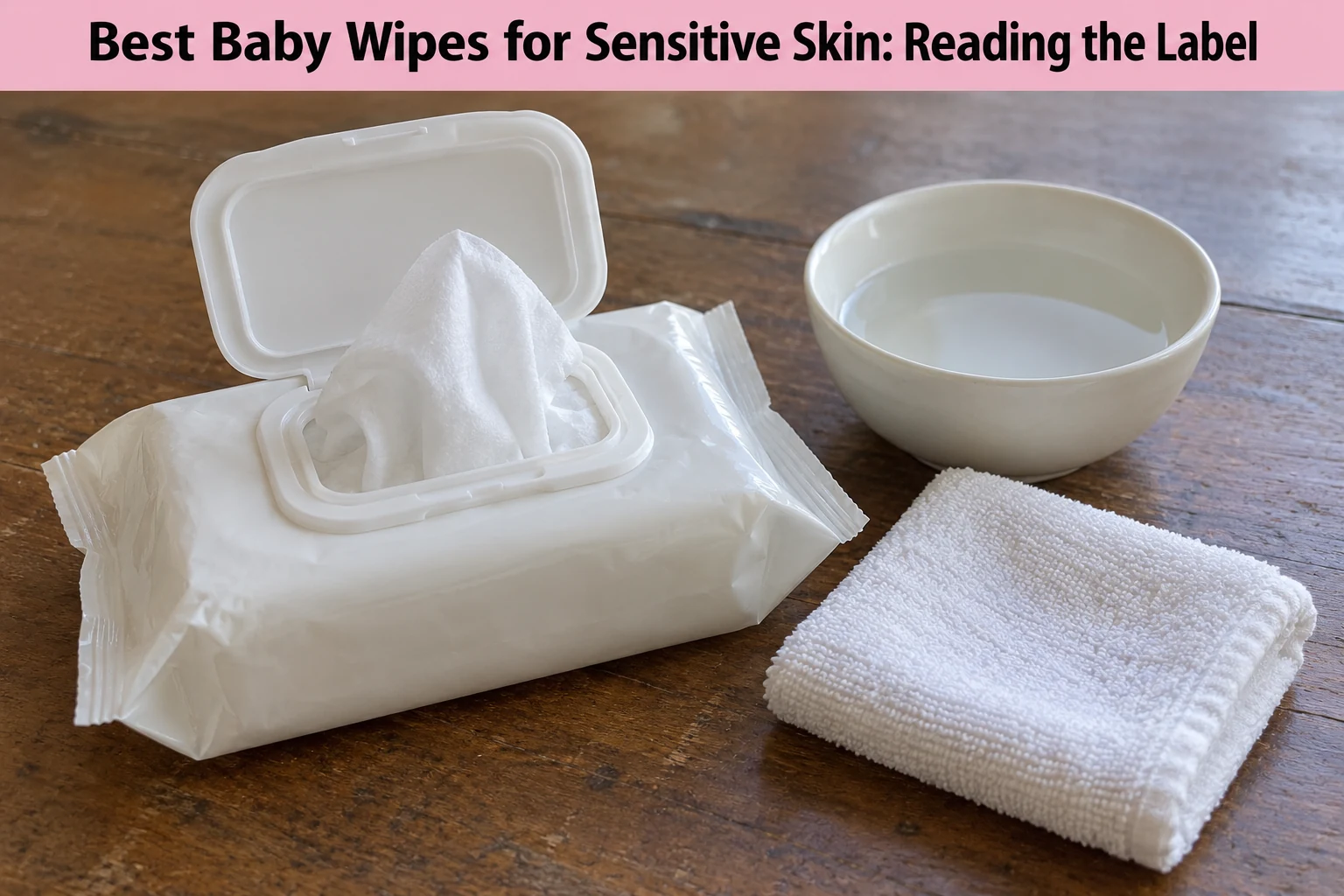
Short answer: the best baby wipes for sensitive skin are not one brand. They are the wipes whose label passes a few specific checks. Pediatric and dermatology sources point to wipes free of alcohol and fragrance. "Fragrance-free" is the claim to look for, because the FDA says even products labeled "unscented" may contain masking fragrance. "Hypoallergenic" has no federal definition. The National Eczema Association's Seal of Acceptance is the one widely used third-party mark with published criteria. Water and a soft cloth remain an option in every source we read.
This guide shows how to read a wipes pack. It is general information, not medical advice, and we have not tested any wipe ourselves.
If your baby's skin is already reacting
Before comparing packs, check whether this is a product question at all. The American Academy of Dermatology's page on treating diaper rash (read September 27, 2026) says to call a doctor or board-certified dermatologist if a baby develops signs of a skin infection, which it lists as "a fever, blisters, pus that drains from the rash, and a rash that does not go away after treatment or worsens." It also names a baby who "is in pain or is hard to console."
The AAP's HealthyChildren.org diaper rash page (last updated December 18, 2024, read September 27, 2026) adds a rash that has not improved after two to three days, and a bright red rash with red spots that appears while a baby is on antibiotics. Our diaper rash guide covers these in more detail.
A new pack of wipes will not fix any of those. Your pediatrician is the right next step.
"I read fragrance-free and alcohol-free more closely than broad promises such as gentle or hypoallergenic. I also check the full formula instead of assuming a high water percentage tells the whole story. Plain water and a soft cloth remain a useful option to weigh against the convenience of a pack, and changing only one product at a time keeps a suspected reaction easier to discuss with the pediatrician."
What the pediatric and dermatology sources actually say about wipes
The authorities are brief on this, and they agree:
- AAD: "Use water and a soft washcloth or baby wipes that are alcohol and fragrance-free." For severe rash, the AAD describes using a squirt bottle of water, "as doing so is gentler to the skin."
- HealthyChildren.org (AAP): "For wipes, choose a product that is free of alcohol and fragrance," or use water and a non-soap, gentle cleanser.
Notice what they do not say. Neither names a brand. Neither ranks wipes. Neither says any wipe is right for every baby. The standard they set is short: no alcohol, no fragrance. Everything else on the pack is the maker's marketing, and some of it helps you while some of it does not.
The label decoder: what each claim means
This is the section most roundups skip. Each claim below is a term you will see on US wipes packs, with what an authority says it means.
| Label claim | What it means, per the source | How much weight to give it |
|---|---|---|
| Fragrance-free | No fragrance added. NEA's Seal requires products to be fragrance-free with no noticeable scent. | High. This is what the AAD and AAP ask for. |
| Unscented | The FDA says some "unscented" products may contain fragrance added just to mask other ingredients' smell. | Low on its own. Look for "fragrance-free" instead. |
| Alcohol-free | No alcohol in the formula, as stated by the maker. | High. Named by both the AAD and AAP. |
| Hypoallergenic | The FDA says there are "no Federal standards or definitions" for this term. | Very low. It means what the company wants it to mean. |
| Dermatologist tested | The maker says a dermatologist was involved in testing. No federal standard defines the test. | Low without details of what was tested. |
| NEA Seal of Acceptance | Fragrance-free, no formaldehyde releasers, none of the ingredients on NEA's Ecz-clusion List, plus clinical safety testing. | Useful. The criteria are public. |
| "Water wipes" or "99% water" | A high share of water in the liquid. Says nothing about the other ingredients. | Medium. Still read the full list. |
| Natural, plant-based | Marketing terms. | Low. A plant-derived ingredient is not automatically gentle. |
Fragrance-free vs unscented: the distinction that matters most
The FDA's page on fragrances in cosmetics (content current as of February 28, 2022, read September 27, 2026) puts it plainly: "Even some products labeled 'unscented' may contain fragrance ingredients. This is because the manufacturer may add just enough fragrance to mask the unpleasant smell of other ingredients, without giving the product a noticeable scent." The same page notes that "some components of fragrance formulas may have a potential to cause allergic reactions or sensitivities for some people."
So a pack that smells of nothing is not proof of a fragrance-free formula. The words on the pack and the ingredient list are the evidence.
"Hypoallergenic" has no legal meaning
The FDA's page on hypoallergenic cosmetics (content current as of February 25, 2022, read September 27, 2026) says: "There are no Federal standards or definitions that govern the use of the term 'hypoallergenic.'" It continues: "The term means whatever a particular company wants it to mean." It adds that manufacturers are not required to submit proof of the claim to the FDA, and that "Dermatologists say it has very little meaning."
That does not make a hypoallergenic wipe a bad wipe. It means the word cannot do the work of the ingredient list.
The National Eczema Association Seal: what it checks
If you want one mark that saves label-reading, the NEA Seal of Acceptance is the one with published rules. NEA's "About the Seal" page (read September 27, 2026) lists three core criteria:
- Fragrance: "Products must be fragrance-free, and there should be no discernable/strong scent or anything aromatic in nature in the final product."
- Formaldehyde releasers: not allowed.
- Ecz-clusion List: products "cannot contain any ingredients on the Ecz-clusion List," which NEA describes as a list of known eczema triggers. Methylisothiazolinone, a preservative discussed below, is on it.
Makers must also show the product "passed the required clinical safety tests for sensitivity and irritation."
What the Seal does not promise: NEA itself notes that "eczema is different for everyone and a product that works for one may not work for another." Its product listings also say that people with eczema or sensitive skin are responsible for identifying ingredients that could irritate their own skin, and that questions about suitability should go to a physician.
The Seal is also something a maker applies for. A wipe without it has not necessarily failed; the maker may simply not have applied. As one example of how to check, NEA's directory lists Huggies Natural Care Sensitive Baby Wipes among Seal products (directory read September 27, 2026). Any wipe's status can be checked the same way, by searching the NEA product directory.
The preservative question: methylisothiazolinone
Every wet wipe needs something to keep mold and bacteria from growing in a damp pack. Which preservative a maker uses is one of the more useful things on the ingredient list.
Methylisothiazolinone (often shortened to MI) is the one parents most often ask about. A 2014 case report in the journal Pediatrics (Chang and colleagues) described six children with stubborn dermatitis around the bottom and face who had used wet wipes containing MI. As summarized by the medical news site Healio (read September 27, 2026), "Complete resolution of dermatitis occurred after the wipes were discontinued."
Two things keep that finding in proportion:
- It was six children, in a report published more than a decade ago, and formulas change.
- It describes an allergy in those children, not a reaction in every baby.
What it does show is why MI appears on NEA's exclusion list, and why a named preservative on a label is worth a glance. If you suspect a wipe is involved in a rash, the pediatrician can advise whether allergy testing makes sense. We do not claim any ingredient will or will not cause a reaction in your baby.
How to compare packs in 30 seconds
Here is a quick routine for the store shelf or a product page:
- Front of pack: does it say "fragrance-free", not only "unscented"?
- Front or back: does it say alcohol-free?
- Seal: is there an NEA Seal of Acceptance? If not, that is not a fail, but the next step matters more.
- Ingredient list: is it short enough to read? Can you find the preservative? Is methylisothiazolinone listed?
- Set aside: "hypoallergenic", "natural" and "gentle" as reasons on their own.
A wipe that passes steps 1, 2 and 4 meets the standard the AAD and AAP describe. Beyond that, you are choosing texture, thickness, pack size and price, which are real differences but not skin-safety ones.
Water wipes and the washcloth option
"Water wipes" is a category name more than a claim. Several brands market very high water content, and fewer ingredients means fewer things to react to. But water content alone does not tell you which other ingredients are in the formula, so the label still matters.
The simplest option costs nothing extra. Both the AAD and the AAP describe plain water with a soft washcloth as an alternative to wipes. The trade-off is convenience: a washcloth needs a sink, a clean supply and laundering, which is why some families keep it for home and carry wipes for outings.
What a wipe cannot do
This is the honest part.
- No wipe prevents diaper rash on its own. The routine around it, including prompt changes and a well-fitting diaper, matters too. If the diaper itself is the variable you are changing, our look at diapers for sensitive skin and what the box claims applies the same label-reading approach.
- A wipe that suits one baby may not suit another. NEA says the same about its own Seal.
- Switching wipes and diapers at once hides the answer. If you change both in the same week and the skin improves, you will not know which change helped.
- Rubbing is part of the problem. However gentle the wipe, a baby changed many times a day is wiped many times a day. That is part of why the AAD mentions a squirt bottle for severe rash.
Why we do not rank the best baby wipes for sensitive skin
Search this topic and you will find ranked lists, some of them labeled as tested by their authors. We have not tested wipes on a baby, so we will not rank them or call any one the best. What we can do is give you the checks the pediatric sources and regulators describe, so any pack on any shelf can be judged the same way. If you are weighing brands for diapers too, our guide to diaper brands and who makes what takes the same approach.
FAQ
What are the best baby wipes for sensitive skin?
The AAD and AAP describe the standard: wipes free of alcohol and fragrance, or water and a soft cloth. The National Eczema Association Seal of Acceptance adds published criteria, including no fragrance, no formaldehyde releasers and none of the ingredients on its Ecz-clusion List. No authority we read names a single best brand.
Are unscented and fragrance-free the same?
No. The FDA says some products labeled "unscented" may contain fragrance ingredients added to mask other smells. "Fragrance-free" is the claim the AAD and AAP guidance points toward.
Does hypoallergenic mean a wipe will not cause a reaction?
No. The FDA says there are no federal standards or definitions for "hypoallergenic" and that the term means whatever a particular company wants it to mean.
Are water wipes better for sensitive skin?
High water content means fewer other ingredients, which some parents prefer. But no source we read says water wipes are better for every baby, and the full ingredient list still matters. Plain water and a soft washcloth is the option both the AAD and AAP describe.
When should I talk to a doctor about wipes and rash?
The AAD lists fever, blisters, pus draining from the rash, a rash that does not go away or gets worse, and a baby in pain or hard to console. HealthyChildren.org adds a rash that has not improved after two to three days. Your pediatrician can also advise if you suspect an ingredient allergy.
Author Profile
-
Eamin Hosen is the founder and author of BelovedTots. He has raised two young children, Pona and Ruku, and spent years working in child development at Neurosparks, a therapy center that provides Speech Therapy, Occupational Therapy, and ABA Therapy for children with developmental needs.
It was there, watching long therapy sessions get interrupted by leaking, ill-fitting diapers, that he began researching how products perform during everyday use and where their performance falls short of packaging claims.
He holds a Master’s in Psychology and Guidance from the University of Dhaka and brings a behavioral observation lens to every product he reviews. When he’s not testing diapers or writing guides, he’s probably negotiating bedtime with a 4-year-old.
Latest entries
- November 13, 2026Diaper Brands and ComparisonsBamboo Diapers: Viscose, Rayon and the Box Claims
- November 12, 2026Diaper Rash and SkinHypoallergenic Diapers: What the Word Really Promises
- November 11, 2026Diaper Brands and ComparisonsChlorine Free Diapers Meaning: TCF vs ECF Explained
- November 10, 2026Diaper Brands and ComparisonsEco Friendly Diapers: What the Labels Actually Mean