
Diaper Cream Applicator: Do You Actually Need One?

Short answer: a diaper cream applicator is a convenience, not a necessity. It is a small silicone spatula or brush that spreads barrier cream so your fingers stay clean. No pediatric authority we could find says you need one. What the American Academy of Pediatrics does describe is the job itself: a thick layer of paste, "like icing on a cupcake", left in place at clean changes. An applicator can make that thick layer easier and less messy. It does not make the cream work better, and it adds one more thing that needs washing.
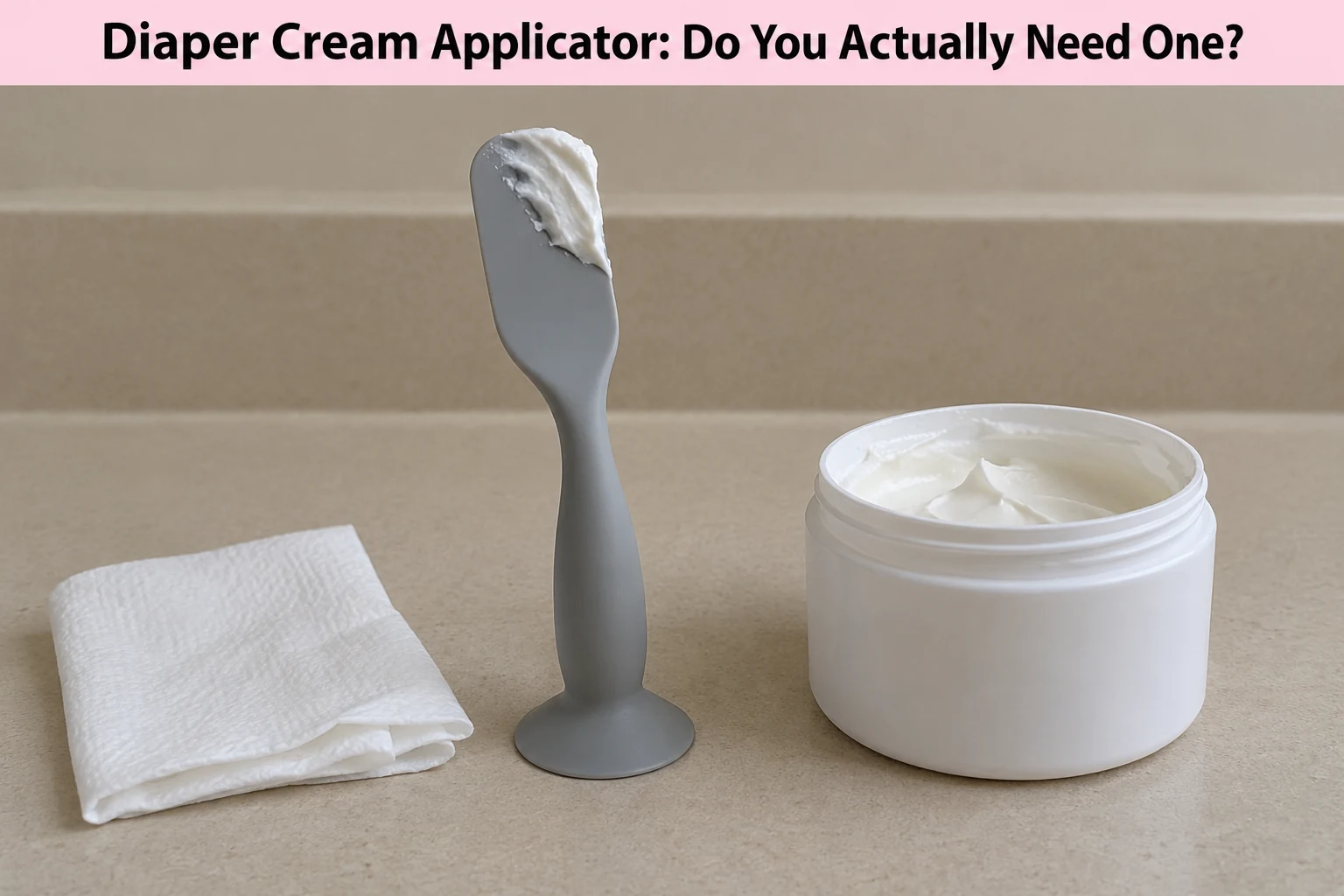
This guide explains where the tool helps, where it does not, and what the makers themselves say about cleaning it. It is general information, not medical advice for your baby.
First, when the question is not about tools
If a rash is the reason you are shopping, the rash comes first. The AAP's parent site, HealthyChildren.org, in its diaper rash page (last updated December 18, 2024, read September 27, 2026), lists these reasons to contact the pediatrician:
- The rash is not improving after two to three days of treatment.
- There are pimples, peeling, blisters or oozing sores.
- A bright pink or red rash with red spots appears while the baby is taking antibiotics.
- The rash seems especially painful.
- The baby has a fever along with the rash.
No spatula changes any of those. If one applies, your pediatrician is the next step, not a new gadget. Our diaper rash guide walks through the main rash types and what the sources say about each.
"I judge a cream applicator by whether it simplifies the routine enough to justify another item to wash. A flexible blade can help lay down thick paste and keep cream off fingers, but it does not improve the barrier itself or replace handwashing. I would choose it for convenience only if I could keep it clean and follow its care instructions, including any extra steps after contact with an infectious rash."
What a diaper cream applicator actually is
The category is simple. Almost every product on the market is one of two shapes:
- Spatula style. A flat, flexible silicone blade on a short handle, often with a weighted or suction base so it stands upright between uses.
- Brush style. A handle with a soft silicone head, sometimes shaped like a small paddle, sometimes with a textured face.
Two makers' own product pages, both read September 27, 2026, show what the category promises. Frida describes its Diaper Cream Booty Brush as a "hygienic spatula-style applicator" made of "100% soft, flexible silicone", with "a suction-cup base that helps you avoid messes while you work." Mushie describes its Diaper Cream Applicator as "100% high-quality food grade silicone" and "Free of BPA, BPS, PVC and phthalates."
Those are the makers' descriptions of their own products. They are not independent test results, and we have not tested either one.
The mechanism: what a barrier cream needs from you
Before deciding on a tool, it helps to know what the cream is supposed to do. A zinc oxide paste or petrolatum ointment is not a medicine that soaks in. It works as a layer between the skin and whatever is in the diaper.
HealthyChildren.org describes the technique in plain terms: apply a thick layer, "like icing on a cupcake", and "there is no such thing as too much diaper paste." It adds: "If the paste isn't soiled, no need to rub it off during changes; simply add more paste on top."
Read that closely and three needs appear:
- Enough product to leave a visible layer.
- Even coverage over the area the diaper touches.
- Little friction, because rubbing already irritated skin works against the point.
Any method that meets those three needs does the job. Clean fingers can. A tissue can. A spatula can. The tool is a question of how you prefer to meet them, not whether you can.
Where an applicator genuinely helps
Here is where a spatula earns a spot on the changing table, based on how barrier products behave and what the makers claim.
Thick pastes. Thick zinc pastes are stiff and sticky. Getting an even layer off your fingertips and onto skin without dragging is easier with a flat blade that, in Frida's words, "glides ointment on smoothly." If you use a thick paste every change, this is the strongest case for owning one.
Laying cream on instead of rubbing it in. A fingertip naturally rubs. A flexible spatula tends to lay product down and smooth it, which lines up with the "add more on top" approach rather than scrubbing.
Clean hands mid-change. Babies wriggle. With paste on your fingers, you are handling tabs, clothes and a squirming baby with a greasy hand. An applicator keeps your hands free of cream until you wash them at the end.
Putting cream only where you mean to. A blade gives a cleaner edge than a fingertip, which can help keep cream on the skin and off the tabs or your baby's clothes. If you use cloth diapers, check your diaper maker's own care guidance on creams, because an applicator does not change what reaches the fabric.
Long nails. Frida's page frames its brush as a way to "take a hands-off approach" when skin is irritated and extra sensitive. If you keep nails long, a smooth silicone edge removes one source of accidental scratching.
Where it does not help (the part the product pages skip)
This is the honest side most listings leave out.
It does not make the cream work better. The barrier is the cream. How it got there does not change what it does once it is on the skin. No source we found links an applicator to faster healing, and no maker's page we read claims one.
It is another surface to clean. The makers are clear about this. Frida's care line reads: "Brush wipes clean with a baby wipe. Hand wash, dishwasher-safe, sterilize in boiling water as needed." Mushie says to "Wash with warm water and mild soap, or clean on the top rack of the dishwasher or in a steam sterilizer," and to "boil for 5 minutes" to sterilize.
It may need replacing after an infection. Mushie's own warning reads: "If applicator comes in contact with yeast infected skin or infectious rash, boil in hot water or replace." That is a real maintenance cost that a product photo does not show. If you are not sure whether a rash is yeast, that is a question for the pediatrician.
It does not replace handwashing. Keeping cream off your fingers is not the same as having clean hands after a change. The next section covers what the CDC says.
It can go missing. A diaper bag, a grandparent's house, a daycare cubby: a spatula that lives in one place is not there when you change somewhere else. Your routine has to work without it anyway.
What the CDC's diaper changing steps say about cream
The US Centers for Disease Control and Prevention publishes step-by-step diaper changing guidance for two settings, and they treat cream differently.
The CDC's diaper changing steps for childcare settings (last updated May 17, 2024, read September 27, 2026) say: "If using diaper cream, dispense it onto a tissue." In the step where the clean diaper goes on, they say: "Apply diaper cream, if needed, with a tissue or a freshly gloved finger." The childcare steps end with the caregiver washing their own hands thoroughly with soap and water.
The CDC's home version (last updated April 16, 2024, read September 27, 2026) is simpler. It says "Apply diaper cream, if needed," with no tool named at all, and it tells caregivers to wash both their own hands and the child's hands with soap and water after changing a diaper.
Two things stand out:
- Neither version names an applicator. The childcare version names a tissue or a gloved finger. The home version names nothing.
- Setting the cream out first is part of the childcare routine. Portioning cream before the messy part of the change means the tube or jar is not being handled with soiled hands. You can do that with a tissue, a spatula or a clean fingertip.
If your baby goes to daycare, the provider follows its own rules. Ask how they apply cream before you send a spatula in.
Applicator vs finger vs tissue: a side-by-side
| Method | What it does well | Trade-off | Where it appears in guidance |
|---|---|---|---|
| Clean finger | Always available, you can feel how much you used | Cream on your hand mid-change; nails can scratch | Not named or ruled out by the CDC home steps |
| Tissue | Disposable, nothing to wash | Can tear or shed on stiff paste | Named in the CDC childcare steps |
| Gloved finger | Clean hand under the glove, disposable | Needs a supply of gloves | Named in the CDC childcare steps |
| Silicone spatula or brush | Smooth thick layers, keeps fingers clean, stands on its base | Must be washed; Mushie says boil or replace after contact with infected skin | Not named in CDC or AAP guidance |
The honest reading: an applicator is one reasonable option among four, and it wins mainly on convenience with thick pastes.
If you buy one: what to look for
We do not rank specific applicators, because no one on this site has tested them. These are the features the product pages themselves put forward, and why each one matters.
- Soft, flexible silicone. A flexible edge follows the body's curves without pressing into skin. Both makers above describe their products this way.
- A base that keeps the head off surfaces. Frida's page describes a suction-cup base that "keeps cream off the changing surface while you work." A head resting on the changing pad picks up whatever is on the pad.
- Easy to clean all the way. A one-piece design with no seams or hollow handle leaves fewer places for cream to sit. Check that the maker lists a way to sterilize it.
- A shape that reaches into your container. A long, narrow blade suits a deep jar. A wide blade suits cream squeezed from a tube.
- Clear care instructions and warnings. A maker that states when to boil or replace the tool is telling you something useful.
"Non-toxic" and "BPA-free" on a label are claims made by the seller. They describe what the maker says about its material; they are not a promise about how any baby's skin will react.
A realistic way to decide
Ask yourself three questions:
- Do you use a thick paste most changes? If yes, an applicator is most likely to feel worth it.
- Will you actually wash it after every use? If a spatula would sit uncleaned on the changing table, a tissue or a clean fingertip followed by handwashing is the simpler choice.
- Where do most changes happen? One changing station suits one applicator. Lots of changes on the go may mean it is rarely with you.
If the answers point to "maybe", skip it for now. A good routine matters more than any tool: changing promptly, as covered in how often to change a newborn diaper, and getting the diaper on with the right fit, as in how to put a diaper on so it does not leak. Friction from a diaper that rubs undoes a lot of careful spreading.
FAQ
Is a diaper cream applicator necessary?
No source we found says it is. HealthyChildren.org describes the goal as a thick layer of paste left in place at clean changes, and the CDC's home diaper steps simply say to apply cream if needed. An applicator is one way to do that, alongside a clean finger or a tissue.
Is it more hygienic to use a spatula than a finger?
It keeps cream off your fingers, but it becomes a surface that has to be cleaned. Mushie says to clean its applicator after use and to boil or replace it if it touches yeast-infected skin or an infectious rash. The CDC says to wash your hands and your child's hands after changing a diaper either way.
How do you clean a silicone diaper cream applicator?
Follow the maker's instructions. Frida says its brush wipes clean with a baby wipe and can be hand washed, run through the dishwasher or sterilized in boiling water. Mushie lists warm water and mild soap, the dishwasher top rack or a steam sterilizer, and boiling for 5 minutes to sterilize.
Can you use an applicator on a baby with a bad rash?
HealthyChildren.org lists a rash that is not improving after two to three days, blisters or oozing sores, or a fever with the rash as reasons to contact the pediatrician. The tool does not change whether a rash needs a doctor, so that call comes first.
Does an applicator help cream work better?
We found no evidence that it does. The cream is the barrier; the tool only changes how it gets to the skin. Its practical advantage is spreading thick pastes smoothly without rubbing.
Author Profile
-
Eamin Hosen is the founder and author of BelovedTots. He has raised two young children, Pona and Ruku, and spent years working in child development at Neurosparks, a therapy center that provides Speech Therapy, Occupational Therapy, and ABA Therapy for children with developmental needs.
It was there, watching long therapy sessions get interrupted by leaking, ill-fitting diapers, that he began researching how products perform during everyday use and where their performance falls short of packaging claims.
He holds a Master’s in Psychology and Guidance from the University of Dhaka and brings a behavioral observation lens to every product he reviews. When he’s not testing diapers or writing guides, he’s probably negotiating bedtime with a 4-year-old.
Latest entries
- November 13, 2026Diaper Brands and ComparisonsBamboo Diapers: Viscose, Rayon and the Box Claims
- November 12, 2026Diaper Rash and SkinHypoallergenic Diapers: What the Word Really Promises
- November 11, 2026Diaper Brands and ComparisonsChlorine Free Diapers Meaning: TCF vs ECF Explained
- November 10, 2026Diaper Brands and ComparisonsEco Friendly Diapers: What the Labels Actually Mean