Swim Diaper Sizes vs Regular Diaper Sizes, Side by Side

Swim diaper sizes do not line up with regular diaper sizes, even from the same brand. Disposable swim pants come in fewer, broader sizes sold by weight, and a number like 4 on a swim pack does not mean the same weight range as size 4 in everyday diapers. Reusable swim diapers are often labeled by age instead. The safest way to choose is to ignore the size number, read the weight range on the swim pack itself, and check that the leg and waist elastic sit snug without gaps, because a swim diaper holds poop by its seal, not by absorbing.
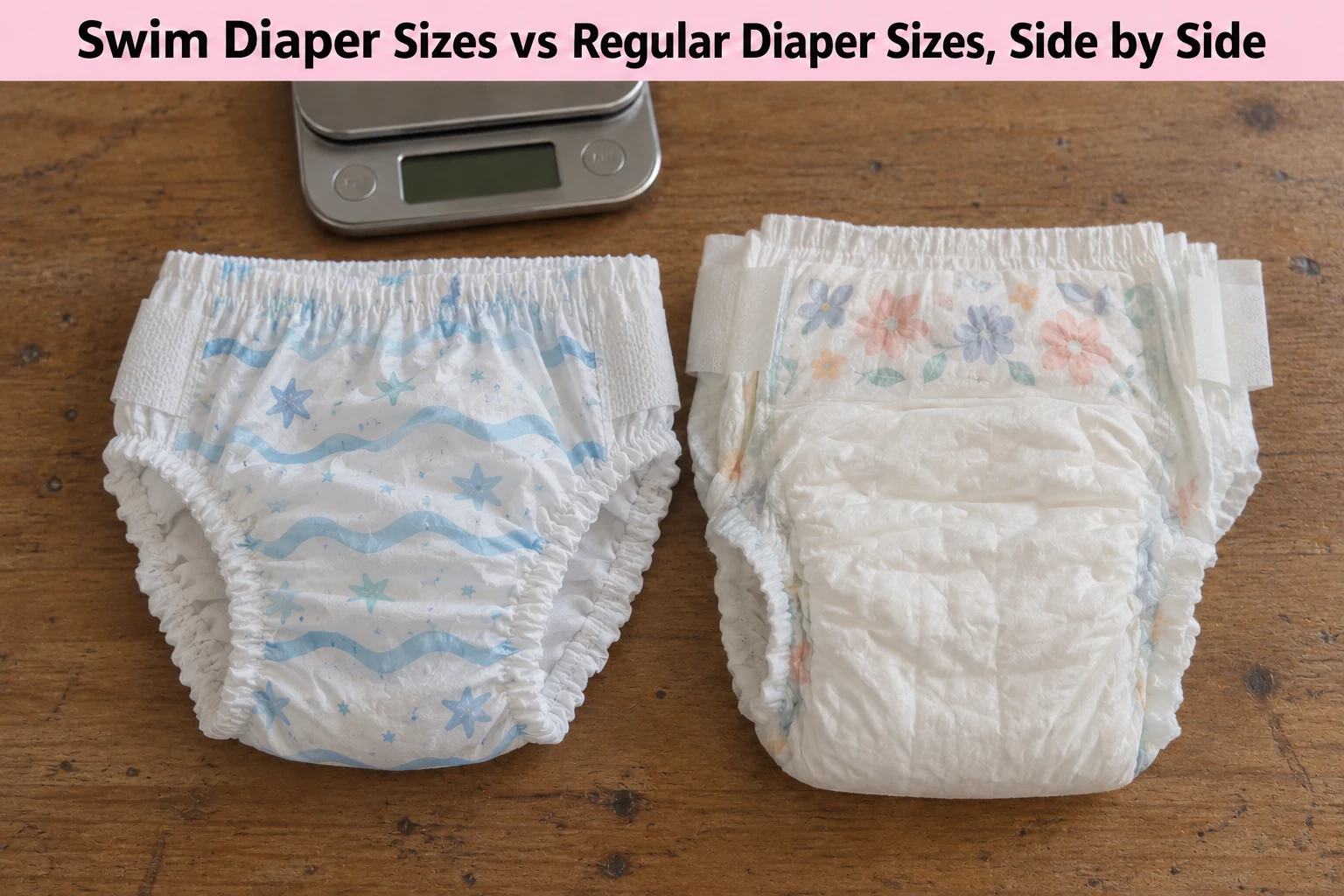
Below, we put one maker's two charts side by side so you can see exactly where the numbers drift apart.
Why swim diaper sizes work differently
A regular diaper and a swim diaper are doing different jobs, and the sizing follows the job.
A regular diaper has to fit around an absorbent core that fills up through the day. A swim diaper has a core that is built not to fill. Pampers says on its Splashers product page (read September 28, 2026) that Splashers do not absorb urine very well, to avoid swelling up in the water, and that their main purpose is containing bowel movements. With no swelling core to hold things in, the fit at the legs and waist is the whole product.
In its swim diaper guide (updated January 16, 2026, read September 28, 2026), Pampers describes swim diapers as sized similarly to regular diapers, typically by weight range, but notes that each brand fits a bit differently. That is the honest summary: same idea, different numbers.
"I start a swim-diaper size check from the range on that specific pack, not the number on an everyday diaper. Even the same brand can use the same number for a different weight range. Once I have a shortlist, I would check the leg and waist openings for gaps or pressure, because neither an age label nor an overlapping weight range can guarantee the right seal."
Swim diaper sizes next to regular sizes: one maker, two charts
The clearest way to see the gap is to compare a single brand against itself. Here are the weight ranges Pampers prints for its everyday diapers on its diaper size and weight chart (updated June 18, 2026, read September 28, 2026) alongside the Splashers swim pants ranges from the Splashers product page (read the same day).
| Pampers everyday diaper size | Weight range | Pampers Splashers swim size | Weight range |
|---|---|---|---|
| Size 2 | 10 to 22 lbs | Size 2-3 | 13 to 24 lbs |
| Size 3 | 13 to 26 lbs | Size 2-3 | 13 to 24 lbs |
| Size 4 | 15 to 34 lbs | Size 4 | 20 to 30 lbs |
| Size 5 | 20 to 37 lbs | Size 5+ | 31 lbs and up |
| Size 6 | 23 to 44 lbs | Size 6 | 35 lbs and up |
| Size 7 | 26 to 50 lbs | (no size 7 listed) |
Four things stand out:
- Splashers start at 13 lbs. The everyday chart runs down through Preemie, Newborn and Size 1, but the smallest Splashers size on the product page begins at 13 lbs. There is no Splashers equivalent listed for a smaller baby.
- Two regular sizes collapse into one swim size. Sizes 2 and 3 in everyday diapers both map to Splashers 2-3.
- The same number means a different range. Everyday Size 4 lists 15 to 34 lbs. Splashers Size 4 lists 20 to 30 lbs. A child in everyday size 4 at 17 lbs is below the Splashers 4 range, and a child at 32 lbs is above it.
- The top sizes are open-ended. Splashers 5+ and 6 list a minimum weight with no maximum, so fit, not the label, tells you when a child has outgrown them.
These are one brand's figures. Huggies Little Swimmers and store brands use their own ranges, and we have not reproduced them here. Read the weight range on the package you are buying.
Worked examples: which swim size, by weight
Because the ranges overlap, the same child can sit inside several everyday sizes but only one or two swim sizes. Using the Pampers figures above:
- An 18 lb baby falls inside everyday Sizes 2, 3 and 4, but only Splashers 2-3.
- A 22 lb baby falls inside everyday Sizes 2 through 5, and inside both Splashers 2-3 and Splashers 4.
- A 28 lb toddler falls inside everyday Sizes 4 through 7, but only Splashers 4.
- A 32 lb toddler falls inside everyday Sizes 4 through 7, and only Splashers 5+.
- A 36 lb toddler falls inside Splashers 5+ and Splashers 6.
So a parent who buys the swim size that matches the number on their everyday box can easily land in the wrong range. The 32 lb toddler in everyday size 4 is a good example: Splashers 4 tops out at 30 lbs.
If your child sits in an overlap, the same reasoning from our guide on when to size up diapers and how the weight overlap works applies: weight gets you to a shortlist, fit decides. For how different brands' everyday sizes compare to each other, see our cross-brand diaper size chart.
Reusable swim diaper sizes: often by age, not weight
Reusables add a third system. Green Sprouts, for example, sells its i play Eco Snap Swim Diaper in sizes labeled 6mo, 12mo, 18mo, 24mo, 3T, 4T and 5T on its product page (read September 28, 2026). The product page we read lists those age labels rather than weight ranges, so check the maker's own size chart or the package before you buy.
Age labels are a rough guide at best. Babies of the same age can differ a lot in weight and build, which is the same reason age is a weak guide for everyday diaper sizes too. An age label on a swim diaper tells you where to start looking, not what will seal on your child.
How to check swim diaper fit before the pool
The size label gets you close. The fit check is what actually matters, because a swim diaper has no absorbent core to catch anything that slips past a gap.
At the legs. The elastic should sit flat against the thigh all the way around. Big Blue Swim School describes the target as snug enough that there are no gaps at the legs or waist, but not so tight that it leaves red marks or restricts movement. If you see daylight at the thigh when your child sits or kicks, that is where a leak will happen.
At the waist. The band should lie flat on the belly and back without folding over or standing away from the skin.
Through the middle. Material bunching between the legs usually means the diaper is too big.
Red marks. Deep marks on the thighs or belly after a swim can mean the diaper is too small. Our guide on how to tell if a diaper is too small covers the signs, and if you see skin irritation that does not settle, ask your pediatrician.
Thigh shape changes the answer more than weight does. A heavier baby with slim legs may get gaps in a size their weight says should fit, while a lighter baby with rounder thighs may need the next size up. That pattern works the same way it does with everyday diapers, so the leg check above is worth repeating each time you try a new swim size.
Why getting the size right matters at the pool
A swim diaper that fits badly is not just uncomfortable. CDC's Tips for Using Swim Diapers page (last updated May 8, 2024, read September 28, 2026) states that research shows swim diapers and swim pants might hold in some solid poop, but they are not leak-proof, and that they do not keep diarrhea-causing germs such as Cryptosporidium from contaminating the water. CDC advises keeping children with diarrhea out of the water and checking swim diapers every 60 minutes. A good fit gives the diaper its best chance of doing the limited job it can do. It does not change CDC's advice about staying out of the water when a child is sick.
Quick sizing checklist
- Read the weight range on the swim pack, not the size number.
- If your child is in an overlap, check fit at the legs to decide.
- For reusables, treat the age label as a starting point and check the maker's own chart.
- Recheck fit at the start of each swim season, since a child can move through sizes between summers.
- Put the swim diaper on at the pool; Pampers says to put Splashers on only once you get there.
FAQ
Are swim diaper sizes the same as regular diaper sizes?
No. Using Pampers as an example, everyday Size 4 lists 15 to 34 lbs while Splashers Size 4 lists 20 to 30 lbs, and everyday Sizes 2 and 3 both correspond to Splashers 2-3. Always read the weight range on the swim pack.
What swim diaper size for a baby in size 3 diapers?
It depends on weight, not the number. In the Pampers ranges, a baby up to 24 lbs fits Splashers 2-3, and from 20 lbs Splashers 4 is also listed. Check the leg fit to choose.
Should I size up in swim diapers?
Only if fit calls for it. A swim diaper that is too big gaps at the legs, and a gap is where poop escapes. Choose by the weight range, then check for gaps or deep red marks.
Are reusable swim diapers sized by age?
Many are. Green Sprouts labels its Eco Snap sizes from 6mo to 5T. Treat the age as a starting point and check the maker's size chart and your child's fit.
What is the smallest swim diaper size?
It varies by brand. On the Pampers Splashers product page we read, the smallest size starts at 13 lbs. Check the package of the brand you are considering for its lowest weight.
Author Profile
-
Eamin Hosen is the founder and author of BelovedTots. He has raised two young children, Pona and Ruku, and spent years working in child development at Neurosparks, a therapy center that provides Speech Therapy, Occupational Therapy, and ABA Therapy for children with developmental needs.
It was there, watching long therapy sessions get interrupted by leaking, ill-fitting diapers, that he began researching how products perform during everyday use and where their performance falls short of packaging claims.
He holds a Master’s in Psychology and Guidance from the University of Dhaka and brings a behavioral observation lens to every product he reviews. When he’s not testing diapers or writing guides, he’s probably negotiating bedtime with a 4-year-old.
Latest entries
- November 13, 2026Diaper Brands and ComparisonsBamboo Diapers: Viscose, Rayon and the Box Claims
- November 12, 2026Diaper Rash and SkinHypoallergenic Diapers: What the Word Really Promises
- November 11, 2026Diaper Brands and ComparisonsChlorine Free Diapers Meaning: TCF vs ECF Explained
- November 10, 2026Diaper Brands and ComparisonsEco Friendly Diapers: What the Labels Actually Mean