
What to Wear Under Swim Diaper Layers, and What Not To

No, a regular diaper does not go under a swim diaper. For what to wear under swim diaper layers, the usual answer is nothing: a swim diaper goes on bare, and a swimsuit can go over it. Pampers states in its swim diaper guide that you do not need, and should not use, a regular diaper under a swim diaper, because it absorbs water instantly and swells. The one common exception is a disposable swim diaper worn under a reusable swim diaper, which some pools and swim schools require. That is a swim layer under a swim layer, not an everyday diaper.
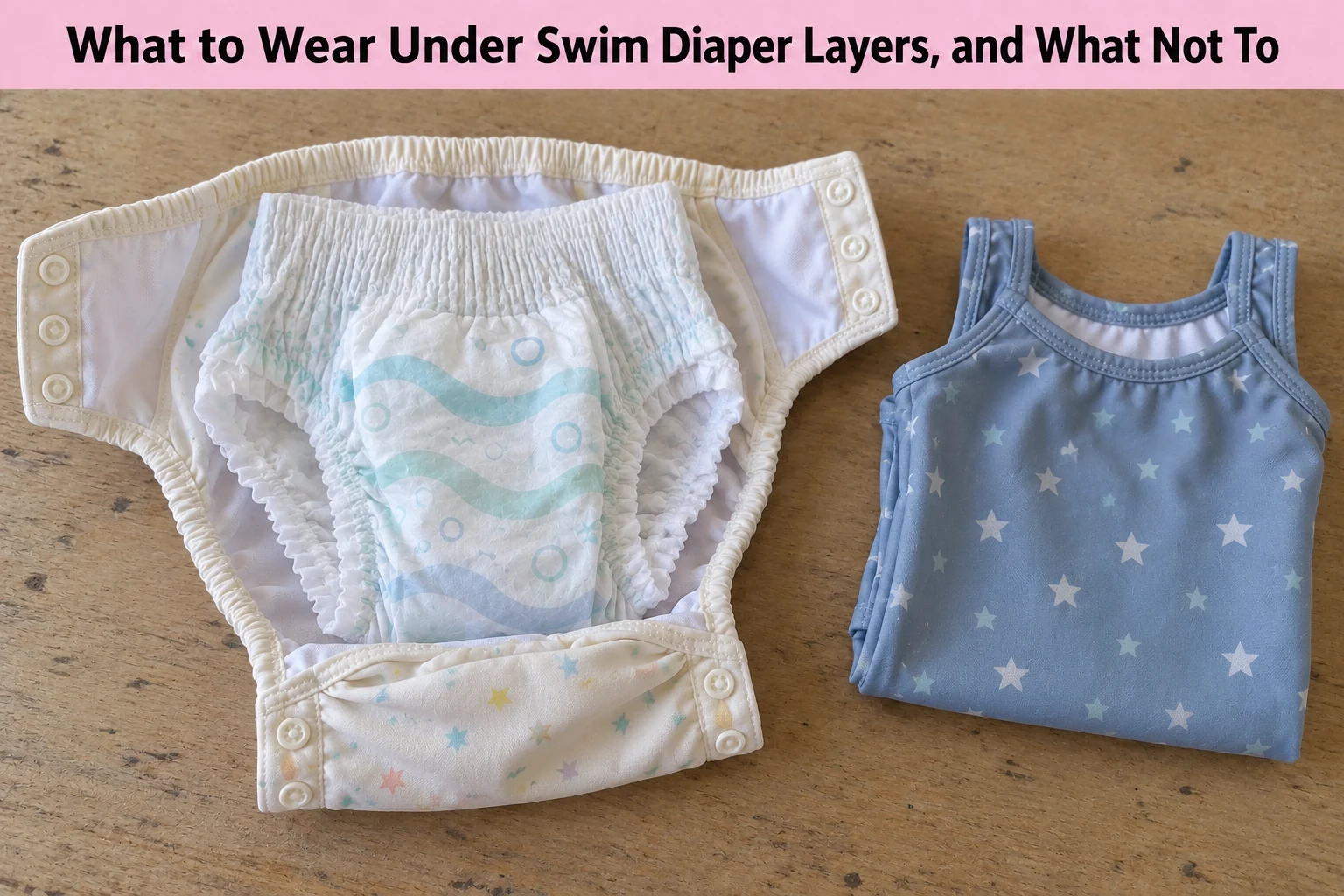
Here is why the rule exists, which layer combinations make sense, and how to put a double layer on so it actually seals.
Why a regular diaper never goes underneath
Everyday diapers are built to soak up liquid. In a pool, that means pool water. In its swim diaper guide (updated January 16, 2026, read September 28, 2026), Pampers explains that a regular diaper would absorb water instantly, swell, and become uncomfortable. It also says swim diapers are made not to absorb water so they do not swell, sag, or weigh your baby down.
Putting a swim diaper over a regular diaper does not fix that. The regular diaper underneath still fills with water. As it swells, it pushes against the swim diaper's leg and waist elastic, and those elastics are what hold poop in. A swim diaper works by sealing snugly at the legs and waist, not by absorbing. Anything that bulks up underneath works against that seal.
So the idea that two diapers are safer than one does not hold when one of them is an everyday diaper. It is heavier and less secure at the seal, not more.
"I check which layers the pool actually requires before adding anything under a swim diaper. If two are needed, I would use a disposable swim diaper under the reusable, with a swimsuit over them if wanted. An everyday absorbent diaper is a separate travel item, because hiding it under swimwear does not stop its core from filling with pool water."
What to wear under swim diaper setups: the combinations that work
These are the layerings you are likely to see at a pool, and what each one is for.
| Setup | What goes next to the skin | What goes over it | When it is used |
|---|---|---|---|
| Disposable swim diaper alone | Disposable swim diaper | Swimsuit, optional | Casual swims where the pool accepts it |
| Reusable swim diaper alone | Reusable swim diaper | Swimsuit, optional | Where the pool accepts a reusable alone |
| Double layer | Disposable swim diaper | Reusable swim diaper, then swimsuit if wanted | Swim lessons or pools that require two layers |
| Regular diaper under swim diaper | Not used | A regular diaper swells in water | |
| Regular diaper alone in the pool | Not used | Same reason |
Two notes on the reusable-only row. Green Sprouts, for example, says of its i play Eco Snap Swim Diaper that no other diaper is necessary under it (product page read September 28, 2026). And some pools still want a second layer regardless of what the maker says, which leads to the double layer.
When a pool or swim school asks for two layers
Double-layer rules are set by the facility, not by the diaper maker. Big Blue Swim School, for example, states that all children who are not completely potty trained are required to wear a reusable swim diaper over a disposable swim diaper during every lesson. Other pools accept a single swim diaper. We did not find one national rule that every public pool follows, so check the posted policy or ask at the desk before your first swim.
If your pool does require two layers, the order matters:
- Disposable swim diaper first. This is the layer against the skin.
- Reusable swim diaper on top. It covers the disposable completely at the legs and waist.
- Swimsuit last, if you are using one.
The layer underneath is always a swim diaper, never an everyday one.
How to put a double layer on so it seals
The most common problem with two layers is not the layers themselves; it is a gap between them. Each elastic needs to sit flat against the skin, or against the layer beneath it, all the way around.
Start with the inner layer. Pull the disposable swim diaper up so the leg elastic sits at the top of the thigh, not down on the leg. Run a finger around each leg opening to check the leak guards are sitting flat against the skin rather than folded inward. The same habits that stop everyday diapers leaking apply here, and our guide on how to put a diaper on so it does not leak walks through them step by step.
Then the outer layer. The reusable should cover the disposable's leg elastic completely. If you can see the disposable peeking out at the thigh, the outer seal is sitting on top of the inner one instead of against skin, and gaps are more likely.
Check at the thigh, not just the waist. Legs are where a swim diaper's seal is easiest to break, for the same reasons covered in why diapers leak at the legs. With two layers, look for a flat, snug edge with no daylight when your child sits or kicks.
Snug, not tight. Big Blue Swim School describes the target fit as snug enough that there are no gaps at the legs or waist, but not so tight that it leaves red marks or restricts movement.
What goes on when, from car to pool
Timing is part of the layering question. Because swim diapers do not hold pee well, putting one on at home means a wet child on the way over.
- On the way to the pool: a regular everyday diaper, as normal.
- At the pool: swap into the swim diaper, or both swim layers if your pool requires them. Pampers advises putting its Splashers on only once you get to the pool.
- During the swim: CDC's Tips for Using Swim Diapers (last updated May 8, 2024, read September 28, 2026) advises checking swim diapers every 60 minutes and changing them in a diaper-changing area away from the poolside, then washing hands.
- After the swim: off with the swim layers and into a dry everyday diaper.
If you notice redness in the diaper area after pool days, our overview of diaper rash and when to call covers what pediatric sources say, and your pediatrician is the right person to check anything that does not settle.
What layering does not change
Adding a layer does not make a swim diaper leak-proof, and it does not change the health guidance. CDC states that research shows swim diapers and swim pants might hold in some solid poop, but they are not leak-proof, and that they do not keep diarrhea-causing germs such as Cryptosporidium from contaminating the water. CDC's advice is to keep children with diarrhea out of the water entirely, whatever they are wearing.
That is the one situation where the layering question has a simple answer: no combination makes swimming with diarrhea acceptable under CDC's guidance. If you are unsure whether your child is well enough to go in the water, ask your pediatrician.
Quick reference
- Never a regular everyday diaper under a swim diaper.
- Usually nothing under a swim diaper at all.
- Sometimes a disposable swim diaper under a reusable one, when the pool or swim school requires it.
- Optional swimsuit over the top.
- Always swap to a swim diaper at the pool, check it hourly as CDC advises, and change back to a dry diaper after.
FAQ
Do you put a regular diaper under a swim diaper?
No. Pampers says you do not need, and should not use, a regular diaper under a swim diaper, because a regular diaper absorbs water instantly and swells. A swollen diaper underneath also pushes against the swim diaper's leg seal.
Can you wear a disposable swim diaper under a reusable one?
Yes. This double layer is the setup some swim schools require. Big Blue Swim School, for example, requires a reusable swim diaper over a disposable swim diaper for children who are not completely potty trained.
Does a swimsuit go over or under a swim diaper?
Over. The swim diaper, or both swim layers, go next to the skin, and a swimsuit can go on top.
Does double layering stop germs getting into the pool?
No. CDC states swim diapers are not leak-proof and do not keep diarrhea germs such as Cryptosporidium from contaminating the water. CDC advises keeping children with diarrhea out of the water.
Should my baby wear a swim diaper to the pool?
Pampers advises putting Splashers on only once you get to the pool, because swim diapers do not absorb pee well. A regular diaper for the trip, then a swap at the pool, avoids a wet ride.
Author Profile
-
Eamin Hosen is the founder and author of BelovedTots. He has raised two young children, Pona and Ruku, and spent years working in child development at Neurosparks, a therapy center that provides Speech Therapy, Occupational Therapy, and ABA Therapy for children with developmental needs.
It was there, watching long therapy sessions get interrupted by leaking, ill-fitting diapers, that he began researching how products perform during everyday use and where their performance falls short of packaging claims.
He holds a Master’s in Psychology and Guidance from the University of Dhaka and brings a behavioral observation lens to every product he reviews. When he’s not testing diapers or writing guides, he’s probably negotiating bedtime with a 4-year-old.
Latest entries
- November 13, 2026Diaper Brands and ComparisonsBamboo Diapers: Viscose, Rayon and the Box Claims
- November 12, 2026Diaper Rash and SkinHypoallergenic Diapers: What the Word Really Promises
- November 11, 2026Diaper Brands and ComparisonsChlorine Free Diapers Meaning: TCF vs ECF Explained
- November 10, 2026Diaper Brands and ComparisonsEco Friendly Diapers: What the Labels Actually Mean