Reusable Swim Diaper vs Disposable, Compared for Pool Days

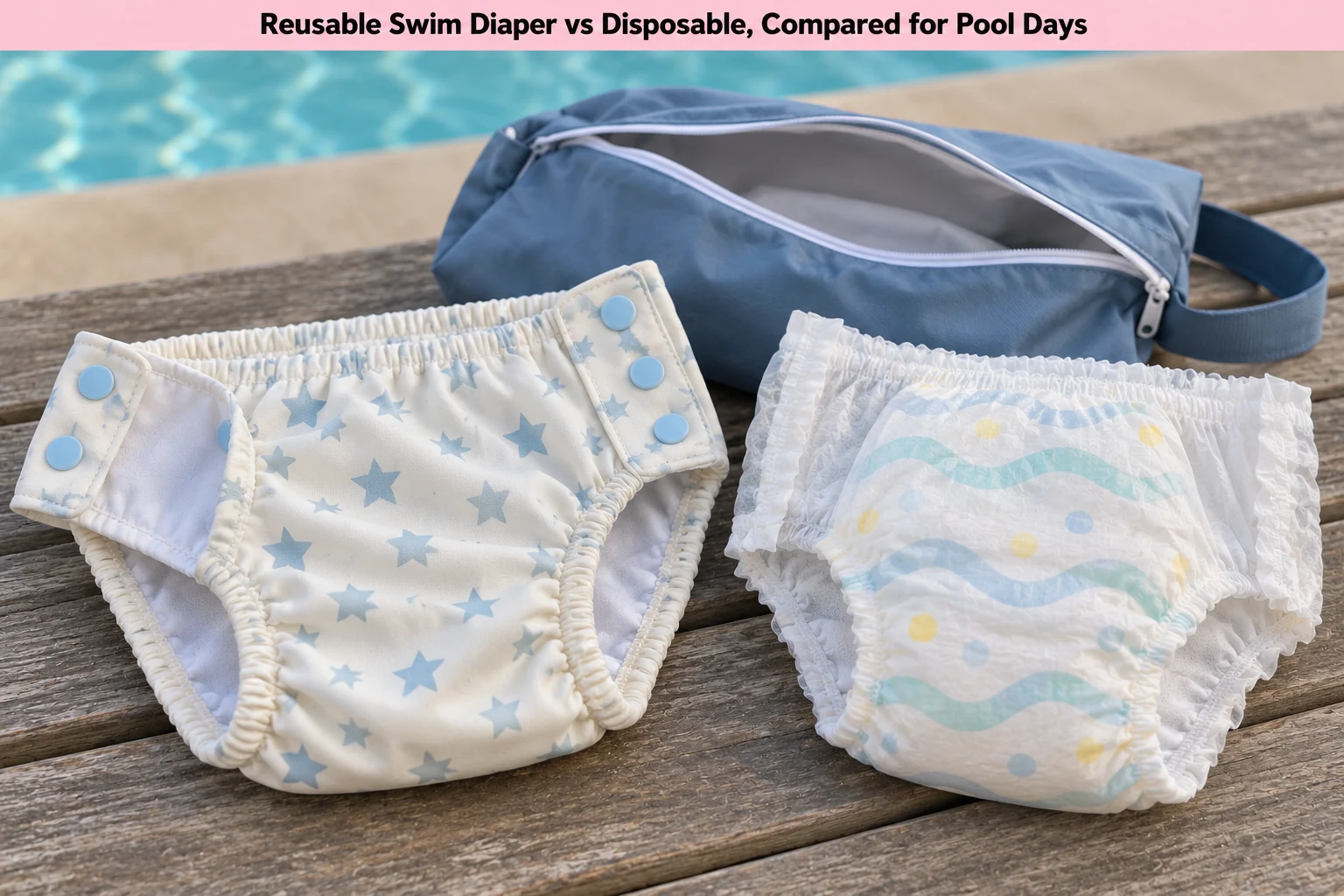
Reusable swim diaper vs disposable comes down to three things: how often you swim, whether you can do laundry after, and what your pool or swim class requires. Both work the same way. Neither absorbs pee; both rely on snug leg and waist elastic to hold in solid poop. A disposable is single use and goes in the trash. A reusable snaps or pulls on, goes home wet, and gets washed. The question most comparisons skip is the pool rule: if yours requires a disposable under a reusable, you are not choosing between them at all.
This guide is research-based. We compare the two types using makers' own product pages and CDC guidance, not hands-on testing.
Reusable swim diaper vs disposable: what is actually different
Start with what is the same, because it is more than most parents expect. Pampers says on its Splashers product page (read September 28, 2026) that the pants do not absorb urine very well, on purpose, to avoid swelling in water, and that their main purpose is containing bowel movements. Reusables share that job. Green Sprouts describes its i play Eco Snap Swim Diaper as a triple-layer design with a waterproof outer layer and an absorbent inner layer it says does not puff up (product page read September 28, 2026). Neither type is meant to be worn as an everyday diaper.
Where they differ:
| Factor | Disposable swim pants | Reusable swim diaper |
|---|---|---|
| How it goes on | Pant-style; Splashers have tear-open sides | Varies; the Eco Snap closes with side snaps |
| After a poop | Tear off, bin it | Empty solids, carry home, wash |
| How it is sized | By weight range on the pack | Often by age label (Eco Snap: 6mo up to 5T) |
| Laundry | None | Machine wash; Green Sprouts lists cold wash, tumble dry low |
| Spares on a pool day | One per change | Enough to cover the changes you expect |
| Cost pattern | Pay per swim | Pay once per size, then laundry |
None of those rows makes one type better. They make one type better for a particular family.
"Before choosing reusable or disposable swim diapers, I check the pool's policy, because a double-layer rule changes both the packing list and the cost comparison. Then I look at how often we would swim, whether washing afterward is practical, and how many clean spares are needed. Neither type earns a pass on fit checks or changing breaks, and I would not call one the better choice for every family."
How each type holds up where it matters: the seal
Because neither type absorbs, containment depends entirely on fit at the legs and waist. This is where the two feel different in practice.
Disposables use stretchy elastic sized to a weight band. The Pampers Splashers page describes dual leak-guard barriers that fit snugly around the legs and a waistband that stretches all the way around. The upside is that stretch gives some room for different builds within a size. The downside is that you cannot adjust it: if the leg elastic gaps on your child's thigh, your only fix is a different size or brand.
Reusables vary more from maker to maker. Snap closures like the Eco Snap's make it easier to get on and off, but snaps at the side do not make a diaper one-size; Green Sprouts still sells it in separate sizes from 6mo to 5T. The upside of a reusable is that a well-chosen one can suit a particular body shape better than a generic disposable. The downside is that age labels are a rough guide, and if you guess wrong you have paid for the wrong size.
If your child has thicker or thinner thighs than average, the fit logic in diaper fit for chunky thighs vs skinny babies applies to swim diapers too, only more strictly, because a swim diaper has no absorbent core to catch what gets past a gap.
The pool rule question, answered before you buy
This is the most practical part of the choice and the part that surprises parents at the front desk.
Some programs set their own layering rules. Big Blue Swim School, for example, states that all children who are not completely potty trained are required to wear a reusable swim diaper over a disposable swim diaper during every lesson. Other pools accept either type on its own. We did not find a single national rule that every public pool follows, so the only reliable answer is your pool's own policy.
That matters for the comparison in three ways:
- If your pool or class requires a double layer, you will buy both. The reusable does not replace disposables; it adds to them. The cost math below mostly stops applying, and the question becomes which outer reusable fits best.
- If your pool accepts a reusable alone, the full comparison applies, and a reusable can replace disposables on regular swim days.
- If your pool accepts a disposable alone, you can skip reusables entirely unless you prefer them.
A phone call or a look at the facility's posted rules before your first visit saves a wasted purchase.
What CDC says, whichever type you choose
The type of swim diaper does not change the health guidance. CDC's Tips for Using Swim Diapers (last updated May 8, 2024, read September 28, 2026) states that research shows swim diapers and swim pants might hold in some solid poop, but they are not leak-proof, and that they do not keep diarrhea-causing germs such as Cryptosporidium from contaminating the water. CDC advises:
- keeping children with diarrhea out of the water
- checking swim diapers every 60 minutes and changing them away from the poolside
- washing hands after diaper changes
No reusable and no disposable changes those points. If your child has diarrhea or you are unsure whether they are well enough to swim, check with your pediatrician before the pool.
The cost question without made-up numbers
Prices for swim diapers change by retailer, pack size and season, so we are not going to quote a figure that may be wrong by the time you read this. What we can give you is the math, so you can run it with the prices in front of you.
Step 1: find your disposable cost per swim. Divide the pack price by the count on the pack, then multiply by how many you typically use per pool trip (one for a quick swim, more if a change happens).
Step 2: find your reusable cost. Take the price of one reusable and multiply by how many you need to own. If you want one drying while another is in use, that means at least two.
Step 3: divide. Reusable cost divided by disposable cost per swim tells you roughly how many swims it takes before the reusables have paid for themselves.
Step 4: compare that to your real season. If you swim weekly through a long season, you may pass the break-even point. If you swim a handful of times on one vacation, you probably will not.
Two things change the answer:
- Growth. Reusables are bought per size. A child who moves up a size mid-season resets the math. Disposables track size changes pack by pack.
- Double-layer rules. As above, if your pool requires a disposable under the reusable, the disposable cost continues regardless.
On the environmental side, Green Sprouts markets its reusable as creating less waste and lists recycled polyester as the shell and lining material. Those are the maker's claims; we have not independently assessed the full footprint of washing versus discarding, so we are leaving it as a stated trade-off rather than a verdict.
Honest downsides of each
Disposable swim pants (such as Pampers Splashers, Huggies Little Swimmers)
- Single use, so the cost continues every swim.
- Fit cannot be adjusted beyond choosing a size.
- Pampers says to put Splashers on only once you get to the pool, so they are not a leave-on-from-home option.
Reusable swim diapers (such as the Green Sprouts i play Eco Snap)
- You carry a soiled diaper home and wash it.
- Age-labeled sizing is a starting point, not a guarantee, so fit takes some trial.
- You need enough spares to cover a day, especially for a child who poops in the water.
Which setup fits which family
These are patterns, not rankings. We are not naming any one brand the winner.
- Occasional swimmer, travel, or no easy laundry: disposables are the simpler fit, as long as your pool accepts them alone.
- Regular swimmer at a pool that accepts reusables alone: a reusable in the right size, with a spare, may make sense once you run the cost math above.
- Swim lessons or a pool with a double-layer rule: you need both, so choose the reusable for fit and use a disposable swim diaper that fits snugly under it.
- Child between sizes or with unusual leg shape: a pack of disposables lets you learn which fit works before committing to a reusable in a specific size.
For the everyday-diaper side of the same decision, our overview of diaper brands and which line fits which baby explains how the big makers differ, and why age is the wrong number for diaper sizes is worth reading before you trust an age label on a reusable.
FAQ
Are reusable swim diapers better than disposable ones?
Neither is better for every family. Both contain solids without absorbing pee. Reusables suit frequent swimmers who can do laundry and whose pool accepts them alone; disposables suit occasional swims, travel, and double-layer rules.
Do public pools require a specific type of swim diaper?
It depends on the facility. Some programs, such as Big Blue Swim School, require a reusable over a disposable swim diaper for children who are not potty trained. Check your pool's posted policy before you buy.
Do reusable swim diapers hold pee?
Not in the way an everyday diaper does. Green Sprouts describes an absorbent inner layer in its Eco Snap that it says does not puff up, but like disposables it is a swim product meant to contain solids in the water.
How many reusable swim diapers do I need?
Enough to cover the changes you expect in one outing, since a soiled one cannot be reused until it is washed. If you want one drying while another is in use, plan on at least two.
Do swim diapers keep germs out of the pool?
No. CDC states swim diapers are not leak-proof and do not keep diarrhea germs such as Cryptosporidium from contaminating the water. CDC advises keeping children with diarrhea out of the water.
Author Profile
-
Eamin Hosen is the founder and author of BelovedTots. He has raised two young children, Pona and Ruku, and spent years working in child development at Neurosparks, a therapy center that provides Speech Therapy, Occupational Therapy, and ABA Therapy for children with developmental needs.
It was there, watching long therapy sessions get interrupted by leaking, ill-fitting diapers, that he began researching how products perform during everyday use and where their performance falls short of packaging claims.
He holds a Master’s in Psychology and Guidance from the University of Dhaka and brings a behavioral observation lens to every product he reviews. When he’s not testing diapers or writing guides, he’s probably negotiating bedtime with a 4-year-old.
Latest entries
- November 13, 2026Diaper Brands and ComparisonsBamboo Diapers: Viscose, Rayon and the Box Claims
- November 12, 2026Diaper Rash and SkinHypoallergenic Diapers: What the Word Really Promises
- November 11, 2026Diaper Brands and ComparisonsChlorine Free Diapers Meaning: TCF vs ECF Explained
- November 10, 2026Diaper Brands and ComparisonsEco Friendly Diapers: What the Labels Actually Mean