
Diaper Fit for Chunky Thighs vs Skinny Babies

Your baby is squarely inside the weight band. The chart is satisfied. And the diaper still does not fit, either because it cuts into the thighs or because it gapes at the legs and leaks.
The size chart has one input, and it is weight. Two babies at the same weight can be shaped completely differently, and shape is what decides whether a diaper seals. That is the whole of this problem, and knowing it is the difference between changing sizes forever and changing approach.
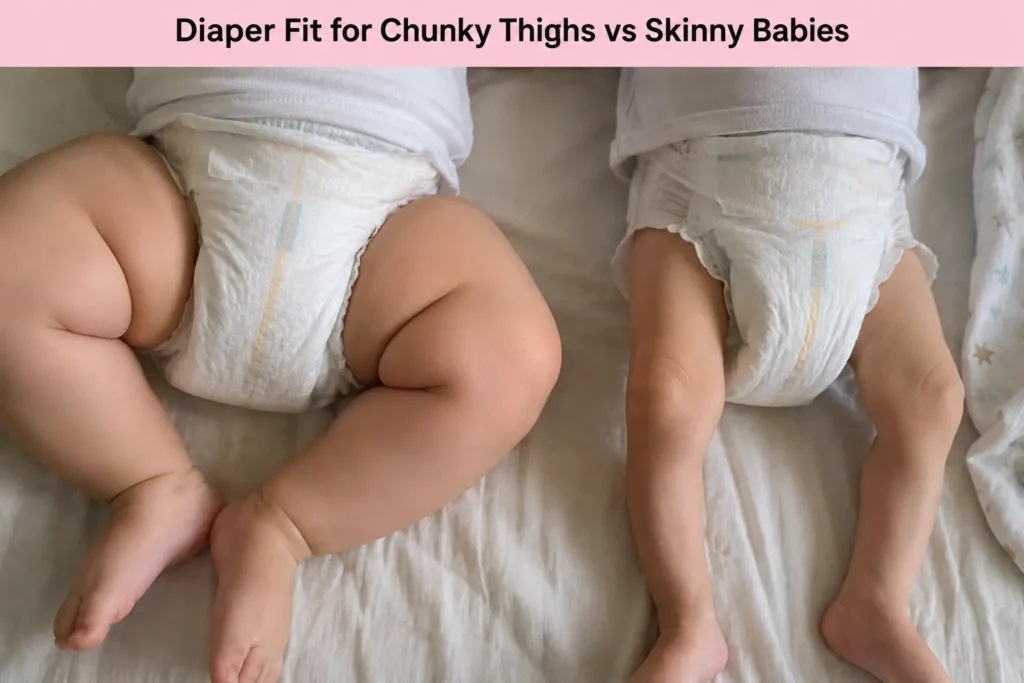
“I’ve found that diaper fit can fail even when the weight chart says the size is right, because thigh shape matters just as much as weight. With fuller thighs I watch for pressure marks and compressed cuffs, while with slimmer legs I look for gaps that let leaks escape. In my experience, changing to a different diaper cut in the same size often works better than simply sizing up or down.”
Two failures, opposite causes
Chunky thighs: the leg opening is too small for the leg. Red marks that persist after a change, a visible indentation, the cuff being forced flat by the thigh so it cannot stand up as a barrier. Leaks happen because a compressed cuff is not a seal.
Slim thighs: the leg opening is too large for the leg. A visible gap you can see daylight through, cuffs that do not touch the skin all the way around, and leaks that run straight out of the leg opening without ever reaching the core. Why diapers leak at the legs covers the mechanism in detail.
Both are fit failures at the same seal, and neither is solved by weight.
Why sizing up and sizing down both fail
The instinct in each case is to change size, and it usually disappoints.
Sizing up for chunky thighs gives you a bigger leg opening, and it also gives you a bigger everything else. The waist becomes loose, the rise gets longer, and you have traded a leg leak for a back leak. Diaper leaking at the waist or back covers what that looks like.
Sizing down for slim thighs tightens the legs and also tightens the waist, and now the tabs barely reach and there are marks at the waistband. How to tell if a diaper is too small covers the signs.
Diapers scale as a whole. You cannot change one dimension by changing size, because size changes all of them together.
Which means the answer is usually a differently shaped product at the same size, not a different size of the same product.
The three measurements nobody publishes
Here is why choosing that differently shaped product is harder than it should be, and it is a checkable fact rather than a complaint.
On 2026-08-24 this site checked US consumer product pages for the three dimensions that decide fit: the rise, the back waistband height, and the leg opening. No US consumer line publishes any of the three.
Take that in properly. The size chart publishes weight, which is the input that does not solve this problem, and does not publish the three measurements that would. So when a review site tells you a particular brand “runs narrow” or “has more room in the thigh”, that is somebody’s impression, not a specification, because the specification is not printed anywhere.
The same is true of absorbency. On the same date we checked both major US brands for a published capacity figure in milliliters or grams, and neither publishes one.
One thing said plainly rather than left implied: Huggies’ consumer and healthcare pages returned access errors to our fetcher on 2026-08-24. That is our retrieval failing. It is not the company withholding anything, and nothing should be read into it.
What this means for switching brands
It does not mean brands are all the same. Diapers genuinely differ in cut, and a parent who says one brand fits their baby better is very likely right.
It means you cannot find out by reading. You find out by trying, and the honest method is to try properly rather than to buy a case on a recommendation.
There is one thing you do not have to worry about while testing. This site checked Pampers and Huggies weight bands at Walmart, Kroger and Fred Meyer on 2026-08-23 and found matching weight ranges at every size checked. So switching between those two does not mean recalculating your size. The number on the box is the same. What differs is the cut, which is exactly the thing you are testing.
How to test one brand honestly
- Buy the smallest pack, not the value pack. You are running a test.
- Change only one thing. Same size, same technique, one new brand.
- Give it several days, including at least two nights.
- Look at the marks, not just the leaks. Red marks that persist for a while after a change tell you the leg opening is tight even on a day with no leak.
- Look at the gap. With the baby lying down, check whether the cuff is in contact with the skin all the way around the thigh, or whether there is daylight.
- Write down what happened. Three brands in and you will not remember which one was which.
Before you change anything: the free fixes
Both failure modes are frequently improved by technique alone, and technique costs nothing.
Untuck the leg cuffs at every change. Pampers publishes this instruction itself, per this site’s record of the 2026-08-24 read: “untuck and smooth out leg cuffs during every change.” A tucked cuff cannot seal at any size, and on a slim-thighed baby it is very often the entire problem. Cuff flipping and the leg ruffle trick covers it in full.
Fasten evenly, and no tighter than snug. For a chunky-thighed baby the instinct is to pull the tabs harder, which forces the cuff flatter against the thigh and makes the seal worse rather than better.
Adjust the tape angle. Kao, which makes Merries, publishes guidance on the angle of the fastening tapes rather than just the target position: for a back leak, raise the back panel higher than the front and “fasten the tape diagonally downwards”, the mirror image for a tummy leak, and for leaks after a child is strapped in, fasten “at a lower level, slightly slanted at an angle”. That is Kao’s guidance for Kao’s taped products in the market it writes for, and it is not a claim about any other manufacturer’s diaper. It is free to try, which is why it is worth trying.
Smooth the whole thing. Run a hand around the waist and both legs after fastening. Bunched material at the thigh is a gap waiting to happen.
When the problem is neither
If you have worked through the above and the fit is still wrong in a way you cannot describe as too tight or too loose, the diaper fit and leaks guide covers the wider picture, including the possibility that the issue is timing or saturation rather than shape at all.
And if your baby is at a weight where several sizes claim them at once, which begins around size 3, the chart is genuinely not going to help. Fit decides, and this page is what fit looks like.
The short version
- The chart only knows weight. Shape is what seals a diaper.
- Chunky thighs and slim thighs are opposite failures at the same seal.
- Sizing up or down changes every dimension at once, so it usually trades one leak for another.
- No US consumer line publishes rise, back waistband height or leg opening. There is no spec to choose by.
- Pampers and Huggies printed matching weight bands at every size checked on 2026-08-23, so switching does not change your size.
- Try the free fixes first: untuck the cuffs, fasten evenly, adjust the tape angle, smooth everything.
- Then test one brand at a time, in the smallest pack, and write down what happened.
Author Profile
-
Saima Mostari is the founder and author of BelovedTots. She has raised two young children, Pona and Ruku, and spent years working in child development at Neurosparks, a therapy center that provides Speech Therapy, Occupational Therapy, and ABA Therapy for children with developmental needs.
It was there, watching long therapy sessions get interrupted by leaking, ill-fitting diapers, that she began researching which products actually perform under real-world conditions, not just on the packaging.
She holds a Master's in Psychology and Guidance from the University of Dhaka, and brings a behavioral observation lens to every product she reviews. When she's not testing diapers or writing guides, she's probably negotiating bedtime with a 4-year-old.
Latest entries
- September 30, 2026Diaper Brands and ComparisonsLuvs vs Pampers: P&G’s Budget vs Premium Line
- September 27, 2026Diaper Brands and ComparisonsKirkland Diapers vs Huggies: What’s Different in 2026
- September 26, 2026Diaper Brands and ComparisonsKirkland Diapers Review: What Costco’s Diaper Is Now
- September 24, 2026Diaper Brands and ComparisonsHuggies Little Snugglers vs Snug and Dry: Which Fits?