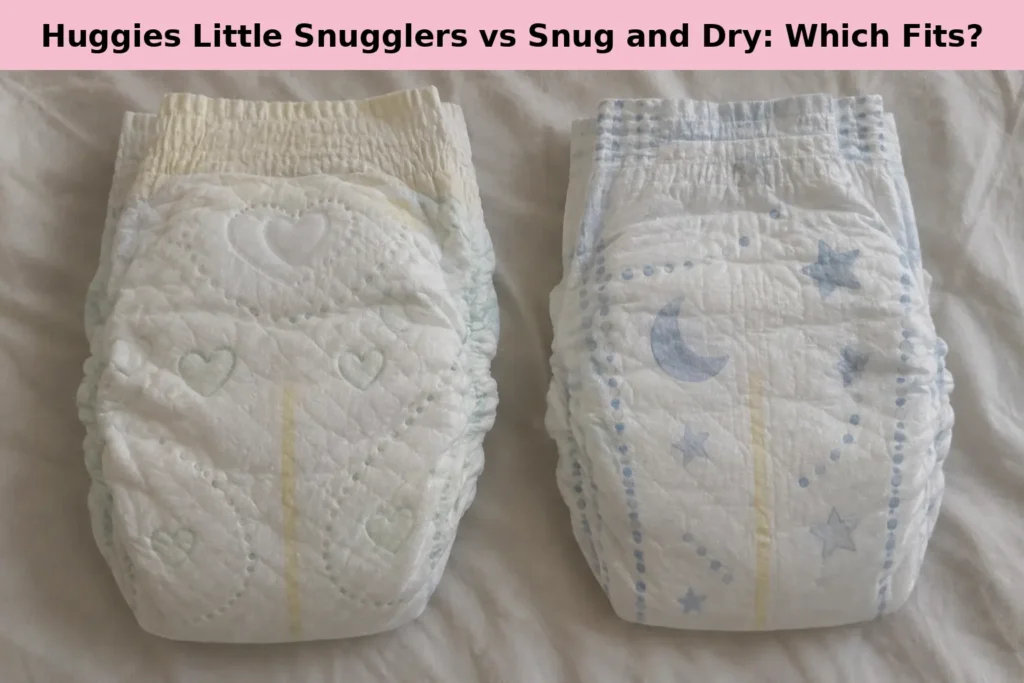
Huggies Little Snugglers vs Snug and Dry: Which Fits?

Huggies Little Snugglers vs Snug and Dry is a stage question, not a quality one. Little Snugglers is Huggies’ newborn-only tape diaper, sized Preemie through size 2, with an umbilical cord cutout in the two smallest sizes. Snug and Dry is a separate tape line that starts at Newborn and runs through size 7, built as Huggies’ everyday option across a much wider age range. Little Movers is a third line, a pull-on diaper for babies who stand and crawl, starting at size 3.
“With my baby in those first tiny sizes, the umbilical cutout on Little Snugglers was the detail I cared about most, but once that newborn stage passed, Snug & Dry made more sense as an everyday taped diaper because it continues through a much wider size range. I’ve learned to treat the switch as a stage-and-fit decision rather than assuming one Huggies line is simply better than the other.”
Huggies Little Snugglers vs Snug and Dry vs Little Movers at a Glance
Before comparing features, it helps to see the three side by side. Nothing below was tested by this site; every figure comes from Huggies’ own product pages, read September 18, 2026, and Huggies updates these pages without notice, so the pack in your hand is the final word if it disagrees with a number here.
| Little Snugglers | Snug and Dry | Little Movers | |
|---|---|---|---|
| Style | Taped | Taped | Pull-on pants |
| Sizes | Preemie, Newborn, 1, 2 | Newborn through 7 | 3 through 8 (HuggFit 360 version: 3 through 7) |
| Umbilical cutout | Preemie and Newborn only | Not listed | Not applicable |
| Wetness indicator | Yes, all sizes | Yes, all sizes | Yes, all sizes |
| Named liner/leak feature | GentleAbsorb Liner | CloudSoft absorbent layers, Leak Lock blowout blocker | 4X Advanced Leak Blockers; HuggFit 360 adds a stretch waistband |
| Positioned as | Newborn comfort | Everyday value tape diaper | Mobile-baby fit |
Sources: Huggies’ own product pages for Little Snugglers, Snug and Dry, and Little Movers HuggFit 360, all read September 18, 2026.
Huggies Little Snugglers: Built for the First Weeks
Little Snugglers only exists for the newborn stretch: Preemie (up to about 6 lb), Newborn (up to about 10 lb), size 1 (8 to 14 lb), and size 2 (12 to 18 lb). According to Huggies’ own Little Snugglers product page (read September 18, 2026), only the Preemie and Newborn sizes carry a front cutout designed to keep fabric off a healing umbilical cord; sizes 1 and 2 do not need it because the cord has typically finished healing by then. The line is described as hypoallergenic and made without added lotions, parabens, and elemental chlorine.
The honest limitation: Little Snugglers stops at size 2. A baby who outgrows size 2 has to move to a different Huggies line, most often Snug and Dry, so this is not a diaper you settle into for the whole first year. For how the weight bands work once a baby is between sizes, diaper sizes by age explains why the box’s weight number, not the calendar, is the one to trust.
Huggies Snug and Dry: Huggies’ Everyday Tape Diaper
Snug and Dry is a separate product, not a renamed Little Snugglers. It starts at Newborn and, per Huggies’ page, runs through size 7, with some retailer listings carrying it to size 8. Huggies describes the line around two named features, CloudSoft absorbent layers and waistband, and a “Leak Lock” blowout blocker, alongside the standard wetness indicator. It does not list an umbilical cutout on any size.
Huggies positions Snug and Dry as the more affordable everyday option next to Little Snugglers’ newborn-focused comfort tier; that is a positioning claim, not a lab measurement, and this site has not tested either for softness. What matters more than the marketing tier is which weight band your baby is actually in, since that decides whether Snug and Dry or Little Snugglers is even an option today.
Huggies Little Movers: When Your Baby Starts Moving
Little Movers is a different shape of diaper, not just a bigger size. It is a pull-on pants style, meaning it goes on like underwear rather than fastening with tabs, aimed at babies who can stand, crawl, or walk and squirm during a change. Huggies’ page lists the standard Little Movers line in sizes 3 through 8, and a separate HuggFit 360 version in sizes 3 through 7 with an added stretch waistband. Both name a wetness indicator and a leak-blocker design at the leg openings.
The tradeoff Huggies doesn’t put on the front of the box: a pull-on diaper has to come all the way off for every change, which is slower for a quick wipe-and-close than tabs you can loosen and refasten. That is a real cost for a caregiver, not a defect, and it is part of why Little Movers is not marketed for newborns who are not yet sitting or standing.
What “Hypoallergenic” and “Fragrance-Free” Actually Mean Here
All three Huggies lines describe themselves as hypoallergenic and made without added fragrance. Worth knowing before that label decides a purchase: the FDA’s own Cosmetics Safety Q&A on the term, read September 18, 2026, states there are no federal standards or definitions governing “hypoallergenic,” and a manufacturer is not required to submit proof of the claim. That does not make the claim false, it means it is not a certification you can look up. “Fragrance-free” is narrower and more checkable: it means no fragrance ingredient was added, which is different from “unscented,” where a masking fragrance can be used to cover other ingredient smells. None of the three lines claims to prevent or treat a skin reaction; they describe what is and is not in the diaper, and a baby’s own skin is still the test that matters.
The Fit Mechanism: Why the Line Matters Less Than the Fit
Here is what most line-by-line comparisons skip: switching lines does not fix a leak or a rash if the diaper is not fitted correctly in the first place. According to the American Academy of Pediatrics’ HealthyChildren.org page on diaper rash (read September 18, 2026), exposing the skin to air and attaching a diaper loosely at the waist helps keep skin dry, while leg openings that gap are the more common source of leaks. In practice: loose at the waist, snug at the legs, on any of these three lines.
That is why a “better” line rarely solves a fit problem by itself. If a Little Snugglers or Snug and Dry diaper is leaking from the legs, the leg cuffs may be tucked in rather than standing up against the thigh; cuff flipping covers how to check that on any brand before assuming the diaper itself failed. And on any of the three lines, the color-changing strip is a convenience, not a fit gauge; how wetness indicators work explains what the color change does and does not tell you.
None of this is a treatment claim. No diaper here is described anywhere as preventing or treating diaper rash. Fit is a mechanical factor in leaks and in how long skin sits against moisture; a rash that is not improving is a question for your baby’s pediatrician, not a product switch, and diaper rash: what it is, what helps, and when to call covers the sourced signs that warrant a call.
How to Choose Between the Three
- Under about 10 lb, cord still healing: Little Snugglers, Preemie or Newborn, is the only one of the three with a cutout built for the umbilical area.
- Past the newborn stage, still fastening tabs, budget-conscious: Snug and Dry covers sizes 1 through 7 without needing a second line for a while.
- Standing, crawling, or fighting every change: Little Movers, or the HuggFit 360 version if the stretch waistband matters for a wriggly toddler.
- Between two sizes on any line: the line name does not decide this; the weight band printed on the box does, and a slightly loose fit is safer than a slightly tight one.
What Happens When You Outgrow One Line
Every baby eventually ages out of Little Snugglers, and most eventually age into Little Movers. Because these are three separate products with three separate size charts, and Huggies has revised size bands before, check the current weight range printed on the box at every switch rather than assuming a “size 3” means the same weight across lines. Buying a single diaper before committing to a case is the cheapest way to confirm a new line fits before the current one runs out.
FAQ
Is Huggies Little Snugglers better than Snug and Dry?
Huggies does not publish a claim that one is better; they are positioned for different stages. Little Snugglers only goes through size 2 and includes an umbilical cutout in the smallest sizes. Snug and Dry covers a much wider range and is Huggies’ everyday tape diaper. Neither page makes a skin-safety claim over the other.
Can I use Snug and Dry instead of Little Snugglers for a newborn?
Snug and Dry starts at Newborn on Huggies’ size chart, so it fits the weight range, but Huggies does not list an umbilical cutout for it. If the cord has not healed yet, Little Snugglers’ Preemie or Newborn size is built with that specifically in mind.
What size does Little Movers start at?
Huggies lists Little Movers starting at size 3, for roughly 16 to 28 lb, which is around where the newborn-focused features on Little Snugglers and Snug and Dry are no longer offered, since most babies are past the newborn stage by then.
Do all three have a wetness indicator?
Yes. Huggies’ pages for Little Snugglers, Snug and Dry, and Little Movers each list a color-changing wetness indicator across their sizes.
My baby is between sizes on one of these lines. Which one do I buy?
Size up rather than down. A slightly loose diaper at the waist is a comfort issue; a slightly tight one, or gapping at the legs, is more often the cause of leaks and skin irritation, per the AAP’s HealthyChildren.org guidance cited above.
Last checked
Every Huggies figure above was read from huggies.com on September 18, 2026. Huggies revises its size charts and product pages without notice, so the current pack always wins if it disagrees with a number here.
Author Profile
-
Saima Mostari is the founder and author of BelovedTots. She has raised two young children, Pona and Ruku, and spent years working in child development at Neurosparks, a therapy center that provides Speech Therapy, Occupational Therapy, and ABA Therapy for children with developmental needs.
It was there, watching long therapy sessions get interrupted by leaking, ill-fitting diapers, that she began researching which products actually perform under real-world conditions, not just on the packaging.
She holds a Master's in Psychology and Guidance from the University of Dhaka, and brings a behavioral observation lens to every product she reviews. When she's not testing diapers or writing guides, she's probably negotiating bedtime with a 4-year-old.
Latest entries
- September 30, 2026Diaper Brands and ComparisonsLuvs vs Pampers: P&G’s Budget vs Premium Line
- September 27, 2026Diaper Brands and ComparisonsKirkland Diapers vs Huggies: What’s Different in 2026
- September 26, 2026Diaper Brands and ComparisonsKirkland Diapers Review: What Costco’s Diaper Is Now
- September 24, 2026Diaper Brands and ComparisonsHuggies Little Snugglers vs Snug and Dry: Which Fits?