
How Do Swim Diapers Work? What They Hold and Miss

How do swim diapers work? They do the opposite of a regular diaper. Instead of soaking up liquid, a swim diaper is built so water and most pee pass through while snug elastic at the legs and waist holds in solid poop. That is on purpose: an absorbent diaper would fill with pool water, swell and drag. The trade-off is real, though. The CDC's Healthy Swimming guidance says swim diapers are not leak-proof and only delay germs, like those spread in diarrhea, from reaching the water for a few minutes. They are a containment tool, not a seal.
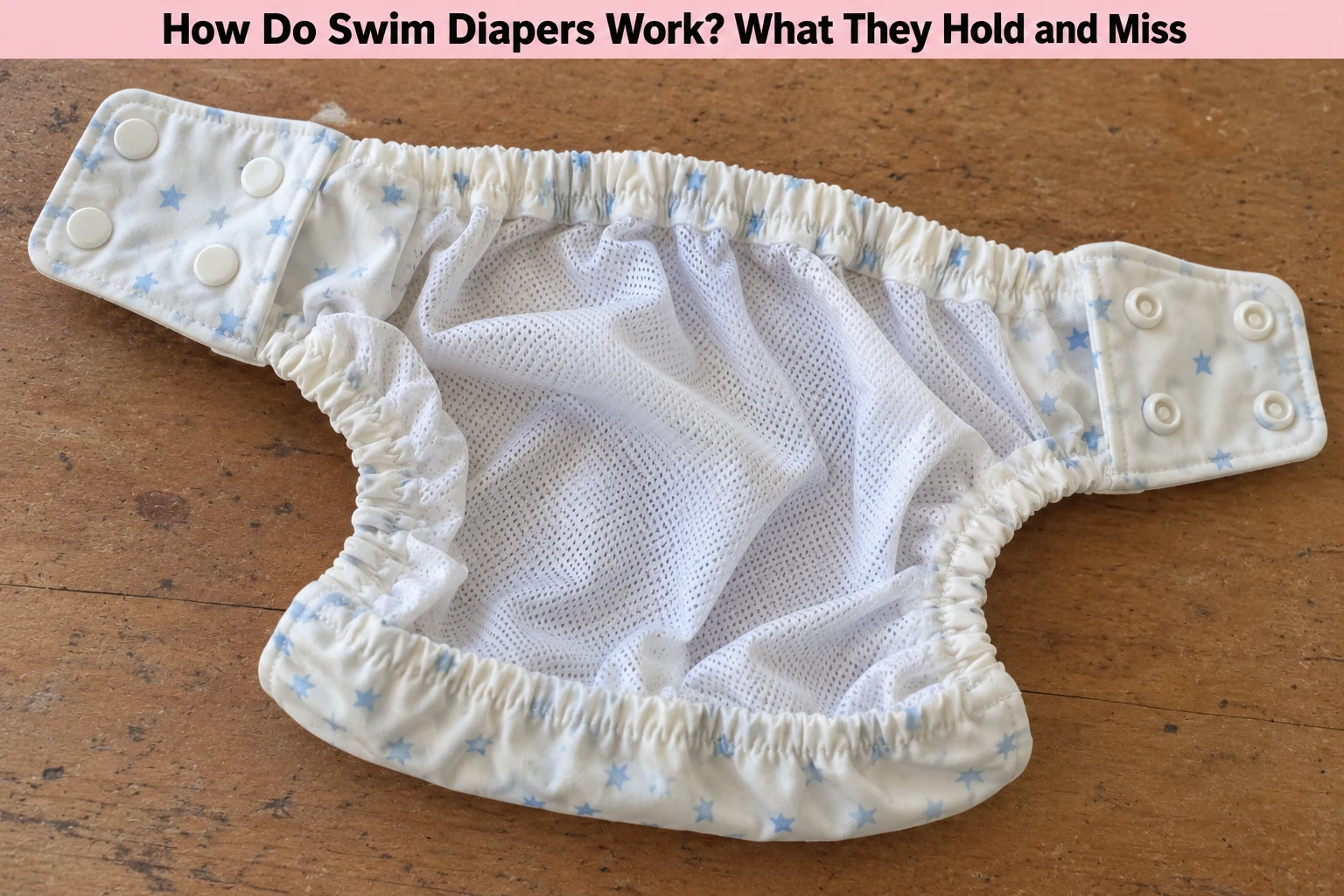
Below is how the design works, where it gives way, and what that means for how long your baby wears one.
How do swim diapers work compared with a regular diaper?
A regular disposable diaper has one main job: pull liquid away from skin and lock it into an absorbent core. That core is exactly what makes it useless in a pool. Pampers puts it plainly in its swim diaper guide (updated January 16, 2026, read on September 28, 2026): a regular diaper would absorb water instantly, swell, and become uncomfortable. A diaper that swells in water gets heavy and saggy, and a sagging diaper tends to open gaps at the legs, which is the one place a swim diaper cannot afford a gap.
A swim diaper flips the priorities:
- The core does not swell. Makers build the middle to stay thin in water. On the Pampers Splashers product page (read September 28, 2026), Pampers says the pants do not absorb urine very well, specifically to avoid swelling up when a child swims.
- The seal does the work. With no absorbent core to catch anything, the containment comes from the fit. The same Pampers page describes dual leak-guard barriers that fit snugly around the legs and a stretchy waistband that goes all the way around.
- The target is solids. Pampers states the main purpose of Splashers is to contain bowel movements. Pee is not the design goal.
So the honest one-line summary is: a swim diaper is an elastic basket for poop, sized to your child, that lets everything liquid flow through.
"I pay more attention to the leg and waist openings than to how padded a swim diaper looks. Its job depends on a close fit, while water and most pee can pass through, so a loose opening leaves very little margin. I would put it on at the pool, check it regularly, and change away from the water rather than treat it as a sealed barrier against germs."
The three parts that do the containing
Once you know the mechanism, you can check any swim diaper, disposable or reusable, against three points.
1. The leg openings
This is where swim diaper leaks are most likely, for the same reason regular diapers leak at the legs: a gap between elastic and thigh. In a regular diaper, a small leg gap might still be rescued by the absorbent core. In a swim diaper there is no core to rescue anything, so a gap is an exit. If you have ever dealt with why diapers leak at the legs, the same fit logic applies here, only with less margin for error.
2. The waistband
The waist seal matters most when your child is lying back, floating, or being held horizontally. A loose waist in water lets contents travel up the back. A band that sits flat against the skin all the way around is what you want to see.
3. The inner layer
Here is where disposables and reusables differ. Disposables like Splashers aim for a core that barely takes on water. Some reusables work differently: Green Sprouts describes its i play Eco Snap Swim Diaper as a three-layer design with a wicking liner, an absorbent inner layer that it says does not puff up, and a waterproof outer layer (product page read September 28, 2026). Even with that inner layer, a reusable swim diaper is still a swim product. It is not built to hold a day of pee on dry land.
What swim diapers do not hold
This is the part most parents learn the hard way, so it helps to see it as a list.
| What | Does a swim diaper hold it? | Why |
|---|---|---|
| Pool water | No, by design | Holding water would make it swell and sag |
| Pee | Mostly no | The core is built not to absorb; pee passes through |
| Formed poop | Often, for a while | The leg and waist seal contains it |
| Runny poop or diarrhea | Not reliably | Liquid behaves like water and escapes the seal |
| Germs from poop | No | CDC says swim diapers only delay germs reaching the water |
The last two rows are the ones that matter for everyone else in the pool.
Pee goes into the water
Because swim diapers are not built to absorb, your child's pee ends up in the pool. The CDC's Tips for Using Swim Diapers page (last updated May 8, 2024, read September 28, 2026) explains why that is more than a squeamish point: urine in pool water uses up chlorine that would otherwise kill germs, and it combines with chlorine to form irritants in the air.
Diarrhea and germs get through
The CDC is direct on this. It states that research shows swim diapers and swim pants might hold in some solid poop, but they are not leak-proof. Diarrhea-causing germs such as Cryptosporidium can be delayed for a few minutes, but swim diapers do not keep those germs from contaminating the water. CDC's separate Preventing Diarrheal Illnesses page (last updated May 19, 2025, read September 28, 2026) repeats that swim diapers can only delay poop germs from getting into the water for a few minutes.
That is why CDC's first recommendation is not about the diaper at all. CDC advises keeping children who have diarrhea out of the water, and for anyone diagnosed with Cryptosporidium, CDC advises staying out of the water until two weeks after diarrhea has completely stopped. If your child has diarrhea, or you are unsure whether they are well enough to swim, that is a question for your pediatrician, not for a better swim diaper.
What this means for how you use one
Understanding the mechanism explains most of the usage rules you see on packages and at pools.
Put it on at the water, not at home. Pampers advises putting Splashers on only once you get to the pool. That follows directly from the design: a diaper that does not absorb pee will leak on the drive over.
Check it on a schedule. CDC advises checking swim diapers every 60 minutes and changing them in a diaper-changing area away from the poolside, then washing hands afterward. A swim diaper that is holding poop is doing its job for a limited window, and CDC's own wording makes clear that window is short.
Wet is not the signal, soiled is. A regular diaper tells you it needs changing when it is full of pee. A swim diaper is always wet in the water, so wetness tells you nothing. What you are checking for is poop. Once your child is out of the water for good, a wet swim diaper has no job left, and swapping into a dry regular diaper is the usual next step. If you notice redness in the diaper area after swim days, our guide to diaper rash and when to call covers what pediatric sources say, and your pediatrician is the right person to look at it.
Fit beats size label. Because the seal is the whole product, a swim diaper that is too big fails faster than a regular diaper that is too big. The same visual checks from how to tell if a diaper is too big apply: gaps at the thigh, a waistband that sits away from the belly, material bunching between the legs. With a swim diaper, sort those out before your child gets in the water.
Disposable and reusable: same mechanism, different trade-offs
Both types rely on leg and waist elastic, not absorbency. The differences are practical:
- Disposables such as Pampers Splashers or Huggies Little Swimmers are single use. Splashers are pant-style with sides that tear open, which Pampers says allows quick changes.
- Reusables such as the Green Sprouts Eco Snap close with side snaps and go in the wash afterward. Green Sprouts lists machine wash cold and tumble dry low as the care instructions, and says no other diaper is necessary under it.
Some swim schools ask for both. Big Blue Swim School, for example, states that children who are not completely potty trained must wear a reusable swim diaper over a disposable swim diaper during every lesson. Rules vary between pools and programs, so it is worth checking your pool's own policy before you go.
A quick way to think about it
If you only remember one thing, make it this: a swim diaper is designed to keep solids in and let water out, and it does the first job for a limited time. It is not an absorbent diaper, it does not keep pee out of the pool, and it does not make it acceptable to swim with diarrhea. Used for what it is, on a well-fitting child, checked every hour as CDC advises, it does the job pools need it to do.
FAQ
Do swim diapers absorb pee?
Mostly no. They are built not to absorb, so they do not fill with pool water and swell. Pampers says its Splashers do not absorb urine very well, by design, and that their main purpose is containing bowel movements.
How long can a baby wear a swim diaper?
CDC advises checking swim diapers every 60 minutes and changing them away from the poolside. Because they do not hold pee, Pampers suggests putting Splashers on only once you get to the pool rather than wearing them there.
Do swim diapers stop germs from getting into the pool?
No. CDC states that swim diapers are not leak-proof and can only delay diarrhea-causing germs such as Cryptosporidium from reaching the water for a few minutes. CDC advises keeping children with diarrhea out of the water entirely.
Can I use a regular diaper in the pool instead?
Pampers advises against it, saying a regular diaper would absorb water instantly, swell, and become uncomfortable. A heavy, swollen diaper also sits looser at the legs, which is where containment depends on a snug fit.
Do I need a disposable under a reusable swim diaper?
Not for the diaper to work; Green Sprouts, for example, says no other diaper is necessary with its reusable. Some pools and swim schools require a double layer anyway, so check the policy where you swim.
Author Profile
-
Eamin Hosen is the founder and author of BelovedTots. He has raised two young children, Pona and Ruku, and spent years working in child development at Neurosparks, a therapy center that provides Speech Therapy, Occupational Therapy, and ABA Therapy for children with developmental needs.
It was there, watching long therapy sessions get interrupted by leaking, ill-fitting diapers, that he began researching how products perform during everyday use and where their performance falls short of packaging claims.
He holds a Master’s in Psychology and Guidance from the University of Dhaka and brings a behavioral observation lens to every product he reviews. When he’s not testing diapers or writing guides, he’s probably negotiating bedtime with a 4-year-old.
Latest entries
- November 13, 2026Diaper Brands and ComparisonsBamboo Diapers: Viscose, Rayon and the Box Claims
- November 12, 2026Diaper Rash and SkinHypoallergenic Diapers: What the Word Really Promises
- November 11, 2026Diaper Brands and ComparisonsChlorine Free Diapers Meaning: TCF vs ECF Explained
- November 10, 2026Diaper Brands and ComparisonsEco Friendly Diapers: What the Labels Actually Mean