Best Newborn Diapers: Matched to Birth Weight and Cord

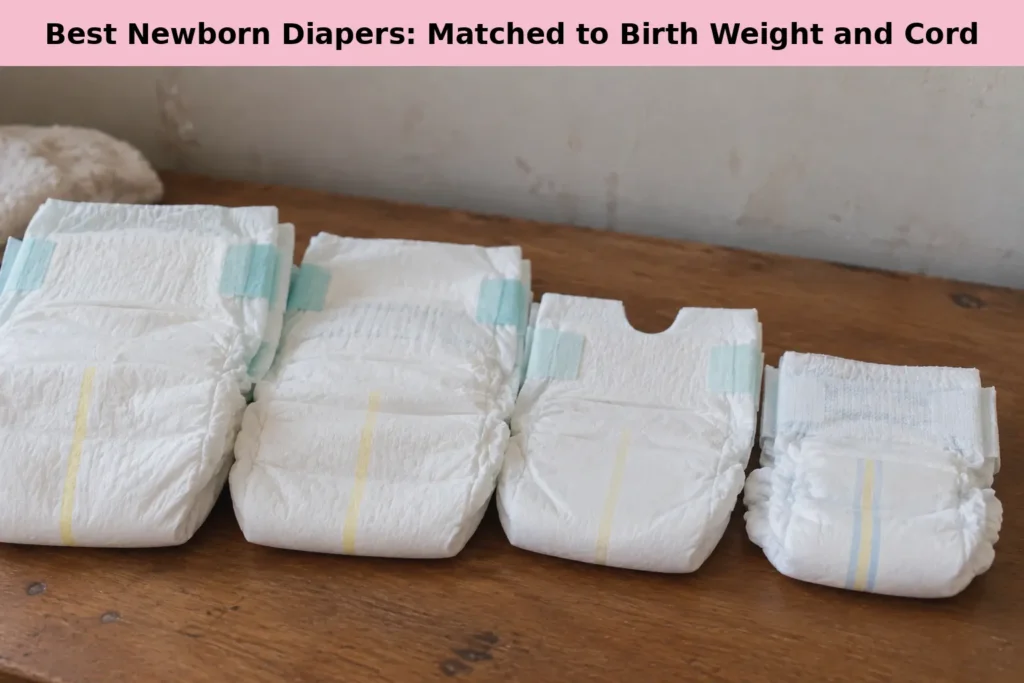
The best newborn diapers are the ones that fit two things you will know in the first days: your baby’s birth weight and the umbilical cord stump. Most makers’ Newborn size covers babies up to about 10 pounds, while smaller babies need a Preemie size. The American Academy of Pediatrics advises keeping the diaper folded below the cord so urine does not soak it, which is why many newborn diapers have a notch or cutout at the front. Brand matters less than those two checks, so buy small packs until you see how your baby fits.
“With a newborn, I would choose diapers by birth weight first and treat the cord notch as a practical convenience rather than a special feature I have to pay extra for. A smaller baby may genuinely need a preemie size, while a baby near the top of the newborn range can move into Size 1 surprisingly quickly. During those first weeks, I would keep the waistband below the cord stump at every change and buy only small packs until I see which size actually seals well around the legs.”
How this guide works
This is a buying guide, not a test. Nothing here was tried on a baby, and no product on this page is ranked. Every diaper below is listed, not tested, and every figure comes from the maker’s own page with the date we read it. Where a maker’s page could not be read, we say so and give no figures for that brand.
The criteria come first, because a list without criteria is just an ad:
- Birth-weight coverage. Does the line make a size that fits a baby under 6 pounds, as well as the usual Newborn size?
- Cord-stump design. Does the maker describe a notch or cutout at the front?
- Wetness indicator. A color stripe helps in the weeks when you are still learning your baby’s output.
- What the label says it leaves out. Fragrance, lotion and latex, quoted, not judged.
- What the maker does not tell you. Every item gets a concession.
Step 1: match the size to birth weight, not to “newborn”
“Newborn” on a box is a weight range, not an age. Pampers publishes one of the clearest charts. Its Preemie Diapers Guide, updated July 9, 2026 and read September 25, 2026, lists these sizes:
| Pampers size | Pampers’s weight range | Pampers’s description |
|---|---|---|
| Pxxs | “<1 pound (<500 grams)” | “Extremely premature babies in NICU care” |
| P3 | “<1.8 pounds (<800 grams)” | “Tiny preterm babies” |
| P2 | “<4 pounds (<1800 grams)” | “Very small premature babies” |
| P1 | “<6 pounds (<2700 grams)” | “Premature or low birth weight babies” |
| Newborn | “<10 pounds (<4.5 kilograms)” | “Full-term newborns and larger preemies” |
Two practical readings follow. A full-term baby who lands in the middle of the Newborn range usually has room to grow in that size. A baby near the bottom of it, under 6 pounds, falls in Preemie territory, where a Newborn diaper may gap at the legs and leak. Our guide to preemie diaper sizes covers which of the smallest sizes you can actually buy in a store.
Watch the top of the range too. Pampers’s Swaddlers page lists Newborn as under 10 pounds and Size 1 as 8 to 14 pounds, so a baby between 8 and 10 pounds fits both on paper. Our comparison of newborn vs size 1 diapers explains how to decide which to have ready before the birth.
Step 2: keep the front clear of the cord stump
For the first weeks, the diaper’s front edge sits right where the cord stump is healing. The AAP’s umbilical cord care page on HealthyChildren.org, updated July 6, 2025 and read September 25, 2026, says “There is no need to use alcohol on the umbilical cord stump; just keep it clean,” and advises: “keep the diaper folded below the cord to keep urine from soaking it.” It adds that the stump “should dry and fall off by the time your baby is 3 weeks old.”
That is the whole reason newborn diapers have a notch. A notch or cutout does the folding for you. A diaper without one works the same way if you fold the front waistband down below the stump at each change. Either route follows the same AAP advice; the notch is a convenience, not a requirement.
When the cord needs a pediatrician, not a different diaper
The same AAP page lists signs that call for your baby’s doctor: “Foul-smelling yellowish discharge from the cord,” “Red skin around the base of the cord,” and “Crying when you touch the cord or the skin next to it.” It says minor bleeding is expected, but “if the cord actively bleeds, call your baby’s doctor immediately,” and that a stump still attached after about three weeks is also worth a call. No diaper design changes any of that. If you see these signs, call your pediatrician.
Step 3: a wetness indicator earns its place early
In the first weeks, many parents are asked to keep track of wet diapers. A color stripe is not required for that, but it makes a quick check easier. Pampers’s Swaddlers page, read September 25, 2026, describes its indicator this way: “This pH-sensitive material changes color when wet with urine, clearly signaling that it’s time for a diaper change.” Treat any stripe as a prompt to look, not as a measurement.
Newborn diapers, listed not tested
Each section below is one product line, drawn only from the maker’s page. None of these is “the best”; each suits a different situation, and each gives something up.
Pampers Swaddlers (Newborn and Preemie)
Pampers’s “Best Diapers for Newborns” article, updated August 20, 2025, reviewed by Christopher B. Peltier, MD, FAAP, and read September 25, 2026, says Swaddlers “feature a soft, breathable liner, umbilical cord notch, and up to 12 hours of leak protection.” Pampers lists the line in Preemie (P1, under 6 pounds) and Newborn (under 10 pounds). Its Swaddlers product page, read the same day, says the diaper is “Free of fragrance, parabens and latex (no natural rubber).”
What it concedes: the product page also claims “drier than the luxury diaper brand” without naming that brand or a method on the page. It calls the diaper “hypoallergenic,” a term the FDA says has no federal definition.
Pampers Pure (Newborn)
The same Pampers newborn article describes Pampers Pure as “fragrance and paraben-free” and made with “a vitamin enriched-liner.”
What it concedes: that article is the only Pure source we read for this guide, and it does not give Pure’s size chart or say whether the Newborn size has a cord notch. Check the box before you rely on either.
Coterie The Diaper (Newborn)
Coterie’s product page, read September 25, 2026, lists size N at “< 10 lbs” and Size 1 at “8-12 lbs.” It states the diaper “Holds over 16 oz. of liquid,” offers “up to 12-hr protection,” and is “Made without fragrance, parabens, latex, lotion, chlorine bleaching, rubber, alcohol, phthalates, and VOCs.” It describes the diaper as “Dermatologist tested” and “Clinically Proven Hypoallergenic.”
What it concedes: the page we read did not mention a cord notch or a wetness indicator, so plan on folding the front down until the stump falls off. Its Size 1 tops out at 12 pounds, lower than some other brands, so a baby may move to Size 2 sooner. “Hypoallergenic” is still undefined at the federal level, per the FDA.
Huggies Little Snugglers (Preemie and Newborn)
Huggies Little Snugglers is Kimberly-Clark’s newborn line, and it is widely sold in Preemie and Newborn sizes. We could not load Huggies’s own product pages when we read them on September 25, 2026, so this guide gives no Huggies weight ranges or feature claims. Our comparison of Huggies Little Snugglers vs Snug and Dry explains how the two Huggies lines differ.
What it concedes: on this page, it concedes that we are not quoting it. Read the weight range and the front-cutout wording on the pack itself.
Brands that start at Size 1
Not every brand makes a Newborn size. Kudos’s product page, read September 25, 2026, starts its chart at Size 1 for 7 to 12 pounds. A line like that can work well later, but it cannot be your hospital-bag diaper for a baby under 7 pounds.
How many newborn diapers to buy before the birth
This is where most first-time parents overbuy. Babies outgrow the Newborn size at different speeds, and a larger baby may move to Size 1 within weeks. Because birth weight is unknown until the day, a sensible pattern is a small stock of Newborn, a small stock of Size 1, and receipts kept. Our guide to how many diapers of each size you actually need walks through the numbers without guessing your baby’s growth for you.
Best newborn diapers: the short version
- Under 6 pounds at birth: look for a Preemie size such as Pampers P1 (“<6 pounds,” per Pampers).
- 6 to about 8 pounds: a Newborn size fits most babies here on paper.
- 8 to 10 pounds: you are in the overlap between Newborn and Size 1; fit at the legs and waist decides.
- Any weight, first three weeks: a notch, or the front folded below the stump, per the AAP.
- Any rash, cord concern or feeding worry: your pediatrician, not a new brand.
FAQ
What size diaper does a newborn wear?
It depends on birth weight, not age. Pampers lists its Newborn size as under 10 pounds and its P1 Preemie size as under 6 pounds, read September 25, 2026. Coterie lists its N size as under 10 pounds. A baby between 8 and 10 pounds sits in the overlap with Size 1 for both brands.
Do newborn diapers need an umbilical cord notch?
No. The AAP advises keeping the diaper folded below the cord so urine does not soak it. A notch or cutout does that for you; folding the waistband down does the same job.
When does the umbilical cord stump fall off?
The AAP’s HealthyChildren.org page says it “should dry and fall off by the time your baby is 3 weeks old,” and lists discharge, redness at the base, pain on touch and active bleeding as reasons to call your baby’s doctor.
Are “hypoallergenic” newborn diapers better for sensitive skin?
The label alone cannot tell you. The FDA states there are no federal standards or definitions for “hypoallergenic” and that the term “means whatever a particular company wants it to mean.” Skin questions belong with your pediatrician.
Should I stock up on newborn diapers before the baby arrives?
Only a little. Birth weight decides whether Newborn or Size 1 fits, and many babies outgrow the Newborn size quickly. Small packs of both, with receipts kept, cover more outcomes than one big box.
Author Profile
-
Eamin Hosen is the founder and author of BelovedTots. He has raised two young children, Pona and Ruku, and spent years working in child development at Neurosparks, a therapy center that provides Speech Therapy, Occupational Therapy, and ABA Therapy for children with developmental needs.
It was there, watching long therapy sessions get interrupted by leaking, ill-fitting diapers, that he began researching how products perform during everyday use and where their performance falls short of packaging claims.
He holds a Master’s in Psychology and Guidance from the University of Dhaka and brings a behavioral observation lens to every product he reviews. When he’s not testing diapers or writing guides, he’s probably negotiating bedtime with a 4-year-old.
Latest entries
- November 13, 2026Diaper Brands and ComparisonsBamboo Diapers: Viscose, Rayon and the Box Claims
- November 12, 2026Diaper Rash and SkinHypoallergenic Diapers: What the Word Really Promises
- November 11, 2026Diaper Brands and ComparisonsChlorine Free Diapers Meaning: TCF vs ECF Explained
- November 10, 2026Diaper Brands and ComparisonsEco Friendly Diapers: What the Labels Actually Mean