
Diaper Rash From Diarrhea: Why It Happens, What to Change

Short answer: diaper rash from diarrhea happens because loose stool is harder on skin than normal stool. Seattle Children’s and Nationwide Children’s Hospital both explain that stool carries digestive enzymes that irritate and break down skin, and frequent loose stools keep that contact going. The rash often sits in a ring right around the anus. Teething is a different story: the AAP’s teething guidance says teething does not change how the gut works and does not cause diarrhea, so diarrhea during teething needs its own explanation. With diarrhea, the first questions are about hydration and when to call the pediatrician, not about the rash.
This page covers the mechanism, the teething confusion, and what can change in the diaper routine. It is general information, not medical advice.
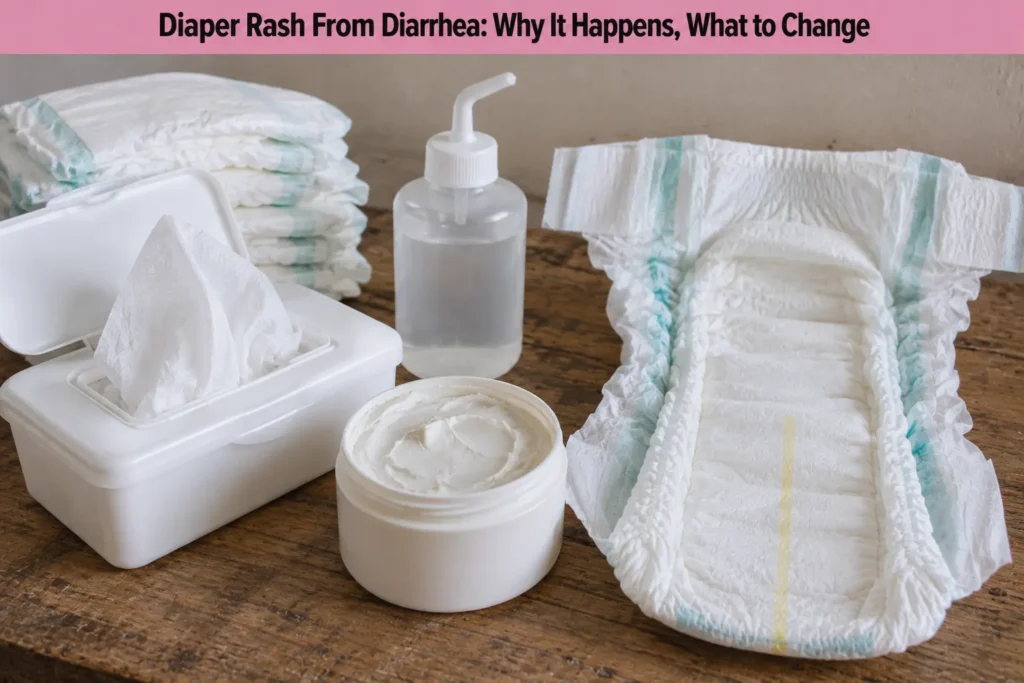
“During diarrhea, I pay much closer attention to how quickly stool is getting off the skin because frequent loose stools can irritate the area surprisingly fast. I try to change after every bowel movement, clean with as little rubbing as possible, let the skin dry, and use a barrier so the next stool is not sitting directly against already sore skin. I also watch the bigger picture, because if my baby seems dehydrated, has a fever, is vomiting, or the rash is getting worse instead of settling, that is when I would stop treating it as a diapering problem and call the pediatrician.”
Call the pediatrician first when these apply
With diarrhea, the rash is usually the smaller problem. The AAP parent site, HealthyChildren.org, in its page on diarrhea in babies (last updated June 10, 2015, read September 25, 2026), lists these as reasons to contact the pediatrician right away when a baby has diarrhea:
- The baby is 3 months old or younger.
- The baby has a rectal temperature of 100.4°F (38°C) or higher.
- The baby is vomiting.
- The baby lacks energy, or is irritable and does not want to feed.
- There are signs of dehydration, such as a dry mouth, or no urine for 3 or more hours.
The same page says a baby can become dehydrated quickly, and it lists stools that are whitish and clay-like, watery and full of mucus, hard and dry, black or bloody as reasons to call. It also states that homemade rehydration drinks may not have the correct electrolyte balance.
For the rash itself, the AAP’s diaper rash page lists a rash not improving or getting worse after two to three days, blisters, pus-filled or oozing sores, marked pain, and fever as reasons to call. Our diaper rash guide has that full list.
Why diarrhea causes diaper rash: the enzyme mechanism
Normal stool and diarrhea are not equally harsh. Nationwide Children’s Hospital (article by Mike Patrick, MD, January 25, 2022) explains that stool contains traces of digestive enzymes, which are useful for breaking down food but also break down skin, and that frequent loose stool coats the skin and breaks it down. Seattle Children’s guidance (last reviewed May 5, 2025) says the same thing in short form: diarrhea stools contain enzymes that digest food and irritate the skin.
Three things stack up during a bout of diarrhea:
- More contact events. Each loose stool is another round of enzymes against the skin.
- More spread. Liquid stool reaches creases and edges that formed stool does not.
- More wiping. Each change adds friction to skin that is already irritated.
That combination is why a baby with no history of rash can develop one quickly during a stomach bug.
Where diaper rash from diarrhea usually shows up
Seattle Children’s notes that rashes found just around the anus are common during bouts of diarrhea. That location is a useful clue because it differs from the everyday irritant rash, which the AAP describes as patches across the skin the diaper covers.
One caution: the AAP also describes a strep bacterial infection as bright red skin around the anus. The two can look alike to a parent. A red ring around the anus that does not settle once the diarrhea stops, or that looks very bright red, is a reason to have the pediatrician take a look.
Antibiotics: the diarrhea and yeast double
Antibiotics often sit behind both the diarrhea and the rash. In the AAP’s article on repeat diaper rashes (by Christine Zimmerman, MD, FAAP, updated December 18, 2024), a pediatrician explains that antibiotics can kill some of the “good” bacteria in the gut, leading to loose stools with digestive enzymes that irritate the skin. The same loss of good bacteria can allow candida, a yeast, to overgrow and cause a separate yeast rash.
So a baby on antibiotics can develop two rashes for two reasons. The AAP lists a bright pink or red rash with red spots at the edges in a baby on antibiotics as its own reason to call the pediatrician.
New foods can change the pattern too
Diarrhea is not the only stool change that matters. The AAP’s repeat-rash article notes that starting solid foods can change digestion and bowel movement patterns, which can lead to rash. Nemours KidsHealth (reviewed September 2023) also lists starting new foods among diaper rash triggers, because new foods change stool content and frequency. If a rash lines up with a new food, writing down the date helps the pediatrician see the pattern.
Teething and diaper rash: what the AAP actually says
This is where parents get mixed messages, and it is worth laying out plainly.
The AAP’s HealthyChildren.org page on teething pain (by the AAP Section on Oral Health, updated July 9, 2025, read September 25, 2026) lists diarrhea and diaper rash among false teething symptoms. It states that teething does not change the way a baby’s gut works, and that teething does not make a baby’s skin more sensitive, except possibly around the mouth, so any diaper rash is a reaction to something else. It adds that because diarrhea is a possible sign of infection, parents should call the pediatrician if diarrhea lasts more than a day.
The AAP’s diaper rash page, meanwhile, says irritant rash is more likely when a child has diarrhea or is teething. Read side by side, the practical upshot is the same: if a teething baby has diarrhea or a rash, the AAP’s teething guidance says to look for another cause rather than write it off as teeth. That matters most for diarrhea, because the teething page flags it as a possible infection.
What to change in the diaper routine
None of this is a treatment plan. It is what pediatric sources describe as reducing contact and friction, so you can discuss it with your pediatrician.
Change timing
The AAP advises frequent changes to limit how long moisture sits on the skin. The American Academy of Dermatology calls changing dirty diapers as soon as possible, even wet-only ones, the most important tip for treating and preventing diaper rash. Nemours KidsHealth suggests every 2 hours and after bowel movements. With diarrhea, that effectively means changing after each stool. For newborn-specific timing, see how often to change a newborn diaper.
Cleaning with less friction
The AAP describes gentle cleaning at changes, using alcohol-free and fragrance-free wipes or water with a gentle cleanser. The AAD mentions a squirt bottle of water as a gentler option for severe rash, followed by letting the area air dry.
A barrier between skin and stool
Seattle Children’s describes a protective ointment around the anus during diarrhea as forming a barrier between the skin and the stool. The AAP’s diaper rash page describes a thick layer of barrier paste containing zinc oxide or petrolatum. Which product, and how often, is a question for your pediatrician; we do not recommend specific products here.
Fit and containment
The AAP recommends a highly absorbent diaper that fits loosely, and its repeat-rash article notes that a diaper fastened too tightly traps moisture and rubs. Diarrhea also tests containment. If loose stool keeps escaping at the waistband, our guide to diaper blowouts up the back explains the fit side of that problem, which also limits how far stool spreads across the skin.
What the diaper cannot fix
Being honest about limits: no diaper stops diarrhea, and no routine change addresses a cause like an infection or an antibiotic effect. Diaper choices and change timing reduce how long stool sits on the skin. They do not replace the pediatrician, especially with the dehydration signs listed at the top of this page.
FAQ
Why does diarrhea cause diaper rash so quickly?
Nationwide Children’s Hospital explains that stool contains digestive enzymes that break down skin, and frequent loose stool coats the skin. Seattle Children’s adds that rashes right around the anus are common during bouts of diarrhea.
Does teething cause diarrhea or diaper rash?
The AAP’s teething guidance says no. It states that teething does not change how the gut works and does not make skin in the diaper area more sensitive, so a diaper rash during teething is a reaction to something else. It advises calling the pediatrician if diarrhea lasts more than a day.
Can antibiotics cause diaper rash through diarrhea?
Yes, according to the AAP. Antibiotics can kill some helpful gut bacteria, leading to loose stools that irritate skin, and can also allow candida to overgrow and cause a yeast rash.
When should I worry about diarrhea in a baby?
HealthyChildren.org lists these reasons to call right away: a baby 3 months or younger, a rectal temperature of 100.4°F or higher, vomiting, low energy or refusing feeds, or signs of dehydration such as a dry mouth or no urine for 3 or more hours.
How long does diaper rash from diarrhea last?
Seattle Children’s and the AAP both say most diaper rashes improve in about three days with proper care. A rash that is not improving, or is worse, after two to three days is on the AAP’s list of reasons to call the pediatrician.
Author Profile
-
Eamin Hosen is the founder and author of BelovedTots. He has raised two young children, Pona and Ruku, and spent years working in child development at Neurosparks, a therapy center that provides Speech Therapy, Occupational Therapy, and ABA Therapy for children with developmental needs.
It was there, watching long therapy sessions get interrupted by leaking, ill-fitting diapers, that he began researching how products perform during everyday use and where their performance falls short of packaging claims.
He holds a Master’s in Psychology and Guidance from the University of Dhaka and brings a behavioral observation lens to every product he reviews. When he’s not testing diapers or writing guides, he’s probably negotiating bedtime with a 4-year-old.
Latest entries
- November 13, 2026Diaper Brands and ComparisonsBamboo Diapers: Viscose, Rayon and the Box Claims
- November 12, 2026Diaper Rash and SkinHypoallergenic Diapers: What the Word Really Promises
- November 11, 2026Diaper Brands and ComparisonsChlorine Free Diapers Meaning: TCF vs ECF Explained
- November 10, 2026Diaper Brands and ComparisonsEco Friendly Diapers: What the Labels Actually Mean