
Diaper Fit for Boys: Positioning and Front Leaks

The pattern is unmistakable once you notice it. The front of the diaper and the front of the clothing are soaked, and the back is completely dry.
A leak that is only ever at the front is not usually a size problem. It is a direction problem, and the fix costs nothing.
Why the direction matters
A diaper absorbs where the liquid arrives, and it needs a moment to do it. If the liquid arrives at the very top edge of the diaper, at the waistband, it can escape over the edge before the core takes it in.
For a boy lying on his back, urine tends to travel upward toward the waistband rather than downward into the middle of the diaper. If nothing directs it downward, some of it goes over the top.
That is the whole mechanism. The diaper is not failing to absorb; the liquid is leaving before it reaches the part that absorbs.
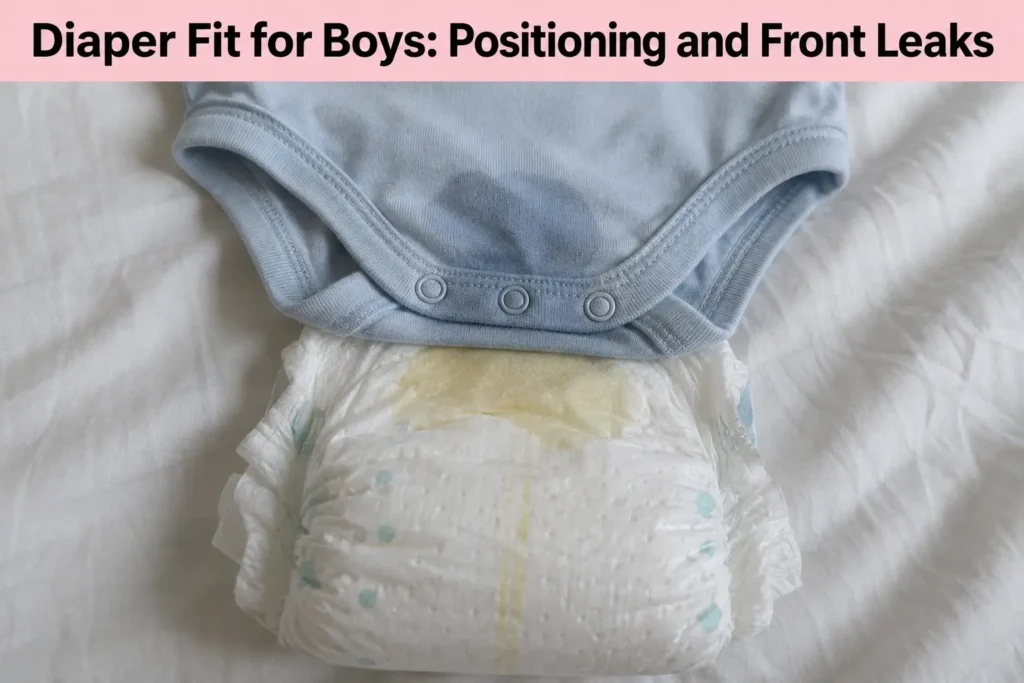
“In my experience, a front-only leak usually points to positioning rather than the diaper being the wrong size. I’ve found that making sure everything is directed downward before fastening, pulling the front panel up properly, and checking that the leg cuffs are fully untucked solves the problem far more often than simply sizing up or switching brands.”
The fix, which is free
Point downward. When you fasten the diaper, make sure the penis is pointing down toward the feet rather than up toward the waistband. Do it every change, and do it before you fasten the tabs rather than after.
That is the single most effective thing on this page and it takes two seconds.
Three things that support it:
Bring the front panel up properly. A front panel that has not been pulled up high enough leaves a shorter run before the edge. Bring it up so it sits where it is meant to, then fasten.
Check that it did not shift. Babies move constantly, and a position that was right at the start of a change can be wrong by the end of it. If you pick them up and put them down, glance again.
Do not fasten tighter to compensate. Tightness does not redirect anything, and it introduces a different problem. A diaper should be snug enough that you can slide a finger or two inside the waistband comfortably, and no more.
The cuffs, which are the other half
Even a well-directed diaper leaks if the leg seal is not built.
The ruffled edges around the legs are a barrier, and they only work when they are on the outside of the leg rather than folded inward. Pampers’ own guidance, per this site’s record from 2026-08-24, is to “untuck and smooth out leg cuffs during every change.”
Run a finger around both leg openings after every change and pull the ruffles out. A tucked cuff is the most common single cause of a leak that has nothing to do with size, and this site has a whole page on it because it is that common: cuff flipping and what the leg ruffles are for covers the mechanics. If your leaks are at the thighs rather than the front, why diapers leak at the legs is the page.
The tape angle, from a manufacturer outside the US SERP
Here is something no US brand page carries, and it is worth trying because it is free.
Kao, which makes Merries, publishes guidance on the angle at which the fastening tapes are applied, not just where the waistband should sit. Per this site’s record of the 2026-08-24 read, its guidance for a tummy leak is the mirror image of its back-leak advice: for a back leak, raise the back panel higher than the front and “fasten the tape diagonally downwards”, so a front leak takes the opposite treatment, raising the front and angling the tapes accordingly. It also publishes that for leaks occurring after a child has been strapped in, the tapes are fastened “at a lower level, slightly slanted at an angle”.
Two honest caveats, and they travel with this everywhere on this site. That is Kao’s guidance for Kao’s taped products in the market Kao writes for, and it is not a claim about any other manufacturer’s diaper. And the tape angle is worth experimenting with precisely because it costs nothing: you are changing how you fasten, not what you buy.
When it is worth suspecting the size after all
Position first, because it is free and it is usually the answer. But some front leaks are a fit problem, and these are the signs.
The tabs barely reach. If you are stretching to fasten, the diaper is small, and a small diaper has a shorter front panel with less margin for the direction problem above. How to tell if a diaper is too small covers the signs, including the one most people miss.
Red marks at the waist or the thighs that are still visible some time after a change.
Volume rather than direction. If the diaper is genuinely saturated when it leaks, this is a capacity or timing question rather than a positioning one, and the answer is a more frequent change or a night-specific approach. Why diapers leak at night covers that.
It happens in both directions. Front leaks and back leaks together are a fit picture rather than a positioning one, and the diaper fit and leaks guide is where to start.
The thing this page will not tell you
Which brand holds more.
On 2026-08-24 this site checked the consumer pages of both major US brands for a published absorbency capacity, in milliliters or grams. Neither publishes one. So any page telling you to switch brands because one absorbs more is making a comparison nobody can verify, including whoever wrote it.
The same applies to the three measurements that actually decide fit, the rise, the back waistband height and the leg opening. No US consumer line publishes any of the three. A brand may genuinely fit your baby better. You will find that out by trying it, not by reading a spec that does not exist.
Which is another reason to exhaust the free fixes first.
The order to work through
- Point downward at every change. Before fastening.
- Pull the front panel up to where it is meant to sit, then fasten.
- Untuck both leg cuffs, every change, per Pampers’ own instruction.
- Try the tape angle, if you are using a taped diaper, remembering whose guidance it is.
- Check the fit signs for a size that is too small.
- Only then consider a different product, knowing there is no published spec to choose by.
The short version
- Front-only leaks are usually direction, not size.
- Pointing downward before fastening is the fix, and it is free.
- Untuck the leg cuffs every change. Pampers publishes that instruction itself.
- Kao publishes a tape-angle technique no US brand page carries. Free to try, and it is Kao’s guidance for Kao’s product.
- Tabs that barely reach, or red marks, mean check the size.
- Nobody publishes absorbency, rise, waistband height or leg opening, so no page can tell you which brand fits your baby.
Author Profile
-
Saima Mostari is the founder and author of BelovedTots. She has raised two young children, Pona and Ruku, and spent years working in child development at Neurosparks, a therapy center that provides Speech Therapy, Occupational Therapy, and ABA Therapy for children with developmental needs.
It was there, watching long therapy sessions get interrupted by leaking, ill-fitting diapers, that she began researching which products actually perform under real-world conditions, not just on the packaging.
She holds a Master's in Psychology and Guidance from the University of Dhaka, and brings a behavioral observation lens to every product she reviews. When she's not testing diapers or writing guides, she's probably negotiating bedtime with a 4-year-old.
Latest entries
- September 30, 2026Diaper Brands and ComparisonsLuvs vs Pampers: P&G’s Budget vs Premium Line
- September 27, 2026Diaper Brands and ComparisonsKirkland Diapers vs Huggies: What’s Different in 2026
- September 26, 2026Diaper Brands and ComparisonsKirkland Diapers Review: What Costco’s Diaper Is Now
- September 24, 2026Diaper Brands and ComparisonsHuggies Little Snugglers vs Snug and Dry: Which Fits?