Diaper Rash Cream Ingredients: How to Read the Label

Short answer: diaper rash cream ingredients are easiest to read from the back of the tube, not the front. If the product carries a "Drug Facts" box, the active ingredient and its percentage come first, usually zinc oxide or petrolatum, and the inactive ingredients come last. The inactive list is where fragrance, lanolin and preservatives appear. A higher zinc percentage means more zinc oxide in the product, not a label promise of faster results. Front-of-pack words such as "natural" and "hypoallergenic" have no FDA definition for cosmetics.
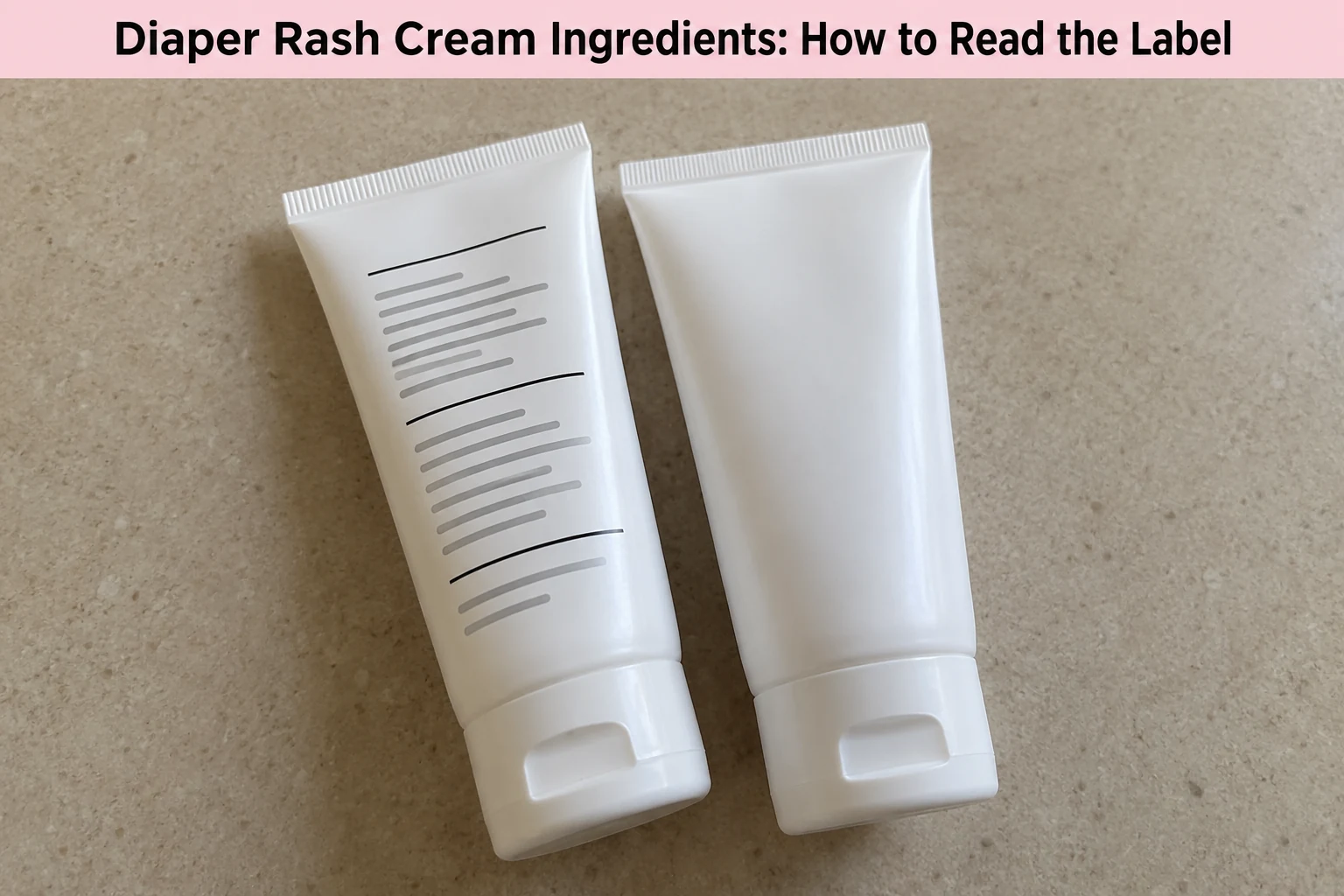
This guide walks through the label section by section. It is general information about labels, not medical advice.
Before reading any label: when to call instead
A label helps you choose between tubes. It cannot tell you whether a rash needs a doctor. The AAP's parent site, HealthyChildren.org, in its page on diaper rash (last updated December 18, 2024, read September 27, 2026), lists these reasons to call the pediatrician: a rash that does not clear after two to three days of treatment; pimples, peeling, blisters or oozing sores; a bright pink or red rash in a baby on antibiotics; a rash that seems especially painful; or a fever with the rash.
If any of those fit, the pediatrician comes before the pharmacy aisle. Our diaper rash guide explains the different types of rash.
"Turning a cream tube over is the first check I make before comparing it with another one. I look for the active ingredient, its percentage, the directions, and then the inactive list for anything I need to avoid. Words such as natural or maximum strength do not replace that check, and a higher zinc number alone does not tell me how the cream will suit a particular rash."
Why the back of the tube matters more than the front
Diaper creams sit in two different regulatory worlds, and the label tells you which one you are holding.
The FDA's page "Is It a Cosmetic, a Drug, or Both?" (content current as of September 11, 2024, read September 27, 2026) explains that a product intended to treat or prevent disease is a drug, while a product intended for cleansing or beautifying is a cosmetic. Claims on the label, in advertising or online can make a product a drug. For products that are both, the FDA says the drug ingredients are listed as "Active Ingredients", followed by the cosmetic ingredients as "Inactive Ingredients" in descending order of predominance.
In practice:
- A cream with a Drug Facts box is sold as an over-the-counter drug. It names an active ingredient, its strength, and its uses.
- A balm or butter with only an ingredient list is typically sold as a cosmetic. It may still contain barrier ingredients, but it does not carry drug-style uses or directions.
Neither format is automatically better. They are simply different kinds of label, and it helps to know which kind you are reading.
The Drug Facts box, section by section
The FDA's consumer page on the over-the-counter Drug Facts label (content current as of September 2, 2026, read September 27, 2026) sets out what each section holds. Here is how those sections look on a diaper cream.
Active ingredient
The FDA describes this as the substance that causes the intended effect, with its amount. On diaper creams it is usually one of two things:
- Zinc oxide, a white mineral barrier.
- Petrolatum, the ingredient name for petroleum jelly.
Some products list two actives. On DailyMed, the National Library of Medicine's database of US drug labels, A+D Original Ointment lists lanolin 15.5% and petrolatum 53.4% (label updated October 11, 2023). HealthyChildren.org says zinc oxide and petrolatum are both good choices and that the ingredients matter more than the brand.
Purpose
This is the product's category. On the diaper rash labels we read on DailyMed, it says "Skin Protectant". That word describes the job: a layer that protects the skin from wetness and irritation.
Uses
The FDA describes this section as the symptoms or conditions the product addresses. On diaper creams it names diaper rash and chafed skin, and describes helping to seal out wetness.
Warnings
This is where to find when to stop. The Desitin Maximum Strength label on DailyMed (updated November 15, 2024) says to stop use and ask a doctor if the condition worsens, or if symptoms last more than seven days or clear up and occur again within a few days.
Directions
On the diaper rash labels we read, the directions follow one pattern: change wet and soiled diapers promptly, cleanse the diaper area, allow it to dry, and apply liberally with each change. That is also a reminder that the routine matters as much as the tube. See how often to change a newborn diaper for that half of it.
Inactive ingredients
The FDA describes these as substances such as binders, colors or flavorings. On a diaper cream, this is the most useful list for a family watching for a particular ingredient, because it is where fragrance, lanolin and preservatives turn up.
Percentages: does 40% zinc mean more than 13%?
This is the question most parents bring to the label. On DailyMed, the percentages vary widely within the zinc category:
| Product (as labeled) | Active ingredient | Form | Label updated |
|---|---|---|---|
| Desitin Daily Defense | Zinc oxide 13% | Cream | Dec 11, 2024 |
| Aquaphor Healing Diaper Rash | Zinc oxide 15% | Cream | Dec 15, 2025 |
| Desitin Maximum Strength | Zinc oxide 40% | Paste | Nov 15, 2024 |
What the percentage tells you is how much of the active ingredient the product contains. What it does not tell you is how the product will perform on a particular baby's skin. Three things are worth knowing.
The directions are the same. The 13% cream and the 40% paste both direct use with each diaper change. The labels do not set a different routine for the stronger product.
Form changes with strength. The 40% product is labeled a paste; the 13% and 15% products are creams. A paste is thicker and clings more, which also makes it harder to clean off.
The authority we cite does not rank by percentage. HealthyChildren.org frames the choice around ingredients, not strength. Whether a thicker, higher-zinc paste suits a specific rash is a question for your pediatrician.
"Maximum Strength" and "Daily Defense": product names, not categories
On Desitin's labels, "Maximum Strength" is the name of the 40% paste and "Daily Defense" is the name of the 13% cream. Read that way, the name points to the percentage, and the percentage itself is printed in the Drug Facts box. The box is the part to trust, because that is where the strength of the active ingredient is stated.
"Maximum" describes the product within that brand's own line. It does not mean the product is the strongest zinc cream on the shelf, or that a lower-percentage cream is weaker at the job of forming a barrier.
"Natural", "hypoallergenic", "clean": what the front of the pack means
These words are marketing labels. Here is what the FDA says about them for cosmetics.
"Natural." The FDA's small business fact sheet on cosmetics (content current as of November 18, 2025) states that the FDA has not defined "natural" and has not established a regulatory definition for it in cosmetic labeling. The same page notes that the FDA does not have regulations for "organic" in cosmetics; the USDA regulates that term under the National Organic Program. It also cautions that choosing ingredients from sources considered "organic" or "natural" is no guarantee that they are safe.
"Hypoallergenic." The FDA's page on hypoallergenic cosmetics (content current as of February 25, 2022) states that there are no federal standards or definitions governing the term, that manufacturers do not have to submit substantiation to the FDA, and that the term means whatever a particular company wants it to mean.
"Clean", "gentle", "pediatrician recommended". These are claims made by the brand. The label does not usually say who recommended it, what was tested, or against what.
"Fragrance-free." This one names something specific that is absent, which makes it easier to check. HealthyChildren.org says fragrance-free products are best. Confirming it takes one look at the inactive ingredient list for the word "fragrance" or for named essential oils. Our guide to diapers for sensitive skin and what the box claims applies the same test to diaper packaging.
Where the ingredients you might be watching for hide
Some families have been told by their pediatrician to watch for a specific ingredient. The active line rarely shows it. The inactive line usually does. From the DailyMed labels read September 27, 2026:
| Product | Lanolin in the formula? | Fragrance listed? |
|---|---|---|
| Desitin Maximum Strength | Yes, inactive | Yes |
| A+D Original | Yes, active (15.5%) | Yes |
| Aquaphor Healing Ointment | Lanolin alcohol, inactive | Not listed |
| Desitin Daily Defense | Not listed | Not listed |
Lanolin is worth singling out because it is a recognized contact allergen: the American Contact Dermatitis Society named it the 2023 Allergen of the Year, as reported in the journal Cutis (August 2023). That does not mean it will cause a reaction in any particular baby. It means the inactive list is the place to check.
Formulas change over time. The label on the package in your hand is the one that applies, and the FDA's own advice is to read the label each time you use a product, because manufacturers can change products and labeling.
A 30-second label check
- Turn the tube over. Is there a Drug Facts box, or only an ingredient list?
- Find the active ingredient and its percentage.
- Read the form: cream, ointment or paste.
- Scan the inactive ingredients for fragrance, lanolin or anything your pediatrician has named.
- Read the Warnings section for when to stop and ask a doctor.
- Treat front-of-pack words as the brand's own description.
FAQ
What are the main diaper rash cream ingredients?
On US Drug Facts labels, the active ingredient is usually zinc oxide or petrolatum, sometimes with lanolin. HealthyChildren.org calls zinc oxide and petrolatum both good choices and says ingredients matter more than the brand.
Is 40% zinc oxide better than 13%?
A higher percentage means more zinc oxide in the product. The labels for 13% and 40% zinc products on DailyMed give the same directions, and HealthyChildren.org does not rank by percentage. Whether a higher-zinc paste suits a particular rash is a question for the pediatrician.
Does "natural" mean a diaper cream is safer?
No. The FDA has not defined "natural" for cosmetic labeling, and it cautions that ingredients from "natural" or "organic" sources are no guarantee of safety.
What does "hypoallergenic" mean on a diaper cream?
According to the FDA, there are no federal standards or definitions for "hypoallergenic" in cosmetics, and the term means whatever a particular company wants it to mean.
Why doesn't my diaper balm have a Drug Facts box?
Products sold as cosmetics carry an ingredient list instead of a Drug Facts box. The FDA explains that a product's intended use, shown in its claims, determines whether it is regulated as a drug, a cosmetic, or both.
Author Profile
-
Eamin Hosen is the founder and author of BelovedTots. He has raised two young children, Pona and Ruku, and spent years working in child development at Neurosparks, a therapy center that provides Speech Therapy, Occupational Therapy, and ABA Therapy for children with developmental needs.
It was there, watching long therapy sessions get interrupted by leaking, ill-fitting diapers, that he began researching how products perform during everyday use and where their performance falls short of packaging claims.
He holds a Master’s in Psychology and Guidance from the University of Dhaka and brings a behavioral observation lens to every product he reviews. When he’s not testing diapers or writing guides, he’s probably negotiating bedtime with a 4-year-old.
Latest entries
- November 13, 2026Diaper Brands and ComparisonsBamboo Diapers: Viscose, Rayon and the Box Claims
- November 12, 2026Diaper Rash and SkinHypoallergenic Diapers: What the Word Really Promises
- November 11, 2026Diaper Brands and ComparisonsChlorine Free Diapers Meaning: TCF vs ECF Explained
- November 10, 2026Diaper Brands and ComparisonsEco Friendly Diapers: What the Labels Actually Mean