
Newborn Diaper Rash vs Toddler Rash: What Changes

Short answer: a newborn diaper rash is handled with a lower threshold for calling the doctor. Cleveland Clinic lists "your newborn has a diaper rash" as a reason to contact your baby's healthcare provider. Seattle Children's Hospital moves grouped water blisters or pimples, signs of infection, or acting abnormal in a baby under 1 month into its "seek care now" group. The AAP says a baby under 3 months with a temperature of 100.4°F (38.0°C) or higher needs a call right away. The everyday care is much the same at any age. What changes for toddlers is the trigger: solid foods, diarrhea and long overnight stretches.
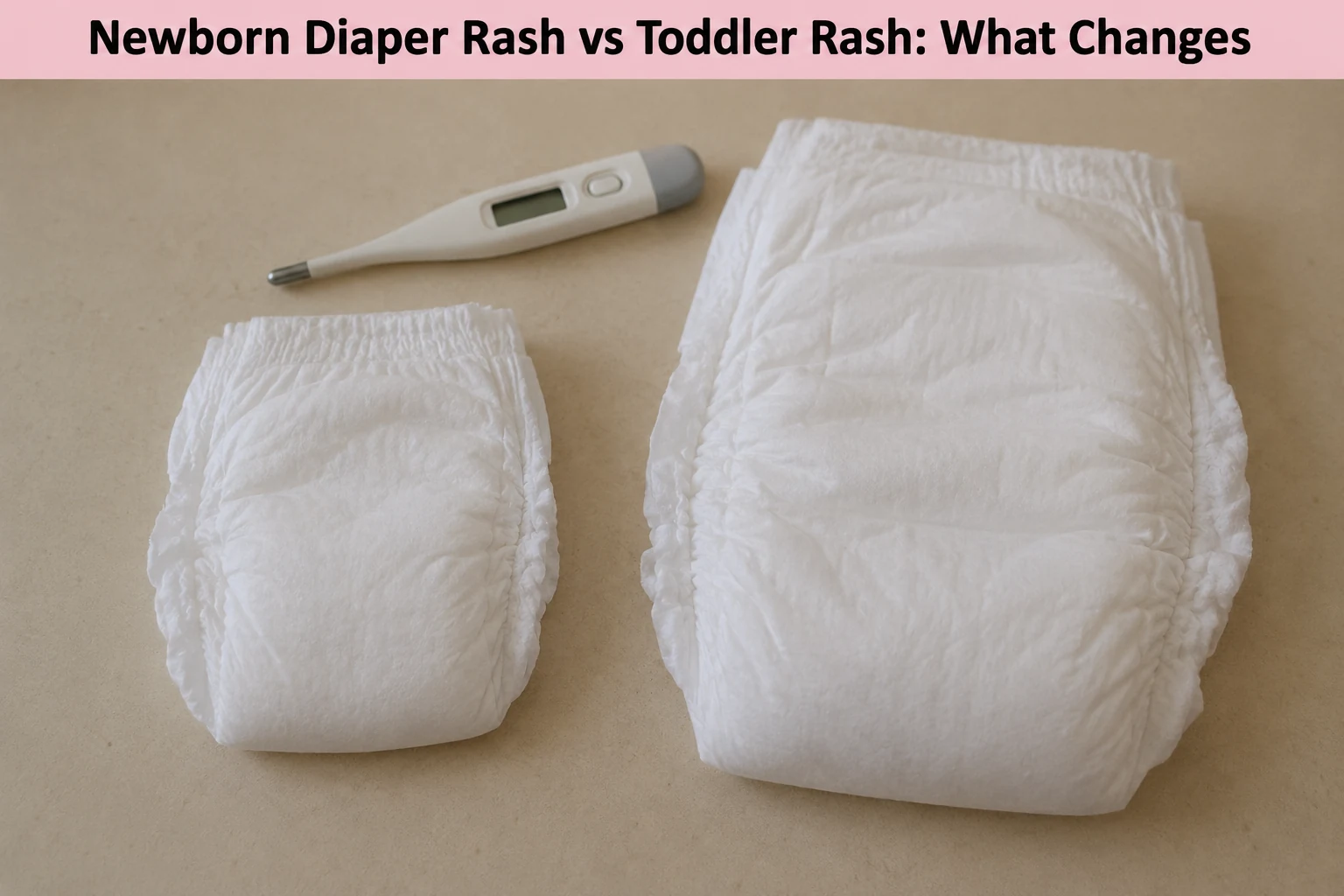
This page walks through the age lines, why the first weeks are different, and what shifts once a baby becomes a toddler. It is general information, not medical advice.
When to call, by age
Age is the single biggest variable in how quickly a diaper rash should be seen. Here is how the sources we read on September 27, 2026 set the lines.
| Age | What the sources say |
|---|---|
| Newborn | Cleveland Clinic lists "your newborn has a diaper rash" as a reason to call the healthcare provider. |
| Under 1 month | Seattle Children's lists these as "call doctor or seek care now": tiny water blisters or pimples in a group; looks infected (yellow scabs, spreading redness); looks or acts abnormal in any way. |
| Under 3 months | HealthyChildren.org says to call the doctor right away for a temperature of 100.4°F (38.0°C) or higher, with or without a rash. |
| Any age | HealthyChildren.org lists a rash not improving or worsening after two to three days; pimples, peeling, blisters, or pus-filled, oozing or crusty sores; a bright red rash with red spots at the edges during antibiotics; an especially painful rash; or fever with the rash. |
UT Southwestern Medical Center pediatrician Jessica Morse MD (March 26, 2025) adds that the doctor should be called right away if a baby suddenly develops a fever, has trouble eating, or is unusually fussy or lethargic. Those are signs about the whole baby, not the skin, and for a newborn they matter more than the look of the rash. Our diaper rash guide covers the rash types at any age.
"I would not use a toddler's rash routine as the rule for a newborn. The cleaning and changing basics may look similar, but a newborn's age, temperature, feeding, and behavior change how quickly I would call the pediatrician. For an older child, I would also look at new foods, diarrhea, a tighter fit, and longer nights in one diaper rather than assume every rash has the same trigger."
Newborn diaper rash: why the first weeks are different
The reasons a newborn's diaper area behaves differently are mostly about what is going into the diaper, and how often.
Output is frequent and changing
HealthyChildren.org's page on a baby's first days (last updated November 14, 2024, read September 27, 2026) describes how quickly things change:
- For the first few days, stools are meconium, a "thick black or dark green substance" that filled the intestines before birth. Once it has passed, stools turn yellow-green.
- Breastfed babies then have yellow stools with small seed-like particles. Formula-fed babies have tan or yellow stools that are firmer, but "should be no firmer than soft clay."
- Newborns "may urinate (pee) as often as every one to three hours or as infrequently as four to six times a day."
That is a lot of moisture and stool against new skin. The AAD calls changing wet or dirty diapers as soon as possible "the most important tip for treating and preventing diaper rash," and for a newborn that means a lot of changes. Our guide on how often to change a newborn diaper sets out the day and night rhythm.
Newborn skin starts with its own coating
Dr. Morse's UT Southwestern article notes that newborn skin is usually coated in vernix, "a cheesy substance that waterproofs a baby's skin in utero," and describes rubbing the vernix in like lotion rather than washing it away. The skin in the diaper area is meeting urine and stool for the first time at the same moment.
Not every red mark is a rash
The same HealthyChildren.org page says that in the first week, "you may see a pink or brick-red stain on the diaper, often mistaken for blood." It says this is usually a sign of highly concentrated urine. It is worth mentioning to the pediatrician, but it is a different thing from a rash.
A newborn cannot tell you much
The practical reason for a lower threshold is simple: a newborn's only signals are feeding, sleeping, crying and temperature. That is why the sources above put so much weight on fever and on whether the baby "looks or acts abnormal," rather than on the rash alone.
What stays the same at every age
The core care in the sources does not change with age. The American Academy of Dermatology's tips on how to treat diaper rash, read September 27, 2026, describe:
- Changing wet or dirty diapers as soon as possible.
- Cleaning gently with water and a soft washcloth, or alcohol-free and fragrance-free wipes, and a squirt bottle of water for a severe rash.
- Letting the area air dry, and letting the child go diaper-free as long as possible.
- A zinc oxide diaper cream, which the AAD describes as especially important if the skin stays red between changes.
The type of diaper is not the deciding factor either. The Children's Hospital of Philadelphia says diaper rashes occur equally with cloth and disposable diapers.
Yeast is also possible at any age. HealthyChildren.org says a yeast diaper rash may develop after a baby has taken antibiotics, with "shiny, bright red or pink patches with sharp edges," usually worse in the groin folds.
Toddler diaper rash: what changes
Once a baby grows into a toddler, the reasons behind a rash shift. Cleveland Clinic's diaper rash page (last updated March 20, 2023, read September 27, 2026) lists risk factors that line up closely with this stage:
- Starting solid foods. Cleveland Clinic lists a baby who "begins to eat solid foods" as at higher risk. New foods change stools, and stool is one of the main irritants.
- Diarrhea. Listed by Cleveland Clinic. Seattle Children's also describes rashes found just around the anus during bouts of diarrhea.
- Stool overnight. Cleveland Clinic lists a baby who "poops frequently, especially when their poop stays in their diaper overnight."
- Antibiotics. Listed by Cleveland Clinic, including when a nursing parent is the one taking them.
Cleveland Clinic also gives a sense of scale: "More than half of babies between 4 and 15 months of age will have a diaper rash at least once in a two-month period." That window runs straight through the months when most babies start solids.
Longer nights, bigger volumes
A toddler who sleeps through the night spends a long stretch in one diaper. That is a moisture problem as much as a leak problem. Our guide on why diapers leak at night explains how overnight volume and fit interact.
Fit and friction
A toddler is on the move, and a diaper that has become too small rubs at the legs and waist. The Children's Hospital of Philadelphia names rubbing from the diaper among the causes of diaper rash. Our guide to diaper sizes by age explains why weight and fit, not age, decide when to change size.
Air time gets harder
The AAD's diaper-free advice is the same for a toddler, but a toddler who runs around the house makes it a different job from a newborn lying on a towel. The principle stays: time with no moisture held against the skin.
Newborn vs toddler at a glance
| Newborn | Toddler | |
|---|---|---|
| When to call | Lower threshold; Cleveland Clinic lists any newborn diaper rash; under 1 month and under 3 months carry their own urgent signs | The general criteria: not improving in two to three days, blisters, sores, pain, fever |
| Main triggers | Frequent urine and stool, changing stool types | Solid foods, diarrhea, stool overnight, antibiotics |
| Worth mentioning to the doctor | A pink or brick-red stain in the first week, which HealthyChildren.org says is usually concentrated urine | A rash that has spread outside the diaper area, which Seattle Children's lists for a doctor visit |
| Core care | Frequent changes, gentle cleaning, air, barrier cream per the AAD | The same |
FAQ
Is diaper rash common in newborns?
Seattle Children's covers diaper rash from birth to 3 years. Cleveland Clinic says more than half of babies between 4 and 15 months will have one at least once in a two-month period, and it lists any newborn diaper rash as a reason to call the provider.
Should I call the doctor for a newborn diaper rash?
Cleveland Clinic lists "your newborn has a diaper rash" as a reason to contact your baby's healthcare provider. For a baby under 1 month, Seattle Children's lists grouped water blisters, signs of infection or abnormal behavior as "seek care now."
Why did my baby get diaper rash when they started solids?
Cleveland Clinic lists starting solid foods as a risk factor. New foods change stools, and stool left on the skin is one of the main irritants Seattle Children's describes.
Is a pink stain in my newborn's diaper a rash or blood?
HealthyChildren.org says a pink or brick-red stain in the first week is often mistaken for blood and is usually concentrated urine. Mention it to your pediatrician.
Do cloth diapers cause more rash in newborns?
The Children's Hospital of Philadelphia says diaper rashes occur equally with cloth and disposable diapers.
Author Profile
-
Eamin Hosen is the founder and author of BelovedTots. He has raised two young children, Pona and Ruku, and spent years working in child development at Neurosparks, a therapy center that provides Speech Therapy, Occupational Therapy, and ABA Therapy for children with developmental needs.
It was there, watching long therapy sessions get interrupted by leaking, ill-fitting diapers, that he began researching how products perform during everyday use and where their performance falls short of packaging claims.
He holds a Master’s in Psychology and Guidance from the University of Dhaka and brings a behavioral observation lens to every product he reviews. When he’s not testing diapers or writing guides, he’s probably negotiating bedtime with a 4-year-old.
Latest entries
- November 13, 2026Diaper Brands and ComparisonsBamboo Diapers: Viscose, Rayon and the Box Claims
- November 12, 2026Diaper Rash and SkinHypoallergenic Diapers: What the Word Really Promises
- November 11, 2026Diaper Brands and ComparisonsChlorine Free Diapers Meaning: TCF vs ECF Explained
- November 10, 2026Diaper Brands and ComparisonsEco Friendly Diapers: What the Labels Actually Mean