
How to Wash Reusable Swim Diaper: Routine and After Poop

Here is how to wash reusable swim diaper pants in one line: tip any poop into a toilet, rinse the diaper in clean water, carry it home in a wet bag, then machine wash and dry it exactly as its care label says. Labels differ, so check yours. Charlie Banana caps its wash at warm, 104°F, while Green Sprouts says machine wash cold. After a poop accident the steps are the same, with gloves and handwashing added. If the accident was diarrhea, read the section below on where CDC laundry advice and the care label disagree before you decide what to do with the diaper.
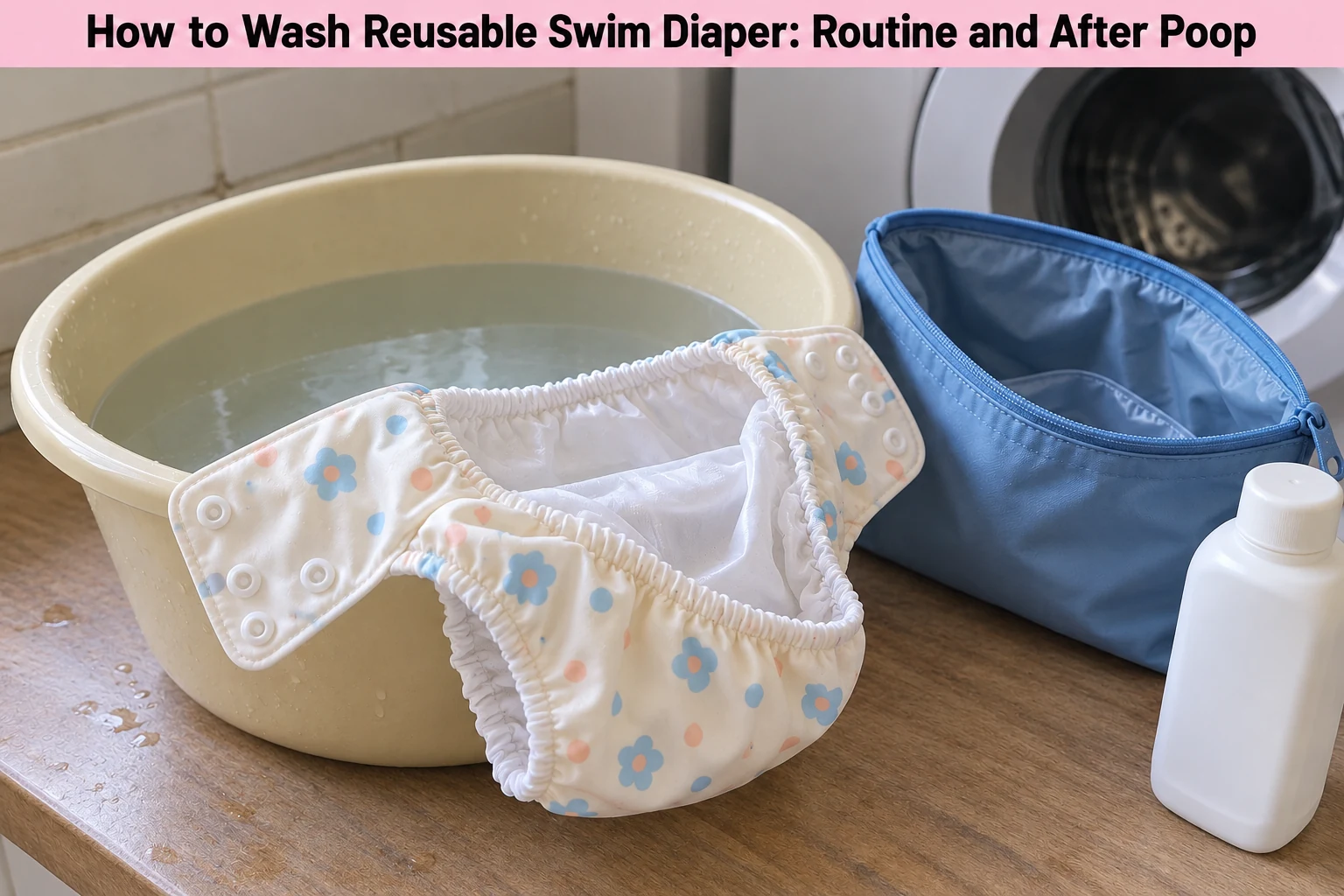
Below is the routine after an ordinary swim, what to do at the pool when an accident happens, and the one situation where washing may not be the whole answer.
The short version
- At the pool: change your child in a changing area, away from the water. CDC advises this in its swim diaper tips.
- Solids go in the toilet. Tip out anything solid before the diaper goes near a sink or a washing machine.
- Rinse. A rinse in clean water gets pool water, sand and sunscreen out of the fabric.
- Bag it. A zippered wet bag keeps a damp, soiled diaper away from towels and clothes until you get home.
- Wash by the label. Temperature, bleach and drying rules vary by brand.
- Wash your hands after every change, as CDC advises.
"I treat the wet bag as a way to get a swim diaper home, not a place to leave it sealed for days. I would remove solids appropriately, rinse, and wash promptly by that diaper's own care label rather than assume every brand tolerates the same heat. A diarrhea accident is a separate decision, because infection-control laundry advice can conflict with the garment's limits, and I would not assume an ordinary wash settles that question."
How to wash reusable swim diaper pants after a normal swim
A reusable swim diaper is not built like an everyday diaper. Green Sprouts' i play Eco Snap Swim Diaper, for example, lists a recycled polyester shell with a polyurethane coating and a recycled polyester lining. A swim diaper is not designed to soak up pee. Its job is to hold in solid poop with a close fit at the legs and waist, which is why care that protects the elastic matters as much as care that gets it clean.
Rinse first. Once you have changed your child and tipped any solids into the toilet, hold the diaper under clean running water, inside and out. Turn it inside out if the lining has caught sand. This keeps a damp diaper from sitting in a bag with pool water and residue in it.
Do not leave it sealed for days. A wet bag is for the trip home. Wash the diaper the same day if you can, rather than leaving it zipped up wet.
Machine wash by the label. Both brands we checked are machine washable. Charlie Banana asks for a full dose of good-quality detergent and plenty of agitation. Fasten any snaps or hook and loop tabs first so they do not snag other items in the load.
Dry by the label. Charlie Banana lists hanging to dry or a low tumble dry. Green Sprouts lists a low tumble dry. Neither allows high heat.
What the care labels actually say
Two reusable swim diaper makers, read on October 2, 2026, show how much instructions vary.
| Charlie Banana | Green Sprouts (i play Eco Snap Swim Diaper) | |
|---|---|---|
| Wash temperature | Warm, 40°C / 104°F maximum | Machine wash cold |
| Bleach | Avoid chlorine bleach | Nonchlorine bleach only when needed |
| Fabric softener | Avoid | Not mentioned on the page |
| Drying | Hang to dry or tumble dry low | Tumble dry low |
| Other | High heat can damage the waterproof layer and elastics | Do not iron, do not dry clean |
Charlie Banana's complete guide to swim diapers (published May 6, 2024, read October 2, 2026) explains the reason for its heat limit: high heat can damage the waterproof layer and the elastics and affect how the swim diaper performs. It also says its fabrics do not need high temperatures to get thoroughly clean, and that when in doubt you should check the manufacturer's label. The Green Sprouts column comes from the laundry instructions on its Eco Snap Swim Diaper product page, read the same day.
That last point from Charlie Banana is the rule to carry over to any brand. A swim diaper from a third maker may differ from both of these, and the label sewn into it is the instruction that applies to that diaper.
What to do at the pool when an accident happens
If your child poops in a swim diaper while in the water, the first job is getting them out and to a changing area. The second is telling the lifeguard or pool staff straight away, even if the swim diaper seems to have held everything.
The reason for telling staff is what CDC asks them to do next. CDC's guidance for pool staff, What to Do When There is Poop in the Pool (last updated June 5, 2024, read October 2, 2026), tells them to close the pool and remove the poop with a net or bucket rather than vacuuming it. For formed poop, the guidance has staff hold the free chlorine at 2 ppm with a pH of 7.5 or less for 30 minutes. For diarrhea in a public pool, the response is much bigger: the chlorine level is raised significantly for many hours. Staff can only do any of that if they know.
A swim diaper does not make this step optional. In its Tips for Using Swim Diapers (last updated May 8, 2024, read October 2, 2026), CDC states that swim diapers and swim pants might hold in some solid poop but are not leak-proof, and that they do not keep germs like Cryptosporidium, which can spread in diarrhea, from contaminating the water. Everyday diapers have the same limit at the waistband and back, which our guide to diaper blowouts up the back walks through.
Cleaning a swim diaper after a poop accident
Once your child is changed and clean, deal with the diaper.
- Tip solids into the toilet and flush. Get off as much as you can before any rinsing, so less goes down a sink or into the machine.
- Wear gloves if you have them. CDC's guidance on preventing Crypto at camps tells staff to use gloves and disposable cleaning products when cleaning poop and soiled items. The same idea is easy to borrow at a changing table.
- Bag it on its own. Keep the soiled diaper in a wet bag or plastic bag, separate from towels and swimsuits.
- Wash your hands, and your child's. CDC advises washing hands after diaper changing to prevent the spread of germs in and around the pool.
- At home, wash it promptly. For an ordinary, formed poop, a normal wash by the care label is what the maker intends.
Check the changing surface too. If you used a pool changing table, wipe it down or ask staff how the facility prefers it handled.
If it was diarrhea: where CDC and the care label disagree
None of the swim diaper care guides we found in our search covered this.
CDC's guidance on preventing and controlling Crypto at camps (last updated July 7, 2025, read October 2, 2026) covers items soiled with poop or vomit. It says to wash them with detergent in hot water at 113°F or higher for at least 20 minutes, or at 122°F or higher for at least 5 minutes, and then machine dry on the highest heat setting.
Now compare that with the swim diaper labels above. Charlie Banana's maximum is 104°F, and it warns that high heat damages the waterproof layer and elastics. Green Sprouts says wash cold and tumble dry low. So a swim diaper washed by its label does not reach the conditions CDC describes for poop-soiled laundry in that guidance, and a diaper washed CDC's way is being treated in a way its maker warns against.
We did not find a source that resolves this for swim diapers specifically. What we can tell you is what each side says:
- The maker's label protects the diaper. Follow it, and you keep the elastic and waterproof layer working.
- CDC's camp guidance is written for stopping Crypto from spreading. When a camp cannot reach the recommended temperatures, CDC lists three options: launder the items off site, double bag them and give parents washing and drying instructions, or discard them.
Whether to wash the diaper by its label, wash it hot and accept the wear, or replace it is your call, made with the facts above. Neither source gives a ruling on swim diapers.
The illness matters more than the laundry. CDC advises that children not swim when they are sick with diarrhea. On the camp page, CDC also says people diagnosed with Crypto should stay out of the water for an additional two weeks after diarrhea stops, because they can keep spreading the germs for up to two weeks. If your child has diarrhea, or seems unwell after a pool visit, your pediatrician is the right person to call.
When a reusable swim diaper needs replacing
A clean swim diaper that no longer fits closely is not doing its job. Signs to look for:
- Loose leg elastic. If the leg openings gap when your child sits or kicks, solids can escape. The same gap problem shows up in everyday diapers, explained in our piece on why diapers leak at the legs.
- A waistband that no longer grips. It slides down or rolls over.
- Peeling or cracked coating on the inside of the shell.
- Outgrown sizing. Red marks at the legs or waist after a swim can mean the diaper is now too small.
Charlie Banana's care guidance names high heat as something that can damage the elastics and waterproof layer, which is one more reason to keep a swim diaper away from a hot dryer unless you have decided it is on its last wash anyway.
Mistakes that shorten a swim diaper's life
- Fabric softener. Charlie Banana says to avoid it.
- Chlorine bleach. Both makers above rule it out. Green Sprouts allows nonchlorine bleach only when needed.
- High heat. Charlie Banana says high heat can damage the waterproof layer and the elastics.
- Ironing or dry cleaning. Green Sprouts says not to do either.
- Leaving it wet in a sealed bag for days. Wash it the same day where you can.
If your child's skin looks red or irritated after a pool day, our overview of diaper rash and when to call covers what pediatric sources say, and your pediatrician can check anything that does not settle.
FAQ
Can you put a reusable swim diaper in the washing machine?
The two brands we checked say yes. Charlie Banana says to wash on warm, up to 104°F, and Green Sprouts says to machine wash its Eco Snap Swim Diaper cold. Check the label on your diaper, because the temperature limit differs by brand.
Can you put a reusable swim diaper in the dryer?
Some allow it on low. Charlie Banana says hang to dry or tumble dry low, and Green Sprouts says tumble dry low. Neither allows high heat, and Charlie Banana says high heat can damage the waterproof layer and elastics.
What do you do if a swim diaper has poop in it at the pool?
Get your child out of the water, tell the lifeguard or pool staff, and change your child in a changing area away from the water. Tip the solids into a toilet, bag the diaper and wash your hands. CDC's guidance has pool staff close the pool and remove the poop.
Should you throw out a swim diaper after diarrhea?
No source we read gives a rule for swim diapers specifically. CDC's camp guidance calls for hot washes and high-heat drying for poop-soiled items, which swim diaper labels warn against, and it lists discarding items as one option when those temperatures cannot be reached.
Can you use bleach on a reusable swim diaper?
Not chlorine bleach on the two brands we checked. Charlie Banana says to avoid chlorine bleach, and Green Sprouts allows nonchlorine bleach only when needed.
Author Profile
-
Eamin Hosen is the founder and author of BelovedTots. He has raised two young children, Pona and Ruku, and spent years working in child development at Neurosparks, a therapy center that provides Speech Therapy, Occupational Therapy, and ABA Therapy for children with developmental needs.
It was there, watching long therapy sessions get interrupted by leaking, ill-fitting diapers, that he began researching how products perform during everyday use and where their performance falls short of packaging claims.
He holds a Master’s in Psychology and Guidance from the University of Dhaka and brings a behavioral observation lens to every product he reviews. When he’s not testing diapers or writing guides, he’s probably negotiating bedtime with a 4-year-old.
Latest entries
- November 13, 2026Diaper Brands and ComparisonsBamboo Diapers: Viscose, Rayon and the Box Claims
- November 12, 2026Diaper Rash and SkinHypoallergenic Diapers: What the Word Really Promises
- November 11, 2026Diaper Brands and ComparisonsChlorine Free Diapers Meaning: TCF vs ECF Explained
- November 10, 2026Diaper Brands and ComparisonsEco Friendly Diapers: What the Labels Actually Mean