
Diaper Free Time for Rash: How to Do It Without a Mess

Short answer: diaper free time for rash means leaving the diaper off for a stretch so the skin can dry. The American Academy of Dermatology says to let a child go diaper-free "as long as possible to let the skin dry and heal," and the AAP's parent site says to expose the bottom to air "as much as possible." Neither sets a number of minutes. The mess is a setup problem, not a skin problem: a waterproof layer under an absorbent one, on the floor, right after a change. A rash with blisters, open sores, bleeding or fever is a pediatrician question, not an air-time question.
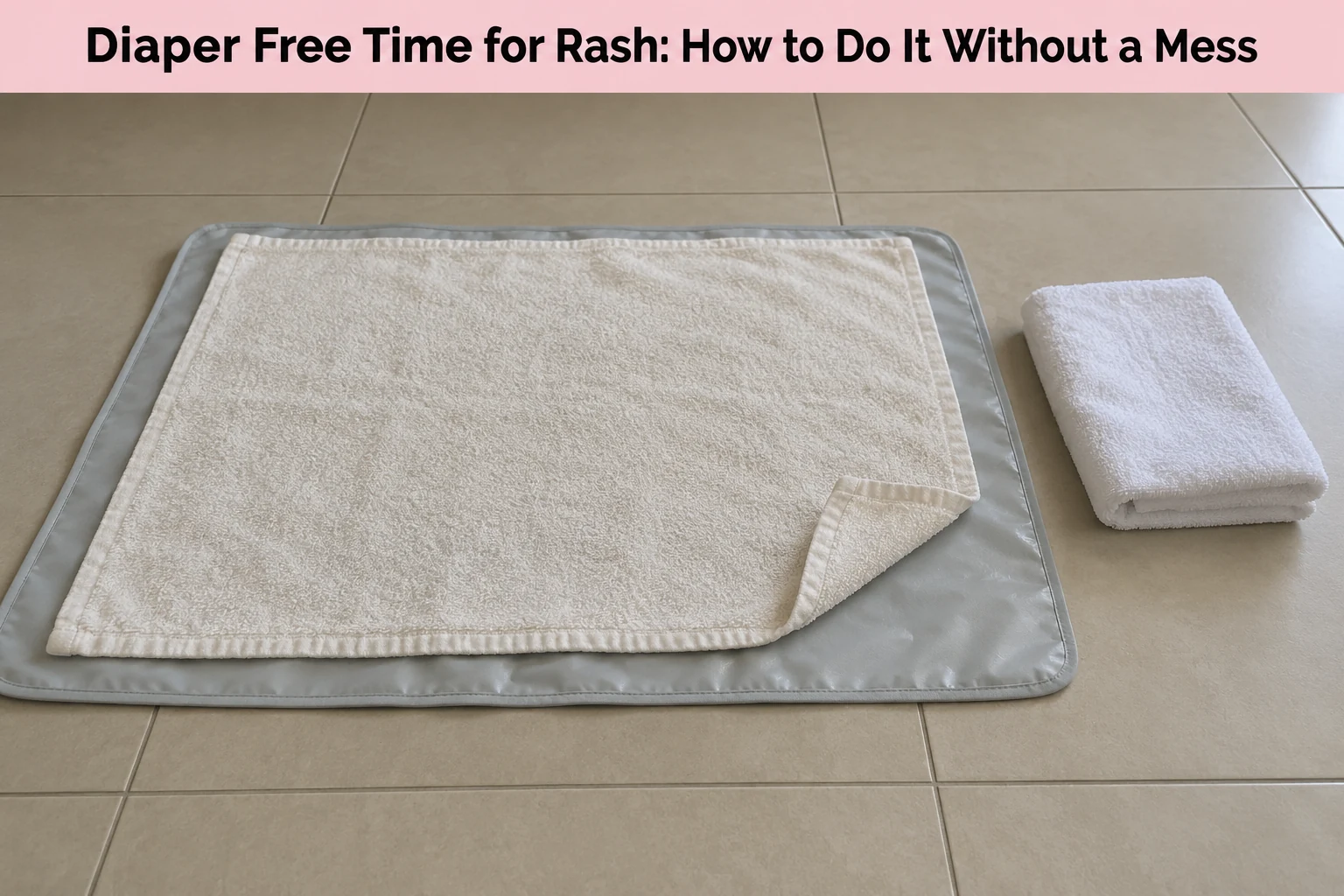
This page covers what the pediatric and dermatology sources actually say, how to set up air time on carpet or a bed without ruining either, and where the advice stops. It is general information, not medical advice.
First: when air time is not the answer
Diaper-free time is a comfort and drying measure for an ordinary rash. It is not a substitute for a look from the pediatrician when the rash has changed character. HealthyChildren.org, the AAP's parent site, lists reasons to call in its diaper rash page (last updated December 18, 2024, read September 27, 2026):
- The rash is not going away, or is getting worse, after two to three days.
- The rash has pimples, peeling skin, blisters, or pus-filled, oozing or crusty sores.
- A baby on antibiotics develops a bright pink or red rash with red spots at the edges.
- The rash is especially painful.
- The baby has a fever along with the rash.
The AAP symptom checker adds an age line: a baby less than 1 month old with tiny water blisters or pimples in a group falls under "call doctor or seek care now." If any of this matches, the pediatrician comes first. Our diaper rash guide explains the main types of rash and how they differ.
"My practical focus for diaper-free time is the setup: a waterproof mat underneath, an absorbent towel on top, and a spare close by. I would keep it on the floor while the baby is awake and supervised, rather than add loose towels to an infant's sleep space. I do not treat a set number of minutes as a target or let air time delay a call about a worsening rash."
Why air helps: the moisture mechanism
A diaper holds urine and stool against skin, under a waterproof outer layer. That is exactly what it is designed to do, and it is also why the skin underneath stays damp and warm.
The AAP symptom checker on HealthyChildren.org, written by Barton Schmitt MD, FAAP, and read September 27, 2026, names the irritants behind the most common rashes. It says stool left on the skin "can be very irritating because it contains bacteria," and that stool and urine left in a diaper too long can combine to make ammonia. The American Academy of Dermatology calls changing wet or dirty diapers as soon as possible "the most important tip for treating and preventing diaper rash," because it reduces moisture on the skin.
Air time works on the same variable from the other direction. Frequent changes shorten how long skin sits in moisture. Diaper-free time gives the skin a stretch with no moisture held against it at all. If changes have been stretching out, our guide on how often to change a newborn diaper covers the day and night rhythm.
What the sources say about diaper free time for rash
Here is what the main sources say, read September 27, 2026. Notice what they have in common: none gives a fixed number of minutes.
| Source | What it says about air time |
|---|---|
| American Academy of Dermatology, "How to treat diaper rash" | After cleaning, "allow the area to air dry. Let your child go diaper-free as long as possible to let the skin dry and heal." |
| HealthyChildren.org symptom checker, Diaper Rash | "Expose the bottom to air as much as possible." It also suggests attaching the diaper loosely at the waist, and says "When napping, take the diaper off and lay your child on a towel." |
| HealthyChildren.org, Common Diaper Rashes and Treatments | "Pat gently and allow skin to air-dry." |
| Cleveland Clinic, Diaper Rash (last updated March 20, 2023) | Suggests giving the baby's bottom fresh air by leaving the diaper off when you can. |
Specific figures such as a set number of minutes, several times a day, do circulate online. The ones we found came from diaper brand pages and clinic blogs, not from the pediatric and dermatology pages above. That does not make them wrong. It means the authoritative advice is "as much as is practical," and the practical limit is usually the mess, which is the part you can solve.
The setup: how to do air time without a mess
The goal is simple: whatever happens during air time lands on something washable, and nothing soaks through to the carpet, the couch or the mattress. A layered setup does that.
Layer from the bottom up
- A waterproof layer at the bottom. A waterproof changing pad, a crib mattress protector, or a washable waterproof mat. This is the layer that saves the floor.
- An absorbent layer on top. A folded bath towel, a receiving blanket or a couple of cloth prefolds. This catches liquid so it does not pool under the baby's back.
- A spare towel within reach. For the moment the first one gets wet.
The absorbent layer alone will soak through. The waterproof layer alone lets urine run. Together they contain the mess, which is the whole point.
Where and when
- On the floor, not a raised surface. A floor setup has nothing to roll off, which matters once a baby starts to squirm and roll.
- Right after a change or a bowel movement. The skin has just been cleaned and the next stool is, in most cases, some time away. That is the lowest-risk window for a mess.
- In a warm, comfortable room. A bare bottom is the only change; the rest of the baby can stay dressed in a top.
Boys and girls
For boys, the urine goes up and forward, not down. A small folded cloth laid loosely over the front, not fastened, catches it without trapping moisture against the skin. For girls, the layer under the bottom does most of the work.
Stay with the baby
Air time is supervised time. Tummy time, a play mat session or a feed with the baby lying across a towel-covered lap are all natural moments to fit it in.
The nap question: reading one tip against another
The AAP symptom checker suggests taking the diaper off at nap time and laying the child on a towel. That tip needs to be read alongside the AAP's own safe sleep guidance for infants.
HealthyChildren.org's parent guide to safe sleep (last updated September 11, 2026, read September 27, 2026) says the sleep surface should be firm and flat, and that "soft objects and loose bedding can increase your baby's risk of entrapment, suffocation or strangulation," naming blankets and non-fitted sheets among them. A loose towel in an infant's sleep space is the kind of item that guidance describes.
We are not in a position to reconcile two AAP pages for your baby. For an infant, the nap version of air time is worth asking the pediatrician about specifically, rather than improvising with loose bedding in the crib. Supervised floor time while the baby is awake avoids the conflict entirely.
The halfway option: a loose diaper
When fully diaper-free is not practical, the AAP symptom checker offers a middle step: attach the diaper loosely at the waist to let more air reach the skin.
This is a deliberate trade. A loose waist lets air in, and it also lets liquid out, especially at the back when a baby is lying down. Our guide on how to put a diaper on so it does not leak explains why a snug waist and sealed leg cuffs are what hold liquid in. A looser fit gives up some of that on purpose. For short, awake stretches on a covered floor, the trade is manageable. Overnight, it is more likely to mean a wet bed.
After air time: drying and the next diaper
Before the next diaper goes on, the sources agree on gentleness. HealthyChildren.org says to "pat gently and allow skin to air-dry." The AAD suggests water and a soft washcloth, or baby wipes that are alcohol-free and fragrance-free, and for a severe rash a squirt bottle of water, which it calls gentler on the skin.
The sources do not all agree on wipes. The AAP symptom checker says not to use diaper wipes during a rash, because "they leave a film of bacteria on the skin," while the AAD allows alcohol-free and fragrance-free ones. If a rash is present, plain water is the option both sources accept.
On creams, the AAD describes zinc oxide diaper cream as especially important if the skin stays red between changes. Which cream, and whether one is needed, is a question for your pediatrician; our guide to diapers for sensitive skin covers how to read the claims on the diaper box itself.
How to tell whether it is working
The AAP symptom checker says that "with proper treatment, most diaper rashes are better in 3 days." HealthyChildren.org's diaper rash page says to call if the rash is not going away, or is getting worse, after two to three days.
Those two lines give you a simple window. Air time, frequent changes and gentle cleaning are the ordinary measures. If the rash is not clearly improving within that window, or if it spreads, gets raw, blisters or bleeds, the question has moved from "how do I do this better" to "what kind of rash is this," and that belongs to the pediatrician.
FAQ
How long should diaper free time be for a rash?
The AAD says "as long as possible" and the AAP symptom checker says "as much as possible." Neither gives a fixed number of minutes. The practical limit is how long you can keep the setup clean and the baby comfortable and supervised.
Can my baby sleep without a diaper to air out a rash?
The AAP symptom checker suggests diaper-off naps on a towel, but the AAP's safe sleep guidance warns against loose bedding in an infant's sleep space. Ask your pediatrician before doing this with an infant.
What do I put under my baby during diaper free time?
A waterproof layer at the bottom, such as a changing pad or mattress protector, with an absorbent towel or blanket on top. One layer alone tends to leak or soak through.
Is a loose diaper as good as no diaper?
It is a middle step. The AAP symptom checker suggests attaching the diaper loosely at the waist for air exposure. It lets in less air than no diaper and leaks more easily than a snug one.
When should I stop air time and call the pediatrician?
HealthyChildren.org lists a rash that is not improving after two to three days, blisters, pus or oozing sores, a painful rash, or a fever. For a baby under 1 month with grouped water blisters or pimples, the AAP symptom checker says to seek care now.
Author Profile
-
Eamin Hosen is the founder and author of BelovedTots. He has raised two young children, Pona and Ruku, and spent years working in child development at Neurosparks, a therapy center that provides Speech Therapy, Occupational Therapy, and ABA Therapy for children with developmental needs.
It was there, watching long therapy sessions get interrupted by leaking, ill-fitting diapers, that he began researching how products perform during everyday use and where their performance falls short of packaging claims.
He holds a Master’s in Psychology and Guidance from the University of Dhaka and brings a behavioral observation lens to every product he reviews. When he’s not testing diapers or writing guides, he’s probably negotiating bedtime with a 4-year-old.
Latest entries
- November 13, 2026Diaper Brands and ComparisonsBamboo Diapers: Viscose, Rayon and the Box Claims
- November 12, 2026Diaper Rash and SkinHypoallergenic Diapers: What the Word Really Promises
- November 11, 2026Diaper Brands and ComparisonsChlorine Free Diapers Meaning: TCF vs ECF Explained
- November 10, 2026Diaper Brands and ComparisonsEco Friendly Diapers: What the Labels Actually Mean