
How to Apply Diaper Rash Cream: How Thick and How Often

Short answer: how to apply diaper rash cream comes down to four steps that pediatric and dermatology sources describe the same way. The diaper area is cleaned gently, allowed to dry, and then covered with a layer of barrier paste thick enough to act as a shield. The American Academy of Pediatrics compares it to "icing on a cupcake". At the next change, paste that is still clean is left in place and more is added on top, rather than scrubbed off. On the "thin smear or thick frosting" question, the authorities we cite come down on the side of thick.
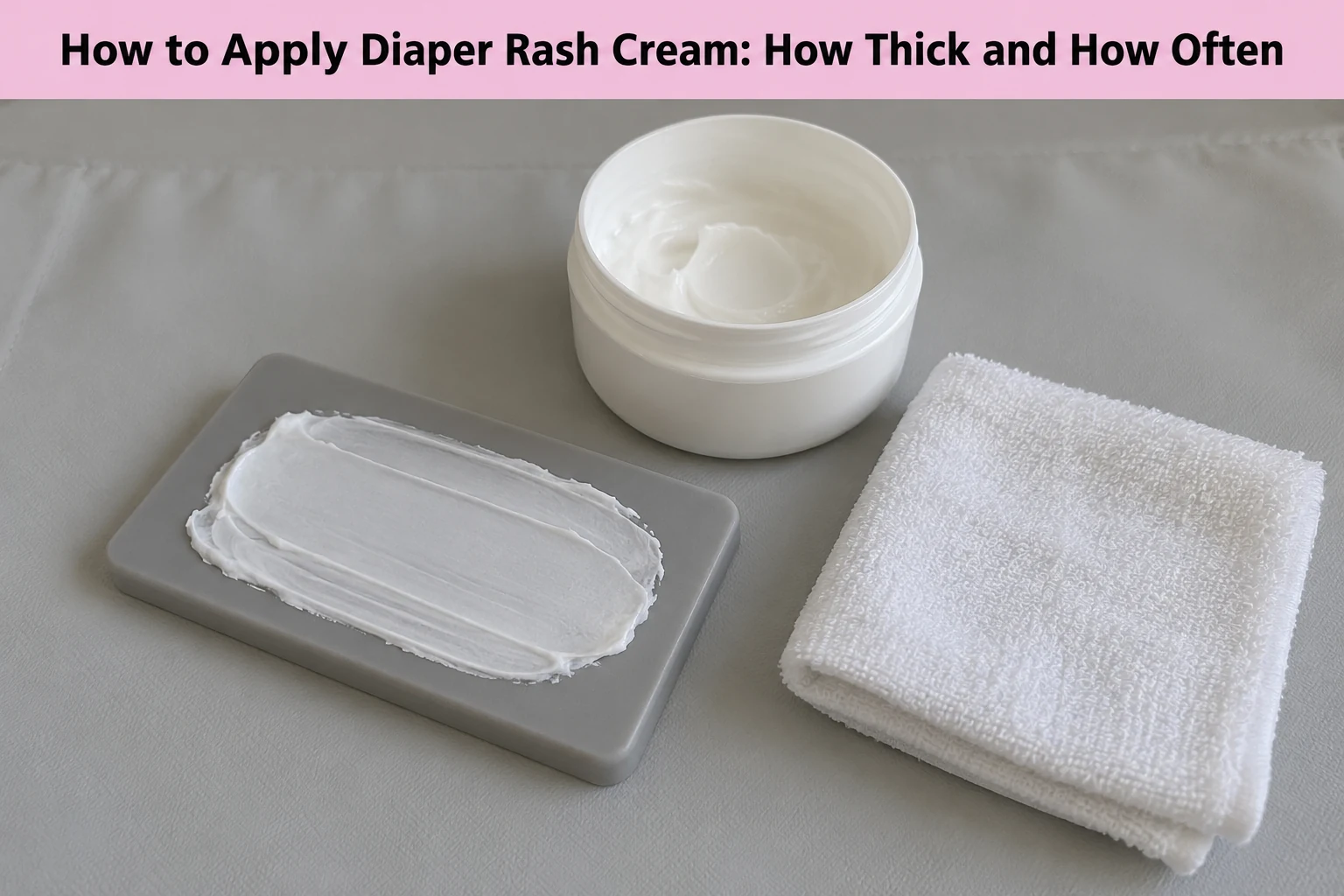
This guide explains what those sources say and why. It is general information, not medical advice for your baby.
Before the how-to: when cream is not the next step
Technique matters for everyday irritation. It does not fix a rash that needs a doctor. The AAP's parent site, HealthyChildren.org, in its page on diaper rash (last updated December 18, 2024, read September 27, 2026), lists these reasons to call the pediatrician:
- The rash does not clear after two to three days of treatment.
- There are pimples, peeling, blisters or oozing sores.
- A baby on antibiotics develops a bright pink or red rash.
- The rash seems especially painful.
- The baby has a fever with the rash.
The American Academy of Dermatology adds signs of skin infection, including fever, blisters, pus draining from the rash, and a rash that does not go away after treatment or gets worse. If any of these apply, the pediatrician is the next step. Our diaper rash guide explains the main types of rash.
"For me, the useful reminder is to think of barrier cream as a layer that stays on the surface, rather than something to rub in until it disappears. I give gentle cleaning and drying their own moment before adding that layer, then avoid scrubbing away paste that is still clean at the next change. More cream cannot make up for a wet diaper left on too long or a rash that needs the pediatrician."
Why technique changes whether cream works
A diaper cream is not a medicine that soaks in. HealthyChildren.org describes diaper paste as a shield that sits between the skin and the contents of the diaper. That single idea explains almost every application tip:
- A shield only works where it covers, so coverage matters.
- A shield only works if it stays, so thickness matters.
- A shield put over wet skin seals the wetness in, so drying first matters.
- A shield that is scraped off at every change leaves the skin bare and rubbed, so not scrubbing matters.
Seen that way, "thin smear or thick frosting?" is really a question of how long the shield lasts between changes.
How to apply diaper rash cream: what the sources describe
The steps below combine the AAP's HealthyChildren.org page, the American Academy of Dermatology's page on how to treat diaper rash (read September 27, 2026) and the directions printed on US diaper cream labels on DailyMed, the National Library of Medicine's drug label database.
Step 1: Change the diaper promptly
The AAD calls this the most important tip for treating and preventing diaper rash: change all dirty diapers, even ones that are just wet, as soon as possible. The diaper rash labels we read on DailyMed put it first too: "change wet and soiled diapers promptly". Cream applied to skin that then sits in a wet diaper for hours is doing a harder job. For how often that means in practice, see how often to change a newborn diaper.
Step 2: Clean gently
The AAD describes using water and a soft washcloth, or baby wipes that are alcohol-free and fragrance-free, and being gentle when cleaning the diaper area. Scrubbing already irritated skin works against the point of the whole routine.
Step 3: Let the skin dry
The diaper rash labels we read on DailyMed direct the user to cleanse the diaper area and "allow to dry" before the cream goes on, and the AAD also describes letting the area air dry. This is the step most often skipped in a hurry. Moisture under a water-repelling layer stays against the skin.
Step 4: Put on a thick layer
This is where the sources are most specific:
- HealthyChildren.org describes applying a thick layer, "like icing on a cupcake", and says that in general there is no such thing as too much diaper paste.
- The AAD describes applying a zinc oxide diaper cream, especially if the skin stays red between changes, and for severe diaper rash, layering it on "like you are frosting a cake".
- The labels on DailyMed direct applying the product "liberally" with each diaper change, and several add "especially at bedtime".
None of these sources gives an amount in grams or teaspoons. They describe it visually. A layer you can see, covering all the red skin, fits every description above. A barely-there sheen rubbed in until it disappears does not.
Step 5: At the next change, leave clean paste in place
HealthyChildren.org says that if the paste is not soiled, there is no need to rub it off during changes; more paste goes on top. The AAD likewise says there is no need to remove the cream with each change, and that it can be fully removed at the end of the day. Only the soiled part needs cleaning away.
This is the step that surprises most parents. It feels unclean to leave paste on, but repeated wiping is exactly the friction the routine is trying to avoid.
Why the diaper matters as much as the cream
Application does not end when the tube closes. How the diaper goes on over the paste affects it too.
Fit. Seattle Children's care advice for diaper rash (last reviewed May 5, 2025) describes attaching the diaper loosely at the waist to help with air exposure. A looser waist also means less pressure on the layer underneath. If you are unsure whether the size is right, our guide on how to tell if a diaper is too small walks through the checks, and how to put a diaper on so it does not leak covers the rest of the fit.
Absorbency. HealthyChildren.org notes that cloth diapers are typically less absorbent than most disposable brands, and suggests considering disposables until a rash heals if you use cloth. That is also relevant to cream, because cloth diaper makers such as GroVia warn in their own care guidance that petroleum-based rash creams can build up on cloth fabric.
Cream, ointment or paste: does the product change the technique?
The form printed on the label gives a clue to how it spreads:
| Label form | What it is like | Technique note |
|---|---|---|
| Paste (for example, a 40% zinc oxide paste) | Thickest, clings most | Easiest to leave a visible layer; hardest to clean off |
| Cream (for example, 13% to 15% zinc oxide) | Smoother, spreads more | Needs a deliberate thick layer to stay visible |
| Ointment (petrolatum-based) | Greasy, clear | Harder to see how much is on; spreads thin easily |
Those example strengths come from DailyMed labels read September 27, 2026: Desitin Maximum Strength paste lists zinc oxide 40%, Desitin Daily Defense cream lists 13%, and Aquaphor Healing Diaper Rash cream lists 15%. HealthyChildren.org names zinc oxide and petrolatum as both good choices, and adds that fragrance-free products are best. Which product fits a particular baby is a question for your pediatrician.
Common application mistakes
These follow directly from what the sources above describe:
- Rubbing cream in until it disappears. A barrier that has vanished is not acting as a shield.
- Putting cream on wet skin. The labels' own order is cleanse, allow to dry, then apply.
- Scrubbing off clean paste at every change. Both HealthyChildren.org and the AAD say this is not needed.
- Fastening the diaper tighter to "hold the cream in". Seattle Children's describes the opposite: a loose waist for air.
- Using antibiotic ointment instead. HealthyChildren.org advises against over-the-counter antibiotic ointment for diaper rash, because ingredients in these products can sometimes worsen irritation.
- Keeping going when it is not working. The DailyMed labels say to stop use and ask a doctor if the condition worsens, or if symptoms last more than seven days or clear up and occur again within a few days. HealthyChildren.org's call list is shorter, at two to three days without clearing.
FAQ
How thick should diaper rash cream be?
HealthyChildren.org describes a thick layer "like icing on a cupcake", and the AAD describes layering zinc oxide cream on "like you are frosting a cake" for severe rash. Neither gives a measured amount; both describe a visible layer.
Should I wipe off diaper cream at every change?
HealthyChildren.org says paste that is not soiled does not need to be rubbed off; more goes on top. The AAD says the cream can be fully removed at the end of the day rather than at each change.
How often should diaper rash cream be applied?
The diaper rash labels on DailyMed direct liberal use with each diaper change, and several add "especially at bedtime". Your pediatrician can advise on a specific rash.
Should the skin be dry before applying cream?
Yes. The labels list the steps in order: change wet and soiled diapers promptly, cleanse the diaper area, allow to dry, then apply. The AAD also describes letting the area air dry.
When should I stop using cream and call the doctor?
HealthyChildren.org lists a rash that does not clear after two to three days, blisters or oozing sores, a bright red rash during antibiotics, marked pain, or fever. The AAD adds pus draining from the rash or a rash that worsens.
Author Profile
-
Eamin Hosen is the founder and author of BelovedTots. He has raised two young children, Pona and Ruku, and spent years working in child development at Neurosparks, a therapy center that provides Speech Therapy, Occupational Therapy, and ABA Therapy for children with developmental needs.
It was there, watching long therapy sessions get interrupted by leaking, ill-fitting diapers, that he began researching how products perform during everyday use and where their performance falls short of packaging claims.
He holds a Master’s in Psychology and Guidance from the University of Dhaka and brings a behavioral observation lens to every product he reviews. When he’s not testing diapers or writing guides, he’s probably negotiating bedtime with a 4-year-old.
Latest entries
- November 13, 2026Diaper Brands and ComparisonsBamboo Diapers: Viscose, Rayon and the Box Claims
- November 12, 2026Diaper Rash and SkinHypoallergenic Diapers: What the Word Really Promises
- November 11, 2026Diaper Brands and ComparisonsChlorine Free Diapers Meaning: TCF vs ECF Explained
- November 10, 2026Diaper Brands and ComparisonsEco Friendly Diapers: What the Labels Actually Mean