
Cuff Flipping: The Leg Ruffle Trick Explained

Somewhere in every parenting group, somebody mentions this and half the replies are people saying they had no idea. It is the highest-value two seconds in diapering and almost nothing on a box explains it.
The ruffled edges around the legs are a barrier. If they are folded inward, they are not a barrier, they are a wick.
That is the whole trick. The rest of this page is why it works, why it has to be every change, and what it will not fix.
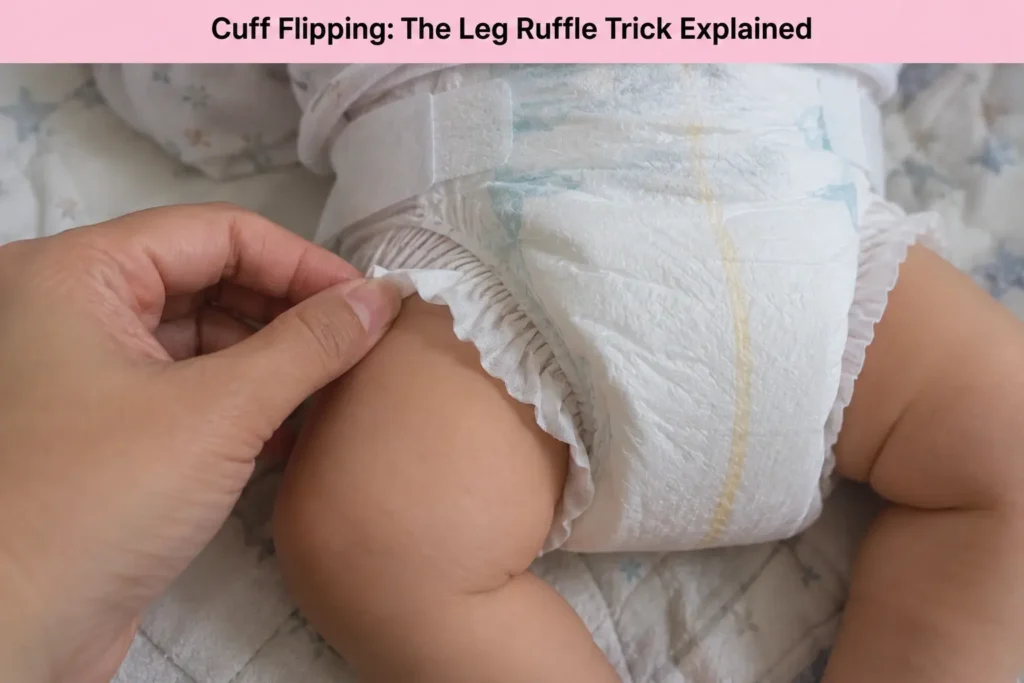
“I used to assume that if the diaper looked properly fastened, the leg seal must be fine too, but tucked ruffles taught me otherwise. I’ve had changes where everything looked normal from the outside, yet the clothing ended up wet at one thigh while the diaper itself was nowhere near full. Now I automatically run a finger around both leg openings after fastening and pull every bit of the ruffle outward. It takes seconds, but in my experience it has prevented more unnecessary leaks than changing size or brand.”
What the ruffles actually are
Look at a diaper flat and you will see two edges around each leg opening.
The outer edge is elasticated and lies against the skin, holding the diaper in position around the thigh.
The inner edge is the ruffle, and it is a separate raised piece designed to stand up rather than lie flat. Its job is to form a wall between the contents and the leg opening.
When the diaper is on correctly, the ruffle stands up against the leg with the elasticated edge outside it. Two lines of defence, one to hold, one to contain.
What goes wrong
If the ruffle is folded inward, tucked under the body of the diaper, three things happen and none of them is neutral.
The wall is gone. Liquid reaches the leg opening with nothing to stop it.
It becomes a wick. The folded ruffle now runs from the inside of the diaper to the outside, and material that touches wetness at one end and clothing at the other moves liquid along itself. It actively transports what it was meant to contain.
Solids escape. This is the mechanism behind a large share of leg-side blowouts, which is a separate subject in its own right: diaper blowouts up the back covers the version that goes upward, and this one is the version that goes sideways.
A tucked cuff is worse than no cuff at all. That is the part that surprises people, and it is why this small step matters more than its size suggests.
Why it happens so easily
It is not carelessness. It is geometry.
The ruffle is soft and it folds the moment anything pushes it. Pulling the diaper up between the legs pushes it. A baby who kicks pushes it. Clothing pulled on afterward pushes it. Sitting down pushes it.
And crucially, you cannot see it once the diaper is on. Nothing looks wrong. The diaper appears to be fitted correctly and it will still leak.
That is why it needs a check rather than an intention.
The check
After you have fastened the tabs, run a finger all the way around each leg opening and pull the ruffle outward so it stands against the skin.
Both legs. Every change. Two seconds.
Then check again after clothing goes on, at least while you are building the habit, because pulling a pair of trousers up over the diaper is one of the most reliable ways to fold a cuff you had just fixed.
Pampers publishes this instruction itself. Per this site’s record of the 2026-08-24 read, its own guidance is to “untuck and smooth out leg cuffs during every change.” It is not a hack that parents discovered; it is the manufacturer’s own instruction, printed somewhere most people never look.
Where it fits in the change
The full order is in how to put a diaper on so it does not leak, and this step comes near the end, after fastening rather than before. Doing it before you fasten wastes the effort, because fastening moves everything.
Two related points from that page:
Do not fasten tighter to compensate. A diaper pulled very tight presses the cuff flat against the thigh, which stops it standing up. Tighter fastening makes this specific problem worse.
Smooth the whole diaper afterward. Bunched material anywhere along the leg is a gap regardless of what the cuff is doing.
What it will not fix
Cuff flipping is the first thing to try for a leg leak and it is not a universal answer. Three situations where it will not be enough.
The diaper is genuinely saturated. If it is heavy and full when it leaks, the seal did its job and ran out of time. That is a change-frequency question, or for nights a different approach entirely: why diapers leak at night covers it.
The leg opening does not match the leg. A cuff pressed permanently flat by a thick thigh cannot stand up no matter how carefully you position it, and a cuff that never touches a slim thigh has nothing to seal against. Both are shape problems rather than technique problems, and diaper fit for chunky thighs vs skinny babies covers them. Worth knowing while you work on it: this site checked US consumer product pages on 2026-08-24 and found no US consumer line publishes a leg opening measurement, so no page can tell you which brand is cut wider. You find out by trying.
The leak is not at the leg. Back leaks and front leaks have different causes and different fixes. Pampers’ own guidance for a leak coming up the back, per the same 2026-08-24 record, is to size up, which is the opposite kind of advice from the leg-cuff instruction it gives on the same page. Two seals, two failures, two fixes. Why diapers leak at the legs is the leg version and the fit and leaks guide covers the whole picture.
The other free technique worth knowing
Since you are already in the business of fixing leaks without buying anything: Kao, which makes Merries, publishes guidance on the angle at which fastening tapes are applied. For a back leak, raise the back panel higher than the front and “fasten the tape diagonally downwards”; for a tummy leak, the mirror image; and for leaks after a child is strapped in, fasten “at a lower level, slightly slanted at an angle”.
That is Kao’s guidance for Kao’s taped products in the market Kao writes for, and it is not a claim about anyone else’s diaper. It is free to try, which is the point.
The short version
- The inner ruffle is a barrier. It has to stand up against the leg, on the outside.
- Folded inward it is worse than useless: it wicks liquid out.
- You cannot see it once the diaper is on, so it needs a check rather than an intention.
- Run a finger around both leg openings after fastening. Every change. Pampers publishes the same instruction.
- Check again after clothing goes on.
- It will not fix a saturated diaper, a mismatched leg opening, or a leak that is not at the leg.
Author Profile
-
Saima Mostari is the founder and author of BelovedTots. She has raised two young children, Pona and Ruku, and spent years working in child development at Neurosparks, a therapy center that provides Speech Therapy, Occupational Therapy, and ABA Therapy for children with developmental needs.
It was there, watching long therapy sessions get interrupted by leaking, ill-fitting diapers, that she began researching which products actually perform under real-world conditions, not just on the packaging.
She holds a Master's in Psychology and Guidance from the University of Dhaka, and brings a behavioral observation lens to every product she reviews. When she's not testing diapers or writing guides, she's probably negotiating bedtime with a 4-year-old.
Latest entries
- September 30, 2026Diaper Brands and ComparisonsLuvs vs Pampers: P&G’s Budget vs Premium Line
- September 27, 2026Diaper Brands and ComparisonsKirkland Diapers vs Huggies: What’s Different in 2026
- September 26, 2026Diaper Brands and ComparisonsKirkland Diapers Review: What Costco’s Diaper Is Now
- September 24, 2026Diaper Brands and ComparisonsHuggies Little Snugglers vs Snug and Dry: Which Fits?